
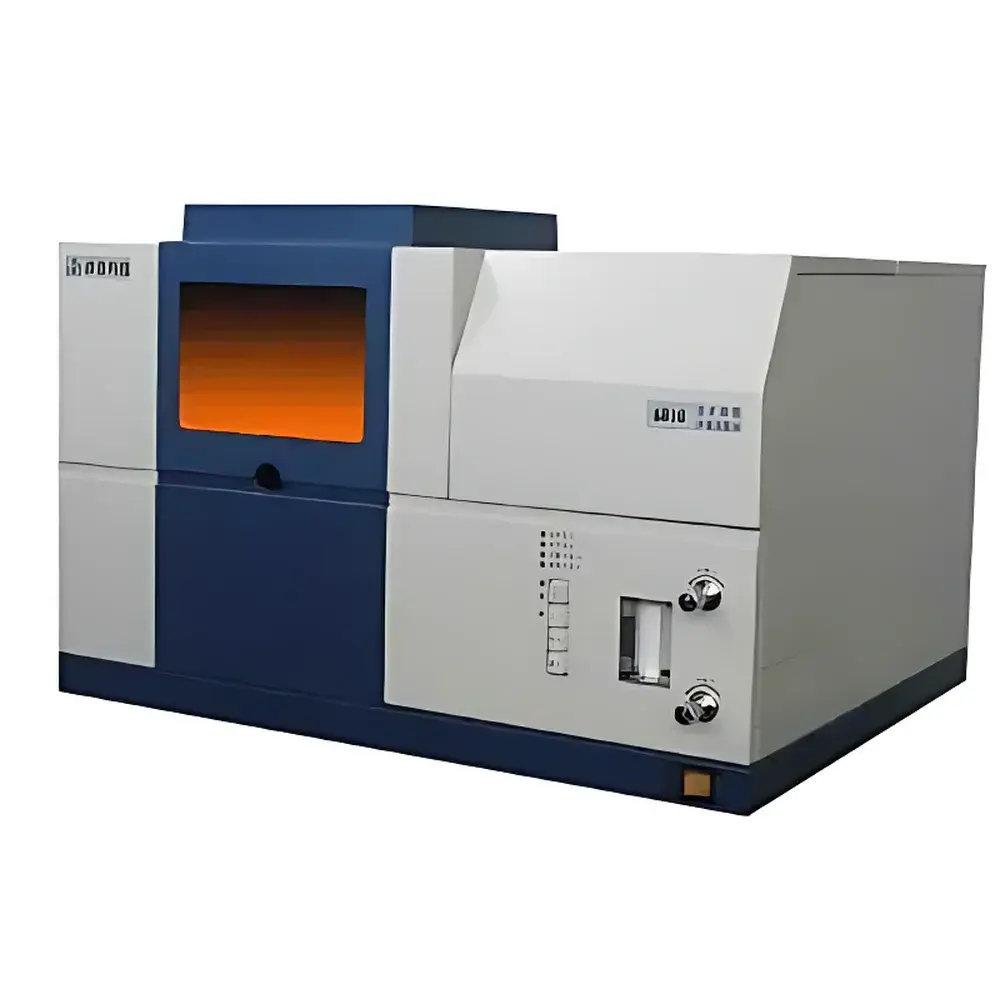
Synpec AA6810 Manual Flame Atomic Absorption Spectrophotometer
| Brand | Synpec |
|---|---|
| Origin | Shanghai, China |
| Manufacturer Type | Direct Manufacturer |
| Instrument Type | Flame AAS |
| Monochromator | Plane Grating |
| Optical System | Single-Beam |
| Detector | Photomultiplier Tube (PMT) |
| Spectral Resolution | 0.2 nm |
| Sensitivity (Cu) | >0.3 A at 5 ppm |
| RSD (Precision) | <0.3% |
| Detection Limit (Cu) | <0.004 µg/mL |
| Wavelength Range | 190–900 nm |
| Slit Widths | 0.1, 0.2, 0.4, 0.7, 1.0, 2.0 nm (auto-switching) |
| Wavelength Accuracy | ±0.2 nm |
| Wavelength Repeatability | 0.1 nm |
| Baseline Drift | 0.002 A / 30 min |
| Background Correction | D₂ Lamp & Self-Reversal |
| Characteristic Concentration (Cu) | ≤0.025 µg/mL / 1% |
| Weight | 65 kg |
Overview
The Synpec AA6810 Manual Flame Atomic Absorption Spectrophotometer is a compact, single-beam flame AAS system engineered for routine elemental quantification in academic teaching laboratories, quality control environments, and industrial process monitoring. It operates on the fundamental principle of atomic absorption spectroscopy: analyte elements in solution are atomized in an air-acetylene flame, and ground-state atoms absorb characteristic radiation from a hollow cathode lamp (HCL) at element-specific wavelengths. The instrument measures the attenuation of this narrow-band light to determine concentration via Beer-Lambert law calibration. Designed with mechanical simplicity and operational robustness, the AA6810 prioritizes long-term stability, operator safety, and method reproducibility over automation—making it especially suitable for labs where cost-effectiveness, ease of maintenance, and pedagogical transparency are paramount.
Key Features
- Compact Industrial Design: With a footprint among the smallest in its class (65 kg total mass), the AA6810 minimizes bench space requirements without compromising optical rigidity or thermal stability.
- Dual-Mode Background Correction: Integrated deuterium arc lamp and self-reversal (SR) background correction systems enable accurate compensation for broadband and structured molecular absorption—critical for complex matrices such as environmental digests or biological extracts.
- Vibration-Isolated Optical Platform: A suspended optical bench decouples the monochromator and detector assembly from mechanical disturbances, enhancing signal stability during extended measurements.
- Sealed Optical Pathway: The fully enclosed single-beam optical train—including plane grating monochromator and PMT detector—prevents dust ingress and ambient light interference, ensuring consistent photometric performance across daily use cycles.
- Flame Atomization with MARS-3 Burner: The manually operated MARS-3 flame atomizer delivers stable, low-noise flame conditions optimized for Cu, Zn, Fe, Ca, Mg, Na, K, and other common metals in aqueous solutions.
- Safety-First Architecture: Includes flame failure detection, gas pressure interlocks, and automatic shutdown protocols compliant with ISO 15195:2018 recommendations for laboratory AAS safety management.
Sample Compatibility & Compliance
The AA6810 accepts standard 16–18 mm borosilicate glass sample tubes and is compatible with dilute aqueous acid digests (e.g., HNO₃/HCl mixtures per EPA Method 200.7 or ISO 11885). It supports analysis of trace metals in drinking water (EPA 7000B), soil extracts (ISO 11047), pharmaceutical excipients (USP /), and food leachates (EN 1122). While not inherently 21 CFR Part 11-compliant due to its manual operation and lack of electronic audit trail, the system can be integrated into GLP/GMP workflows when paired with validated paper-based SOPs, calibrated volumetric glassware, and documented instrument qualification (IQ/OQ/PQ) records. All optical and mechanical components conform to IEC 61010-1:2010 safety standards for electrical equipment used in measurement and laboratory applications.
Software & Data Management
The AA6810 operates via front-panel controls with analog meter readout and optional RS-232 interface for connection to external data acquisition systems. No proprietary software is bundled; instead, it supports ASCII-formatted output compatible with third-party spreadsheet tools (e.g., Microsoft Excel) or LIMS platforms configured for serial data ingestion. Calibration curves may be constructed using linear or quadratic regression models, with absorbance values logged at user-defined intervals. For regulated environments requiring traceability, laboratories typically implement manual logbooks for lamp usage hours, gas cylinder change dates, and daily performance verification (e.g., Cu standard checks per ASTM D5685-22 Annex A1).
Applications
- Quantitative determination of Cu, Zn, Mn, Fe, Ca, Mg, Na, K, and Pb in potable water per ISO 11885 and APHA Standard Methods 3111B.
- Teaching atomic spectroscopy principles—including spectral line selection, calibration curve construction, matrix effects, and limit-of-detection estimation—in undergraduate chemistry curricula.
- Routine QC testing of raw materials in electroplating baths, fertilizer formulations, and ceramic glazes.
- Environmental monitoring of metal contaminants in wastewater effluents and sediment pore waters following EPA SW-846 Method 6010D.
- Pharmaceutical excipient screening for residual catalyst metals (e.g., Pd, Ni) per ICH Q2(R2) validation guidelines.
FAQ
Is the AA6810 suitable for regulatory compliance testing?
Yes—when operated within a documented quality system, including regular calibration with NIST-traceable standards, daily sensitivity checks, and adherence to method-specific validation criteria (e.g., ASTM D5685-22 for fuel metals), it meets technical requirements for many ISO, EPA, and pharmacopeial methods.
Can the instrument be upgraded to graphite furnace capability?
No—the AA6810 is a dedicated flame-only platform. Its optical path, burner alignment, and electronics are not mechanically or firmware-compatible with electrothermal atomizers.
What lamp types are supported?
Standard single-element hollow cathode lamps (HCLs) with B22 or B12 bases; multi-element lamps are not recommended due to reduced intensity and spectral purity.
How often should wavelength accuracy be verified?
Per ISO/IEC 17025:2017 Clause 7.7.1, wavelength calibration verification should occur before each analytical batch or at least daily using holmium oxide or didymium filters.
Does the system include a built-in printer or USB port?
No—it provides only RS-232 serial output. External printers or data loggers must be connected via compatible interfaces and configured externally.




