
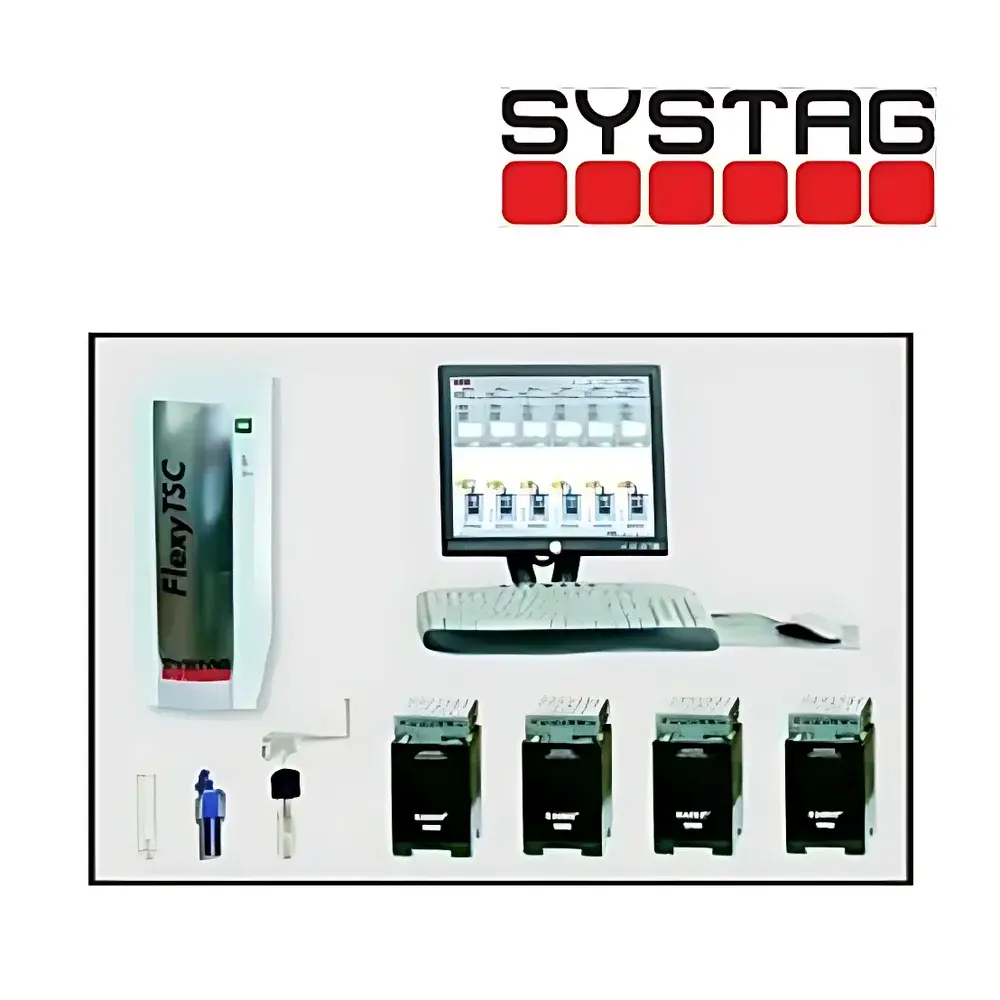
SYSTAG Flexy-TSC Thermal Safety Calorimeter
| Brand | Systag |
|---|---|
| Origin | Imported (Switzerland) |
| Model | Flexy-TSC |
| Sample Volume Range | 2.5 mL to 1 L |
| Operating Pressure | Up to 200 bar (metal vessels) |
| Temperature Range | −10 °C to 400 °C |
| Temperature Resolution | 0.05 °C |
| Measurement Modes | Scanning, Isothermal, Adiabatic |
| Vessel Materials | Standard borosilicate glass (ambient pressure), optional stainless steel or Hastelloy (high-pressure) |
| Max. Simultaneous Samples | 6 |
| Compliance | ASTM E698, ISO 8232, UN GHS Test Series H.1–H.4, compatible with GLP/GMP data integrity requirements |
Overview
The SYSTAG Flexy-TSC Thermal Safety Calorimeter is an advanced benchtop reaction calorimetry platform engineered for quantitative thermal hazard assessment of chemical substances and reactive mixtures under controlled laboratory conditions. Based on heat-flow calorimetry principles—measuring temperature differentials between sample and reference vessels in a precisely regulated thermal environment—the Flexy-TSC delivers high-reproducibility data on onset temperatures, reaction enthalpies (ΔH), time-to-maximum-rate (TMR), self-heating rates (SHR), and adiabatic temperature rise (ΔTad). Designed for process safety R&D, scale-up support, and regulatory dossier preparation (e.g., REACH, CLP, OSHA HCS), the system operates across three fundamental thermal regimes: dynamic scanning (heating/cooling ramps), isothermal hold (constant-temperature stability testing), and quasi-adiabatic mode (low-phi-factor operation approximating worst-case runaway behavior). Its modular architecture enables seamless integration into existing lab workflows while maintaining full traceability per FDA 21 CFR Part 11 and EU Annex 11 requirements.
Key Features
- Multi-sample parallel operation: Up to six independent reaction vessels can be monitored simultaneously—each with individual temperature control, pressure monitoring, and real-time heat-flow acquisition—enabling statistically robust hazard ranking and screening efficiency.
- Flexible vessel configuration: Standard 2.5–100 mL borosilicate glass cells for ambient-pressure screening; optional high-pressure metal reactors (stainless steel or Hastelloy C-276) rated to 200 bar, suitable for pressurized decomposition studies and gas-evolution kinetics.
- Extended thermal range: Equipped with integrated Peltier cooling and resistive heating, the system achieves stable operation from −10 °C to 400 °C with ±0.05 °C temperature resolution and <0.1 K/min ramp accuracy.
- Controlled atmosphere capability: Integrated mass flow controllers support inert (N₂, Ar), oxidizing (O₂), or catalytic gas environments; optional magnetic stirring ensures homogeneous mixing during exothermic events.
- Automated safety-critical parameter derivation: Embedded algorithms compute TMRad, SHR, and criticality classes (e.g., TD24, TD8) directly from raw calorimetric curves—aligned with CCPS Guidelines and NFPA 491 methodology.
Sample Compatibility & Compliance
The Flexy-TSC accommodates diverse sample types including organic intermediates, pharmaceutical APIs, battery electrolyte formulations, polymerization initiators, and energetic materials. Vessels are chemically resistant to common solvents (e.g., THF, DMF, acetonitrile) and corrosive reagents (e.g., HCl, HNO₃ at moderate concentrations). All hardware and software meet ISO/IEC 17025 calibration traceability standards. Data acquisition and reporting comply with GLP audit requirements, featuring electronic signatures, full audit trails, and immutable raw-data archiving. The system supports generation of test reports conforming to UN Manual of Tests and Criteria (Series H), ASTM E1981 (thermal stability), and ICH Q5C (stability testing of biopharmaceuticals).
Software & Data Management
SYSTAG’s proprietary TSC Control Suite provides intuitive experiment setup, real-time visualization, and post-run analysis. The software includes preconfigured method templates for common tests (e.g., DSC-like screening, ARC-style adiabatic simulation, isothermal storage stability). Raw thermograms are stored in vendor-neutral HDF5 format with embedded metadata (user, timestamp, vessel ID, environmental logs). Export options include CSV, PDF, and XML for LIMS integration. Audit trail functionality records all user actions—including parameter modifications, data deletions, and report approvals—with timestamps and operator IDs. Electronic signatures adhere to 21 CFR Part 11 Annex 11 validation protocols.
Applications
- Thermal stability evaluation of new chemical entities (NCEs) during early-phase drug development
- Process safety review for nitration, hydrogenation, and Grignard reactions prior to pilot-plant transfer
- UN transport classification testing (Class 4.1, 5.1, 5.2) per TDG/ADR regulations
- Root-cause analysis of batch failures linked to unexpected exotherms or gas evolution
- Development of emergency relief system (ERS) design basis using adiabatic data
- Validation of thermal management strategies in Li-ion battery electrolyte formulations
FAQ
What is the minimum detectable heat flow resolution?
The Flexy-TSC achieves a heat-flow sensitivity of ≤1 mW under standard glass-vessel conditions, scalable to ≤0.2 mW with high-sensitivity metal-cell configurations.
Can the system perform true adiabatic testing?
It operates in quasi-adiabatic mode (φ-factor < 1.2) using active feedback control—sufficient for reliable TMR extrapolation per ASTM E2070 and CCPS guidance—but does not replace dedicated ARC systems for ultra-low-phi applications.
Is remote monitoring supported?
Yes—via secure HTTPS interface with role-based access control; live thermograms, alarms, and system status are accessible through enterprise-grade network infrastructure.
How is calibration verified?
Annual traceable calibration is performed using certified reference materials (e.g., indium, zinc) per ISO 11357-1; user-executed verification checks are available before each test series.
Does the system support custom scripting for automated test sequences?
Python API integration is available via SYSTAG’s SDK, enabling programmable method chaining, conditional branching based on real-time thresholds, and direct LIMS synchronization.



