
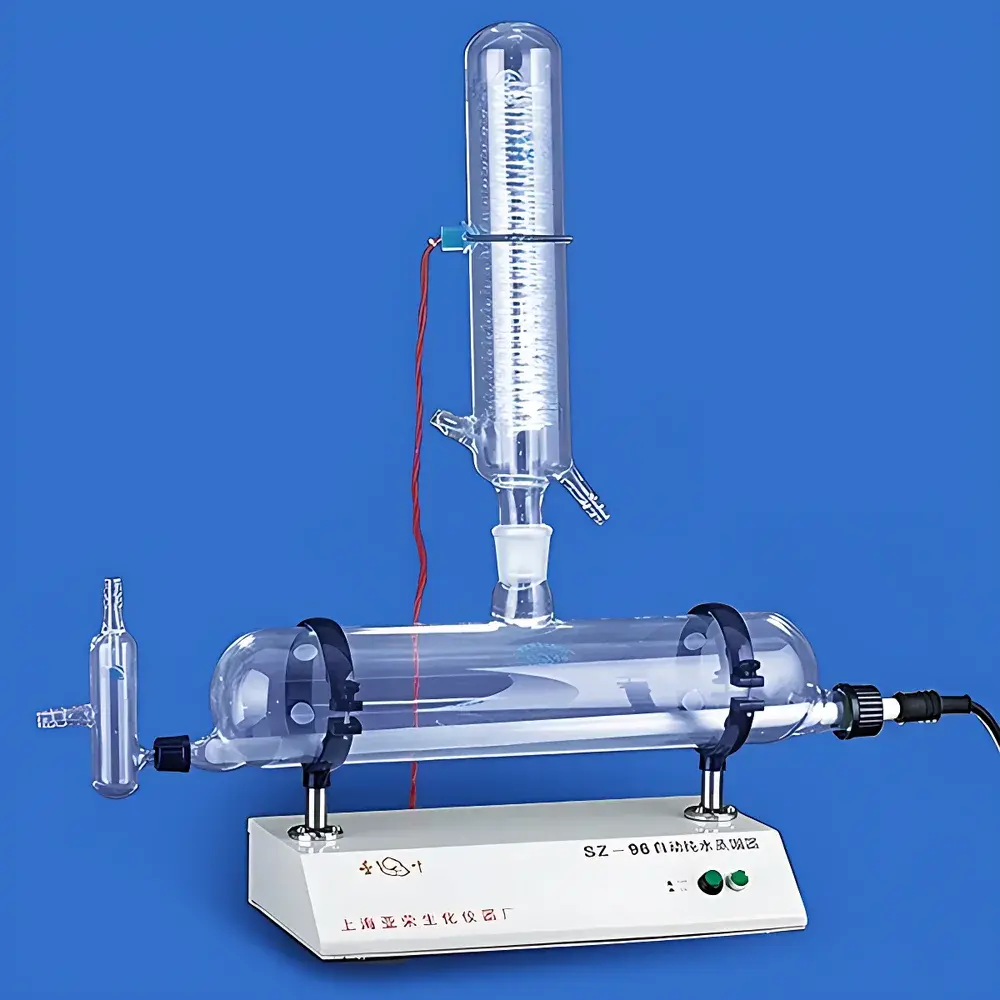
SZ-96 Automatic Pure Water Distiller by Yarong (Shanghai)
| Brand | Yarong |
|---|---|
| Origin | Shanghai, China |
| Manufacturer Type | Direct Manufacturer |
| Country of Origin | China |
| Model | SZ-96 |
| Pricing | Available Upon Request |
Overview
The SZ-96 Automatic Pure Water Distiller is a benchtop, electrically heated steam-distillation system engineered for reliable, continuous production of Type III purified water in academic, industrial, and quality control laboratories. Operating on the principle of single-stage thermal distillation, the unit vaporizes feed water—typically tap or deionized water—via a stainless-steel heating element, condenses the steam in an air-cooled or water-jacketed condenser, and collects the condensed distillate in a sealed, corrosion-resistant reservoir. Designed for unattended operation, the SZ-96 incorporates automatic level control, overheat protection, and dry-run prevention to ensure operational safety and long-term stability. It meets foundational requirements for laboratory-grade purified water as defined in ISO 3696:1987 (Grade 3) and ASTM D1193–20 (Type IV), serving as a primary source for rinsing glassware, preparing reagents, buffer solutions, and supporting non-critical analytical workflows where ultrapure water (e.g., ASTM Type I or ISO Grade 1) is not mandated.
Key Features
- Integrated automatic water-level regulation with float-controlled feed mechanism to maintain consistent boiler fill volume and prevent boil-dry conditions
- Stainless-steel boiling chamber and condenser housing for enhanced corrosion resistance and prolonged service life
- Dual safety interlocks: thermal cutoff at 120 °C and low-water sensor shutdown to comply with IEC 61010-1 electrical safety standards
- Modular design enabling easy access to internal components—including heater assembly, condenser tubing, and collection vessel—for routine maintenance and cleaning
- Front-panel indicator lights for power status, heating active, and distillate full alert, supporting intuitive operational monitoring
- No external cooling water required—air-cooled condensation system reduces infrastructure dependency and installation complexity
Sample Compatibility & Compliance
The SZ-96 accepts municipal tap water, softened water, or pre-treated deionized water as feedstock. Feed water conductivity should not exceed 500 µS/cm to minimize scaling and extend maintenance intervals. The distiller does not remove volatile organics (e.g., chloroform, acetone) or dissolved gases (e.g., CO₂, NH₃); therefore, it is not intended for applications requiring organic-free or particle-free water per USP . Output water resistivity typically ranges between 0.5–1.0 MΩ·cm at 25 °C, consistent with ISO 3696 Grade 3 specifications. Unit construction complies with GB/T 12804–2011 (Chinese standard for laboratory distillers) and incorporates CE-marked electrical components meeting EMC Directive 2014/30/EU and Low Voltage Directive 2014/35/EU.
Software & Data Management
The SZ-96 is a standalone analog-operated instrument with no embedded microprocessor or digital interface. It does not feature data logging, remote monitoring, or electronic audit trail capabilities. As such, it is suitable for environments operating under GLP or GMP frameworks where manual logbook entries—recording batch date, operator ID, feed water source, and distillate volume—are sufficient for traceability. For laboratories requiring 21 CFR Part 11–compliant electronic records, integration with external environmental monitoring systems via analog output (0–5 V signal for heating status) may be implemented using third-party DAQ hardware and validated software.
Applications
- Routine preparation of rinse water for volumetric glassware and sample containers in chemistry and biology labs
- Formulation of general-purpose buffers (e.g., PBS, Tris-HCl) and diluent solutions for spectrophotometry and titration
- Feed water supply for autoclaves, humidifiers, and ultrasonic cleaning baths where mineral-free water is required
- Supporting educational laboratory instruction in separation techniques and phase-change thermodynamics
- Backup purification source in facilities where central RO/DI systems undergo scheduled maintenance
FAQ
What feed water quality is recommended for optimal performance?
Tap water with total hardness below 200 mg/L CaCO₃ equivalent is preferred. Pre-filtration through a sediment + activated carbon cartridge is advised if chlorine or particulate content is elevated.
Does the SZ-96 produce pyrogen-free water?
No. The unit does not include endotoxin removal stages (e.g., ultrafiltration or distillation above 100 °C under pressure) and is not validated for parenteral or cell culture applications.
How often should the boiling chamber be descaled?
Frequency depends on feed water hardness; typical interval ranges from once every 2–4 weeks under moderate hardness conditions. Citric acid or food-grade descaling agents are compatible.
Can the distillate output rate be adjusted?
No. The SZ-96 operates at fixed thermal input (~3.0 kW). Output rate is governed by ambient temperature, feed water inlet temperature, and condenser efficiency—typically 2–3 L/h under standard lab conditions (25 °C, 50% RH).
Is validation documentation provided with the unit?
Factory test reports (including pressure integrity and thermal cutoff verification) are supplied. IQ/OQ protocols and calibration templates are available upon request for customer-led qualification activities.



