
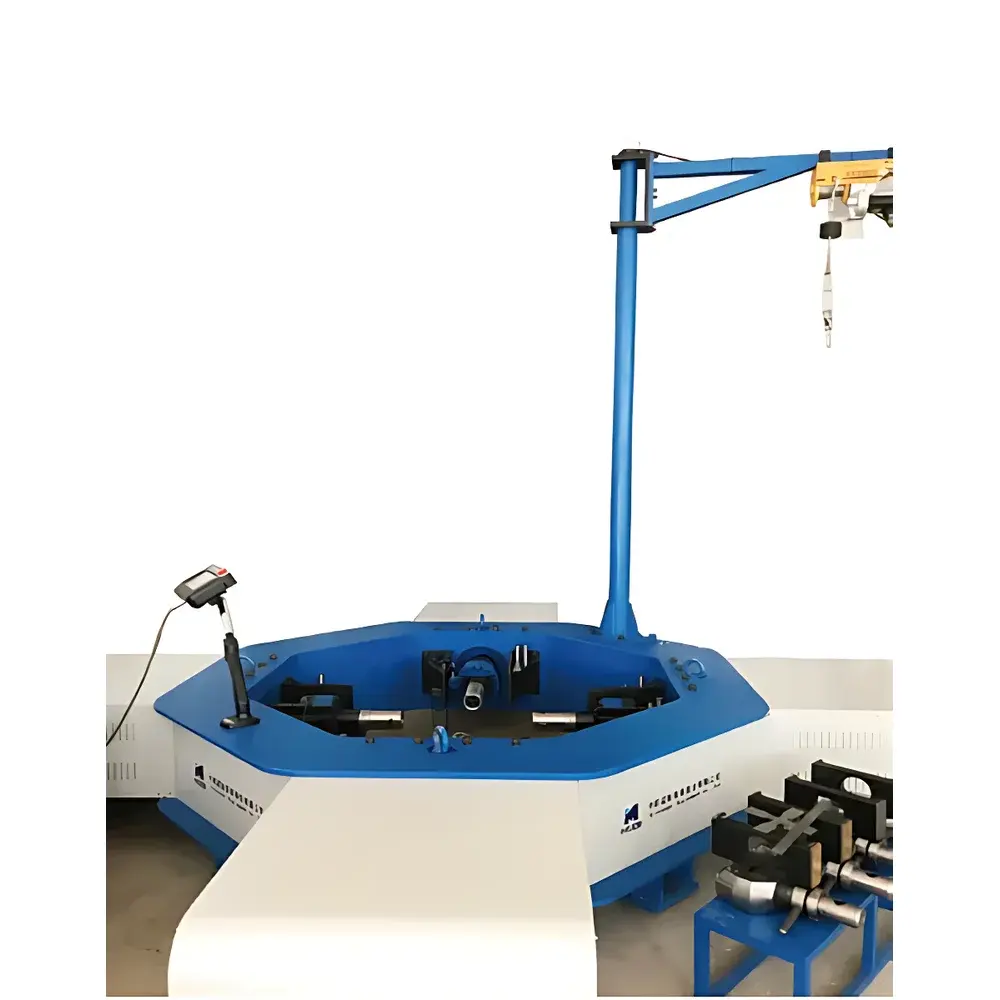
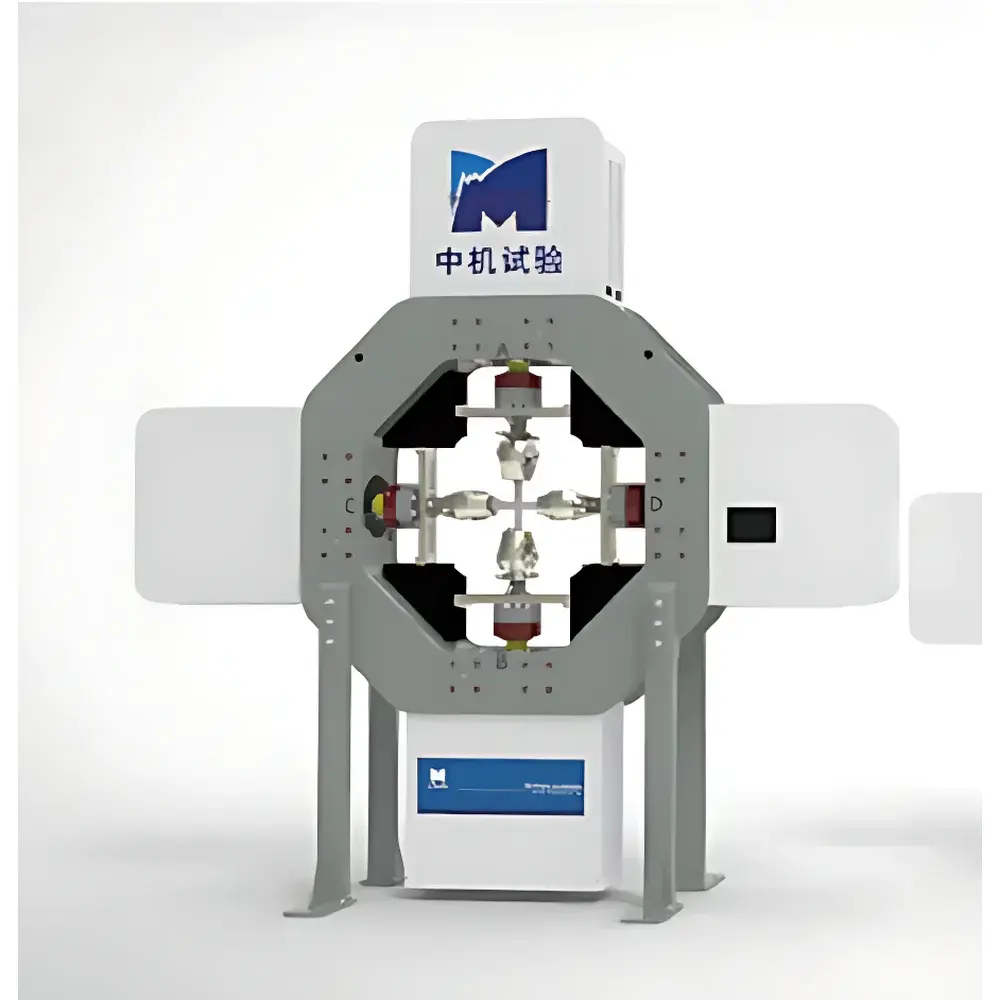
SZL Series Dual-Axis Universal Testing Machine by SINOTEST
| Brand | SINOTEST |
|---|---|
| Origin | Jilin, China |
| Manufacturer Type | Direct Manufacturer |
| Instrument Type | Electromechanical Universal Testing Machine |
| Model | SZL Series |
| Control Modes | Force Control & Displacement Control |
| Application Scope | Biaxial Static Tensile and Compressive Testing |
Overview
The SZL Series Dual-Axis Universal Testing Machine is an electromechanical testing system engineered for precise biaxial mechanical characterization of advanced materials under controlled static loading conditions. Unlike conventional uniaxial universal testing machines, this system applies independent, synchronized tensile or compressive loads along two orthogonal axes—typically designated as X and Y—enabling true planar stress-state simulation. It operates on the principle of servo-controlled electromechanical actuation, where high-accuracy load cells and linear encoders provide real-time feedback for closed-loop regulation of force and displacement. The system is particularly suited for evaluating anisotropic deformation behavior, fracture initiation under multiaxial stress, and nonlinear constitutive response in heterogeneous materials such as fiber-reinforced composites, technical ceramics, elastomeric polymers, and cellular foams.
Key Features
- Dual independent servo-driven actuation axes with synchronized motion control, supporting both simultaneous and sequential loading protocols
- High-rigidity structural frame with precision-machined crossheads and low-backlash ball screws to minimize parasitic bending and ensure axial alignment fidelity
- Integrated dual-channel load measurement using calibrated, temperature-compensated strain-gauge load cells (standard range: ±5 kN to ±50 kN per axis, configurable)
- Real-time displacement monitoring via non-contact optical encoders or high-resolution linear variable differential transformers (LVDTs), with sub-micrometer resolution
- Modular grip interface accommodating custom-designed biaxial fixtures—including cruciform, picture-frame, and hydraulic bladder configurations—for specimen-specific boundary condition replication
- Compliance with mechanical safety standards including ISO 7500-1 (static calibration of force-proving instruments) and ASTM E4 (load verification of testing machines)
Sample Compatibility & Compliance
The SZL Series accommodates flat-sheet and thin-plate specimens ranging from 10 mm × 10 mm up to 300 mm × 300 mm, with thicknesses from 0.1 mm to 25 mm. Specimen materials include carbon-fiber reinforced polymer (CFRP) laminates, alumina and silicon carbide ceramics, silicone and natural rubber compounds, thermoplastic elastomers, and syntactic foams. All test configurations support standardized specimen geometries per ASTM D3039 (tensile), ASTM C1161 (flexural), ISO 527-2 (plastics), and GB/T 1040.2 (Chinese national standard for plastics). The machine’s control architecture supports audit-ready data logging compliant with GLP and GMP requirements, including user access levels, electronic signatures, and immutable test record archiving aligned with FDA 21 CFR Part 11 principles.
Software & Data Management
Control and analysis are executed via SINOTEST’s proprietary TestMaster™ software platform, a Windows-based application supporting multi-threaded real-time acquisition at up to 1 kHz sampling rate per channel. The software enables programmable test sequences—including ramp-hold, cyclic biaxial loading, and stress-relaxation protocols—with full traceability of setpoints, actual values, and environmental metadata (e.g., ambient temperature, humidity timestamp). Raw data exports to ASCII, CSV, and HDF5 formats; post-processing modules include stress-strain tensor derivation, principal strain mapping, yield surface approximation, and digital image correlation (DIC) synchronization capability. All software modules undergo periodic validation per ISO/IEC 17025:2017 Annex A.2 guidelines for computational tools used in accredited testing laboratories.
Applications
- Constitutive modeling of orthotropic composites under combined in-plane tension-compression states
- Evaluation of ceramic matrix composite (CMC) crack bridging efficiency under biaxial fatigue
- Calibration of hyperelastic material models (e.g., Mooney-Rivlin, Ogden) for medical-grade elastomers
- Investigation of strain localization and necking onset in thin metal foils subjected to equi-biaxial stretch
- Validation of finite element simulations requiring experimentally derived biaxial stress–strain curves
- Quality assurance testing of adhesive bondlines in aerospace sandwich panels under shear-dominated biaxial loading
FAQ
What types of biaxial loading modes does the SZL Series support?
The system supports equi-biaxial tension, non-equi-biaxial tension (e.g., 2:1 ratio), biaxial tension-compression, and pure shear via appropriate fixture selection and control profile programming.
Is the machine compatible with third-party DIC systems?
Yes—TestMaster™ provides hardware-triggered synchronization outputs and time-stamped data streams compatible with commercial DIC platforms such as Correlated Solutions VIC-2D and LaVision DaVis.
Can test methods be exported and shared across multiple SZL units?
Test definitions—including control parameters, safety limits, and reporting templates—are stored as XML-based method files, enabling version-controlled deployment across distributed laboratory networks.
Does SINOTEST provide calibration certificates traceable to national standards?
Each system ships with a factory calibration certificate traceable to CNAS-accredited reference standards (GB/T 228.1, JJG 139), with optional on-site recalibration services available globally.



