
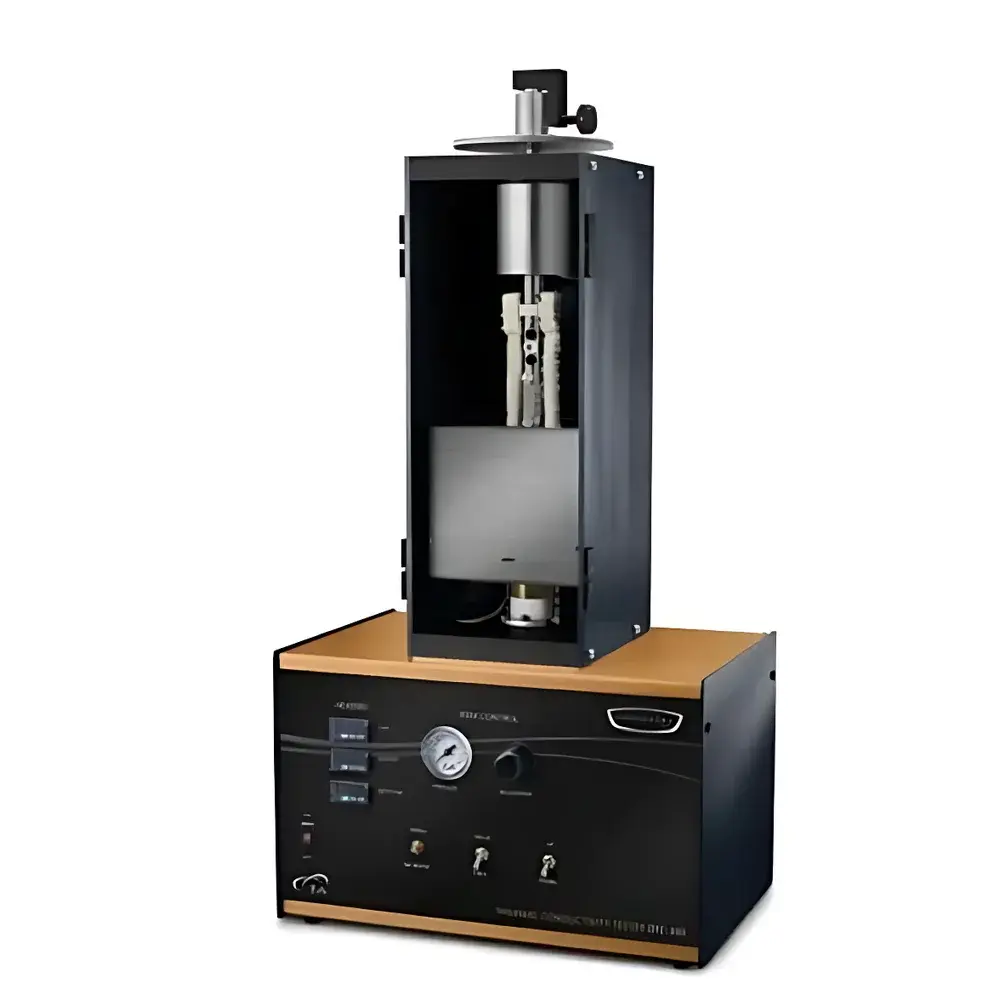
TA Instruments DTC-300 Guarded Heat Flow Meter Thermal Conductivity Analyzer
| Brand | TA Instruments |
|---|---|
| Origin | USA |
| Model | DTC-300 |
| Measurement Principle | Guarded Heat Flow Method (ASTM E1530) |
| Sample Temperature Range | −40 °C to 200 °C (with optional chiller and heater modules) |
| Thermal Resistance Range | Three interchangeable sensor modules covering low-, medium-, and high-resistance regimes |
| Sample Form Compatibility | Solids, thin films (multi-layer stack), pastes, liquids (with custom containment) |
| Compliance | ASTM E1530, ISO 8301, EN 12667 |
Overview
The TA Instruments DTC-300 is a guarded heat flow meter (HFM) thermal conductivity analyzer engineered for precise, steady-state measurement of thermal conductivity (λ) and thermal resistance (R-value) across a broad spectrum of solid, semi-solid, and layered materials. Operating on the principle of one-dimensional, steady-state heat conduction under controlled temperature gradient, the DTC-300 applies a known heat flux across a sample sandwiched between two isothermal plates — a guarded hot plate and a cooled cold plate — while actively suppressing lateral heat loss via precision thermal guarding. This architecture ensures high measurement fidelity for materials with thermal conductivities ranging from approximately 0.01 to 2.0 W/(m·K), making it particularly suited for insulating polymers, structural composites, ceramic substrates, elastomeric seals, architectural glazing, and advanced battery thermal interface materials (TIMs). The system’s design conforms strictly to ASTM E1530 (“Standard Test Method for Evaluating Materials Used in Thermal Insulation Systems for Spacecraft”), as well as ISO 8301 and EN 12667, enabling data traceability in R&D, quality control, and regulatory submission contexts.
Key Features
- Three interchangeable guarded sensor modules — optimized for distinct thermal resistance ranges — allow seamless adaptation to low-conductivity insulators (e.g., aerogels), mid-range engineering plastics, and higher-conductivity metals or ceramics without hardware recalibration.
- Active water-cooled heat sink enables stable cold-side temperatures down to 50 °C; integration with an optional recirculating chiller extends operational lower limit to −40 °C, significantly widening usable ΔT range and improving resolution for low-λ materials.
- Modular sample stage accommodates standard 100 mm × 100 mm specimens up to 50 mm thick; optional fixtures support thin-film multilayer stacks (≥0.1 mm per layer) using calibrated interfacial contact pressure control.
- Non-solid sample capability via sealed, thermally matched containment cells — validated for gels, phase-change materials (PCMs), and Newtonian/non-Newtonian suspensions under static thermal loading.
- Rugged, all-metal frame with precision-machined aluminum platens ensures long-term dimensional stability, minimal thermal drift (<0.02 °C/h), and compliance with GLP/GMP environmental monitoring requirements.
Sample Compatibility & Compliance
The DTC-300 supports heterogeneous material classes including rigid and flexible foams, fiber-reinforced composites, sintered ceramics, tempered glass laminates, vulcanized rubbers, and metallic alloys with surface emissivity >0.2. For thin-film applications, the multi-layer measurement mode accounts for interfacial thermal contact resistance using iterative inverse modeling, consistent with ASTM C1113 practice. All test protocols are fully compliant with ASTM E1530 (primary), ISO 8301 (heat flow meter method), and EN 12667 (building materials). Raw thermal resistance and conductivity outputs include full metadata stamping (timestamp, operator ID, ambient RH/T, calibration certificate ID), satisfying audit requirements under FDA 21 CFR Part 11 when paired with TA’s Trios software in secure user-mode configuration.
Software & Data Management
Controlled via TA Instruments’ Trios software platform, the DTC-300 provides automated test sequencing, real-time thermal gradient monitoring, and embedded uncertainty propagation per GUM (Guide to the Expression of Uncertainty in Measurement). Trios enforces role-based access control, electronic signature workflows, and tamper-evident audit trails — critical for laboratories operating under ISO/IEC 17025 or pharmaceutical GMP frameworks. Export formats include CSV (with SI-unit headers), PDF test reports compliant with ASTM reporting templates, and XML for LIMS integration. Calibration history, module-specific correction factors, and sensor drift logs are stored within the instrument database and synchronized across networked instruments.
Applications
- Thermal management validation of battery pack insulation and cell-to-pack interface materials
- Quality assurance of aerospace-grade composite laminates per MIL-STD-401
- Development of low-λ building envelope components (e.g., vacuum insulation panels, bio-based foams)
- Characterization of thermal interface materials (TIMs) used in high-power electronics packaging
- Regulatory testing of fire-retardant polymer formulations per UL 94 and ASTM E84 thermal performance addenda
- Academic research into phonon transport mechanisms in nanostructured ceramics and polymer nanocomposites
FAQ
What standards does the DTC-300 comply with?
ASTM E1530, ISO 8301, EN 12667, and ASTM C1113 for multi-layer analysis.
Can the DTC-300 measure liquids or pastes?
Yes — using sealed, thermally symmetric containment cells designed to minimize convection and ensure planar heat flow.
Is multi-layer film analysis supported?
Yes — the system includes dedicated firmware routines and correction algorithms for stacked thin-film assemblies down to 0.1 mm per layer.
What is the lowest achievable cold-plate temperature?
−40 °C, when equipped with the optional external recirculating chiller unit.
How is calibration maintained across modules?
Each sensor module carries its own NIST-traceable calibration certificate; Trios software auto-detects module identity and loads corresponding correction polynomials.
Related Products



