
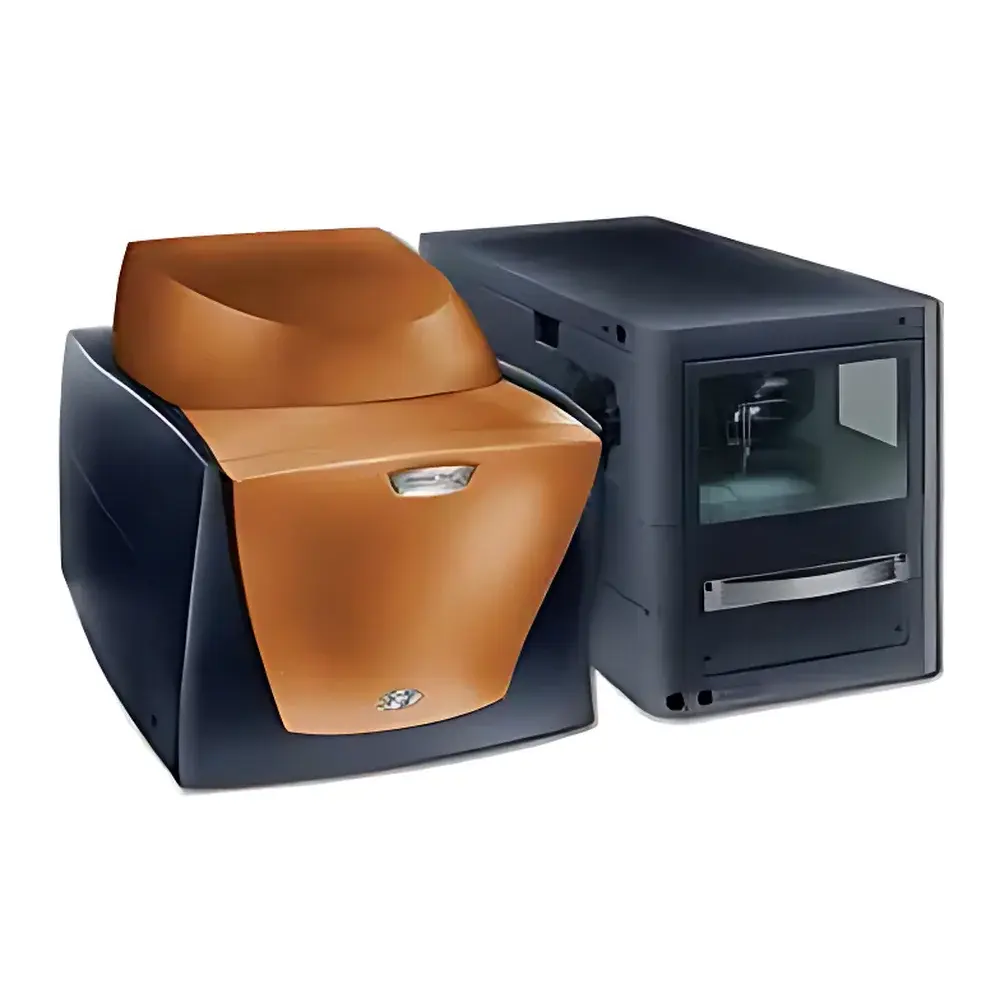
TA Instruments Nano DSC Differential Scanning Calorimeter
| Brand | TA Instruments |
|---|---|
| Origin | USA |
| Instrument Type | Differential Scanning Calorimeter (DSC) |
| Temperature Range | –10 °C to 130 °C |
| Heating/Cooling Rate | 0.001–2 K/min |
| Cell Volume | < 200 µL (capillary-based) |
| Pressure Control | Integrated solid-state linear actuator with ±0.1 psi regulation |
| Automation | Optional DSC Auto autosampler (HPLC-grade precision) |
Overview
The TA Instruments Nano DSC is a high-sensitivity, capillary-based differential scanning calorimeter engineered specifically for the thermodynamic characterization of biomacromolecules in dilute aqueous solution. Unlike conventional macro- or micro-DSC systems, the Nano DSC operates on the principle of power-compensated heat flow measurement using dual, matched capillary cells—one containing sample and the other reference—within a single, thermally symmetric block. Its design eliminates convection artifacts and minimizes thermal lag, enabling direct quantification of transition enthalpy (ΔH), melting temperature (Tm), heat capacity change (ΔCp), and cooperativity of unfolding transitions. The instrument is optimized for applications where sample availability is severely limited (e.g., recombinant proteins, monoclonal antibodies, oligonucleotides, and membrane protein complexes), routinely delivering high-fidelity thermograms from as little as 50–200 µg of protein at concentrations of 0.1–1.0 mg/mL.
Key Features
- Capillary cell architecture: Dual 180–220 µL fused-silica capillary cells ensure minimal sample consumption, reduced thermal mass, and enhanced signal-to-noise ratio—critical for low-concentration biological samples prone to aggregation or precipitation.
- Precision temperature control: Solid-state Peltier elements with closed-loop feedback provide stable, reproducible heating and cooling across the full operating range (–10 °C to 130 °C) at rates from 0.001 to 2 K/min, supporting both equilibrium and non-equilibrium thermodynamic studies.
- Active pressure regulation: A built-in linear actuator maintains constant hydrostatic pressure (±0.1 psi) within both cells during scans, suppressing bubble formation and ensuring baseline stability—particularly essential for volatile buffers or low-surface-tension formulations.
- Low-drift, high-resolution detection: Heat flow resolution of ≤0.1 µcal/sec enables detection of subtle transitions (e.g., domain unfolding, ligand-induced stabilization, or cold denaturation) with excellent inter-run reproducibility (RSD < 1.5% for Tm, < 3% for ΔH).
- Modular automation readiness: Designed for seamless integration with the optional DSC Auto autosampler—a validated, HPLC-compatible platform capable of unattended analysis of up to 96 samples per run with precise syringe-driven loading, air-gap elimination, and integrated cell cleaning protocols.
Sample Compatibility & Compliance
The Nano DSC accommodates a broad range of biologically relevant samples, including purified proteins (monomeric and multimeric), nucleic acids, glycoproteins, liposomes, and small-molecule–biopolymer complexes. Its capillary geometry mitigates sedimentation and wall adsorption effects common in viscous or heterogeneous solutions. Method development adheres to ICH Q5E guidelines for comparability studies and supports regulatory submissions requiring thermodynamic fingerprinting under GLP or GMP-aligned workflows. Data acquisition and processing comply with FDA 21 CFR Part 11 requirements when used with TA Instruments’ Trios software configured with audit trail, electronic signature, and role-based access controls.
Software & Data Management
Control, acquisition, and analysis are performed via TA Instruments Trios software—a validated, Windows-based platform offering automated baseline subtraction, peak deconvolution, van’t Hoff and Gibbs-Helmholtz modeling, and global fitting of multi-transition datasets. Raw data are stored in vendor-neutral .xml and .csv formats. Batch processing, report templating (PDF/HTML), and metadata tagging (sample ID, buffer composition, scan rate, pressure setpoint) support traceability and LIMS integration. The software includes built-in validation tools for system suitability testing (SST), including thermal calibration verification using indium and zinc standards per ASTM E794 and ISO 11357-1.
Applications
- Determination of thermal stability (Tm, ΔH, ΔCp) for biosimilar comparability and formulation screening
- Quantification of ligand binding affinity and stoichiometry via isothermal titration calorimetry (ITC)-complementary DSC titrations
- Assessment of structural robustness under stress conditions (pH, excipients, freeze-thaw)
- Characterization of cold denaturation and heat-induced aggregation onset
- Quality control of therapeutic proteins and viral vectors in process development and release testing
FAQ
What is the minimum sample concentration required for reliable Nano DSC measurements?
Typical working concentrations range from 0.1 to 1.0 mg/mL for globular proteins; lower concentrations may be viable depending on molecular weight and transition enthalpy.
Can the Nano DSC be used with organic solvents or non-aqueous buffers?
The standard capillary cells are compatible with water-miscible solvents (e.g., glycerol, ethylene glycol) at ≤20% v/v; extended solvent compatibility requires custom cell materials and pressure calibration.
Is the DSC Auto autosampler compliant with 21 CFR Part 11?
Yes—when deployed with Trios software in validated configuration, it provides full electronic signature, audit trail, and user permission management.
How often does the instrument require thermal calibration?
Calibration using certified indium (Tm = 156.6 °C, ΔH = 6.8 cal/g) and zinc (Tm = 419.5 °C) standards is recommended before each study series or after major maintenance.
Does the Nano DSC support pressure-dependent unfolding studies?
While the system maintains constant pressure during scans, it is not designed for variable-pressure experiments; dedicated high-pressure DSC platforms are required for p-T phase mapping.



