
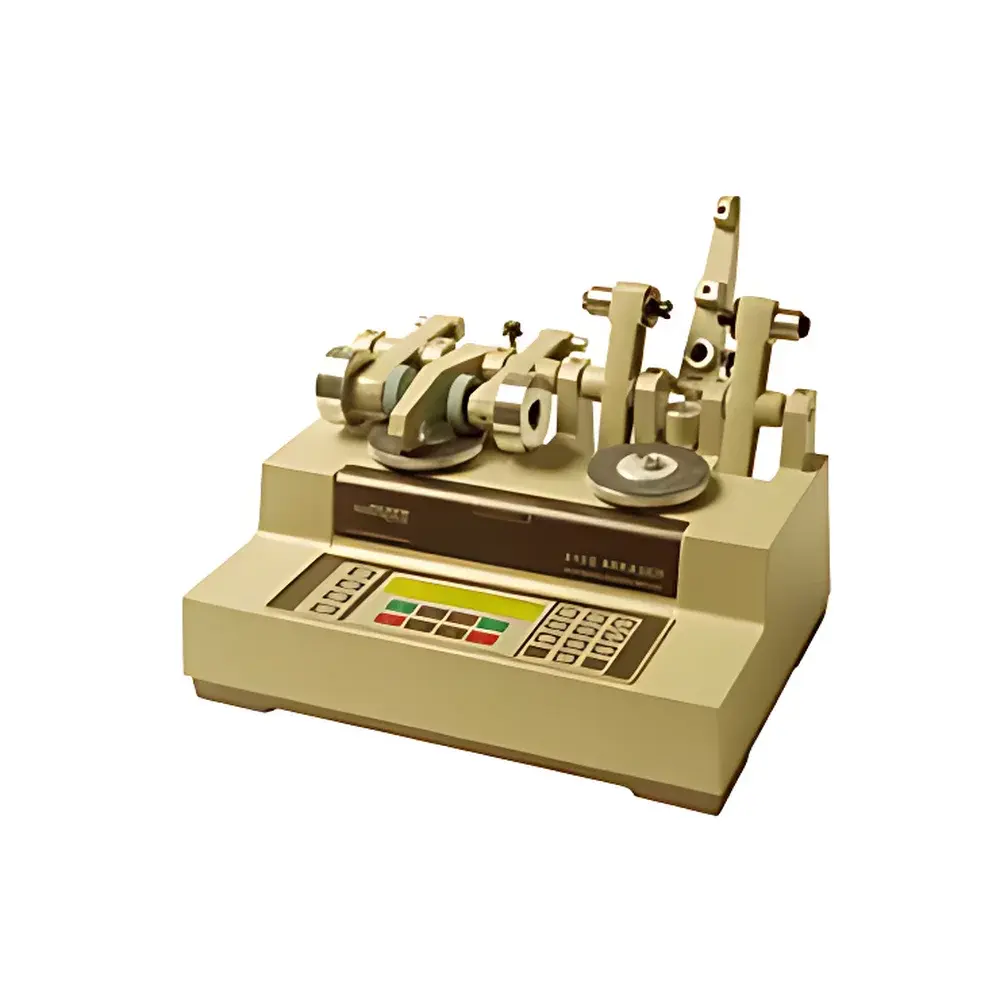
Taber 1750 Dual-Abrader Abrasion Tester
| Brand | Taber |
|---|---|
| Origin | USA |
| Model | Taber 1750 |
| Compliance | ASTM D3884, ASTM D4060, ISO 9352, ISO 5470-1, JIS K7204, TAPPI T476, DIN 52347, EN 13329 |
| Operating Environment | 21–24°C (70–75°F), 50% RH |
| Sample Mounting | Flat, rigid specimens secured on rotating turntable |
| Abrasion Mechanism | Dual counter-rotating abrasive wheels applying controlled load in crossed-arc motion |
| Vacuum-Assisted Debris Removal | Adjustable suction for real-time particulate extraction |
| Control Interface | Digital display with programmable cycle count, vacuum activation, and power-on resume memory |
Overview
The Taber 1750 Dual-Abrader Abrasion Tester is an electromechanical precision instrument engineered for quantitative evaluation of surface wear resistance under standardized mechanical stress. Based on the fundamental principle of two counter-rotating abrasive wheels traversing a flat specimen mounted on a horizontally rotating turntable, the system generates reproducible crossed-arc abrasion patterns—mimicking real-world scuffing, scraping, and sliding contact encountered in industrial use. Unlike single-wheel or linear reciprocating testers, the dual-abrader architecture ensures symmetrical force distribution and eliminates directional bias, enabling high repeatability across material classes. The instrument operates in strict accordance with internationally recognized test methodologies, serving as a primary reference platform for quality control laboratories in packaging, automotive interiors, flooring, coated substrates, and consumer electronics manufacturing.
Key Features
- Programmable digital controller with real-time cycle counting, user-defined rotation limits (up to 999,999 cycles), and automatic shutdown upon completion
- Integrated vacuum system with adjustable suction pressure—removes abraded debris during operation to prevent secondary scratching and ensure consistent loading conditions
- Power-loss recovery memory: retains cumulative rotation count during unexpected power interruption, resuming from last recorded value upon restart
- Modular wheel-mounting system compatible with Taber’s full range of standardized abrasive wheels—including CS-series (elastic rubber-bonded alumina), H-series (rigid ceramic), S-series (sandpaper-backed), and specialty wheels (e.g., S-35 tungsten carbide, CS-O wool-felt)
- Calibrated vertical load application via precision-machined weights (typically 250 g, 500 g, or 1000 g per wheel) ensuring traceable force delivery per ISO/IEC 17025-aligned calibration protocols
- Rigid cast-iron base and precision-ground turntable assembly minimize vibration-induced measurement drift and support long-term dimensional stability
Sample Compatibility & Compliance
The Taber 1750 accepts flat, dimensionally stable specimens up to 102 mm (4 in) in diameter and 12.7 mm (0.5 in) in thickness. It is routinely employed for evaluating abrasion resistance of corrugated board, laminated films, printed labels, decorative laminates, anodized aluminum, PVC flooring, automotive trim coatings, and medical device packaging. Its methodology satisfies requirements specified in ASTM D3884 (abrasion resistance of organic coatings), ASTM D4060 (coating wear by Taber abraser), ISO 9352 (plastics — determination of resistance to abrasion), ISO 5470-1 (rubber — determination of abrasion resistance), JIS K7204 (plastic films), TAPPI T476 (paperboard), and EN 13329 (resilient floor coverings). All testing must be conducted within a controlled environment: 21–24°C ± 1°C and 50% ± 5% relative humidity, with specimens conditioned for ≥24 h (organic materials ≥48 h) prior to testing to stabilize hygroscopic and thermal equilibria.
Software & Data Management
While the Taber 1750 operates as a stand-alone electromechanical system without embedded PC connectivity, its output supports GLP-compliant data capture through external documentation workflows. Test parameters—including wheel type, applied load, cycle count, pre- and post-test mass/thickness measurements, and environmental logs—are recorded manually or via LIMS-integrated spreadsheets. For regulated environments (e.g., ISO 13485-certified medical packaging labs or ICH Q5A-compliant pharmaceutical secondary packaging facilities), users implement audit-trail procedures per FDA 21 CFR Part 11 requirements using validated electronic notebooks or ELN platforms. Taber provides comprehensive calibration certificates traceable to NIST standards, and annual recalibration services are available through authorized service centers adhering to ISO/IEC 17025-accredited practices.
Applications
The Taber 1750 delivers quantifiable metrics critical to product development and conformance verification: mass loss (mg), thickness reduction (µm), haze increase (%), gloss retention (%), or visual rating per ASTM D1014. It is deployed to validate shelf-life durability of retail packaging films, assess scuff resistance of luxury goods leather finishes, verify scratch performance of anti-fingerprint coatings on touchscreens, benchmark wear life of transportation signage laminates, and qualify abrasion tolerance of barrier layers in sterile medical pouches. In packaging R&D, it informs decisions on ink formulation, varnish selection, and substrate lamination architecture—directly correlating laboratory results with field performance observed in distribution chain handling, automated sorting, and end-user interaction.
FAQ
What abrasive wheels are recommended for testing flexible plastic films?
CS-10 or CS-17 elastic wheels with aluminum oxide abrasive are typically used for thin, ductile polymer films; H-series ceramic wheels are avoided due to excessive cutting action.
Can the Taber 1750 accommodate non-circular specimens?
No—the turntable geometry requires specimens to be circular and flat for uniform rotational engagement; irregular shapes must be cut to standard 102 mm diameter prior to mounting.
Is vacuum operation mandatory during testing?
Vacuum activation is strongly recommended for all organic or particulate-prone materials (e.g., paper, textiles, PVC) to prevent abrasive buildup; it may be disabled only for inert, non-dusting substrates like polished metal or glass.
How often should abrasive wheels be dressed or replaced?
Wheels should be visually inspected before each test series; dressing with a diamond lap is required when glazing or loading is observed; replacement intervals depend on material aggressiveness but generally occur after 5,000–10,000 cycles for CS-series wheels under standard 500 g loading.
Does Taber provide method validation support for ISO/IEC 17025 accreditation?
Yes—Taber supplies detailed uncertainty budgets, GUM-based measurement models, and interlaboratory comparison reports to support scope expansion for accredited testing laboratories.




