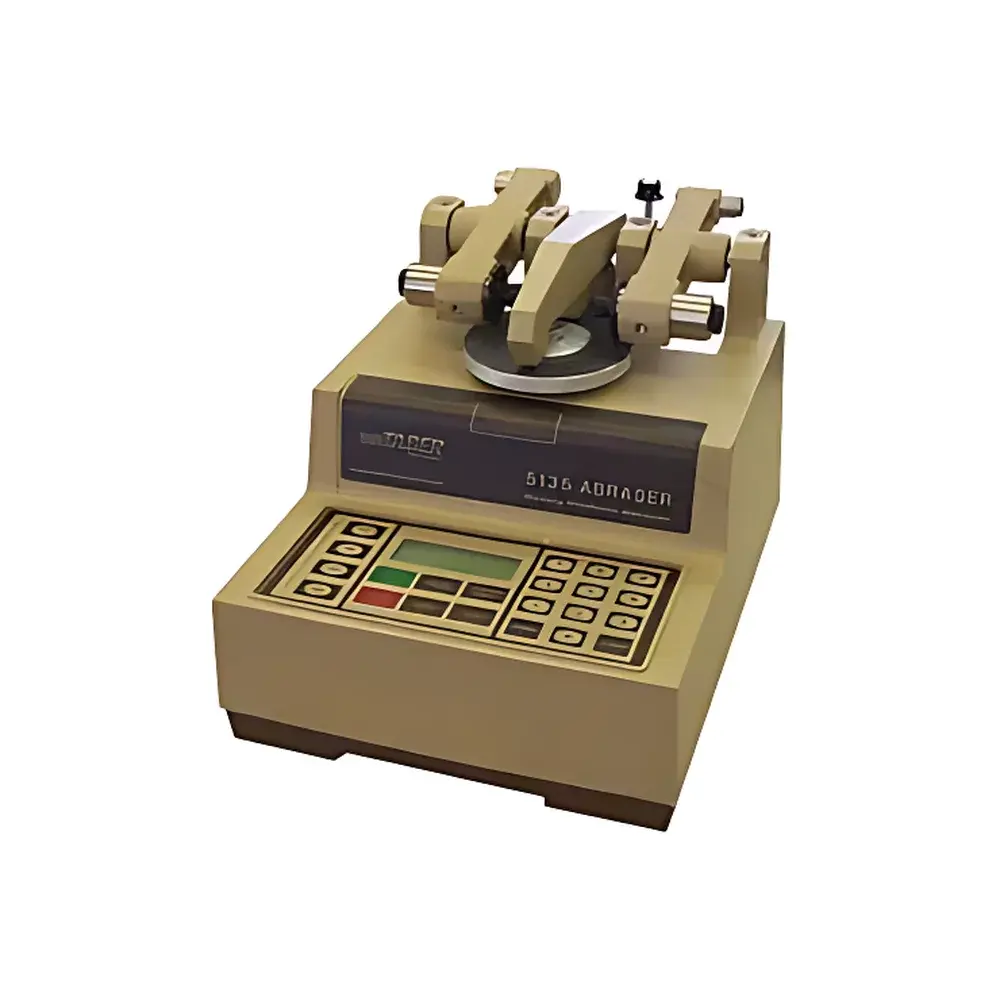
Taber 5135 Single-Station Rotational Abrasion Tester
| Brand | Taber |
|---|---|
| Origin | USA |
| Model | 5135 |
| Power Supply | 115 V, 50/60 Hz AC |
| Compliance | ASTM D3884, ASTM D4060, ISO 9352, ISO 5470-1, JIS K7204, TAPPI T476 |
| Sample Area | 30 cm² |
| Load Range | Adjustable in grams (g) |
| Rotation Count | Electronically measured |
| Vacuum Dust Extraction | Integrated |
Overview
The Taber 5135 Single-Station Rotational Abrasion Tester is an electromechanical instrument engineered for standardized, repeatable assessment of surface wear resistance under controlled rotary-abrasion conditions. It operates on the principle of dual abrasive wheels rotating in counter-rotation against a horizontally mounted test specimen while simultaneously orbiting around the central axis of the turntable—a kinematic configuration known as “orbital rotation.” This motion generates both rolling and sliding components, simulating complex real-world abrasion mechanisms such as scuffing, scratching, and particle-induced erosion. Designed to ASTM D3884 (Standard Test Method for Abrasion Resistance of Textile Fabrics), ASTM D4060 (Abrasion Resistance of Organic Coatings), and ISO 9352 (Plastics — Determination of Resistance to Abrasion), the 5135 delivers high reproducibility across diverse material classes including coated metals, laminates, elastomers, textiles, ceramics, and polymer composites. Its compact footprint, rigid cast-aluminum frame, and sealed control enclosure ensure long-term mechanical stability in QC laboratories and R&D environments subject to routine calibration and GLP-compliant operation.
Key Features
- Single-station configuration optimized for precision testing of one specimen per cycle—ideal for method validation, comparative studies, and regulatory submissions requiring traceable single-point data.
- Digitally controlled turntable rotation with LED-displayed cycle count and programmable stop function; no mechanical counters or analog dials.
- Adjustable vertical load application via calibrated weights or pneumatic actuators (optional), enabling precise force control from 50 g to 1,000 g in 25 g increments—critical for correlating lab results with field wear behavior.
- Integrated vacuum dust extraction system minimizes airborne particulate accumulation and prevents secondary abrasion from debris re-deposition during extended cycles.
- Modular wheel-mounting interface compatible with all Taber-standard abrasive wheels—including Calibrase®, Calibrade®, wool felt, rubber, and tungsten carbide types—ensuring fidelity to application-specific wear modes.
- Interchangeable specimen holders (e.g., E140-15 textile clamps, E100-10 transparent acrylic plates, E140-19 pin-actuated fixtures) accommodate flat, curved, flexible, or rigid substrates up to 12.7 mm (0.5 in) thickness without modification.
Sample Compatibility & Compliance
The Taber 5135 accommodates specimens measuring 108 mm in diameter (30 cm² exposed area) and supports materials ranging from thin films (<0.1 mm) to thick composites (≤12.7 mm). Its design enables testing of coated surfaces (paints, anodized layers, PVD/CVD films), woven/nonwoven textiles, automotive interior trim, flooring materials (LVT, rubber matting), optical lenses, and medical device housings. All operational parameters—including rotational speed (typically 60–72 rpm), load magnitude, wheel type, and cycle count—are fully documented and auditable per FDA 21 CFR Part 11 requirements when paired with compliant data acquisition software. The instrument meets essential clauses of ISO/IEC 17025 for test method validation and is routinely cited in technical documentation supporting UL 94, MIL-STD-810G, and SAE J2527 certification pathways.
Software & Data Management
While the base Taber 5135 operates via front-panel controls, it integrates seamlessly with Taber’s optional Vantage™ Software Suite for automated test sequencing, real-time parameter logging, and statistical analysis. Vantage supports multi-variable test protocols (e.g., stepped-load abrasion, time-series mass loss tracking), generates PDF reports compliant with ISO 17025 Annex A.2, and maintains full audit trails—including user login history, parameter changes, and calibration event timestamps. Raw data exports to CSV or Excel formats enable third-party statistical processing (e.g., ANOVA, Weibull analysis) and integration into LIMS platforms. Firmware updates are delivered via USB and validated through cryptographic checksum verification to maintain integrity in regulated environments.
Applications
- Quality assurance of decorative laminates and HPL panels used in furniture and architectural surfacing.
- Evaluation of scratch resistance in automotive clearcoats and interior polymers per OEM specifications (e.g., Ford WSS-M2P175-B, GMW14872).
- Validation of wear durability in medical-grade silicone tubing, catheter coatings, and dental restorative materials per ISO 10993-6 biocompatibility guidance.
- Assessment of abrasion resistance in aerospace composite fairings, radomes, and thermal barrier coatings.
- Testing of protective packaging films (e.g., stretch wrap, bubble wrap) for logistics durability under simulated warehouse handling conditions.
- Development of anti-scratch nanocoatings for consumer electronics displays and touchscreens.
FAQ
What standards does the Taber 5135 directly support?
ASTM D3884, ASTM D4060, ASTM D1044, ISO 9352, ISO 5470-1, JIS K7204, TAPPI T476, DIN 53754, and EN 13892-4.
Can the 5135 be upgraded to dual-station operation?
No—the 5135 is mechanically and electronically configured for single-specimen testing only. Dual-station capability requires the Taber 5155 platform.
Is vacuum dust extraction mandatory for compliance?
Yes—per ASTM D4060 Section 7.3 and ISO 9352 Clause 6.2, removal of abraded debris during testing is required to prevent artifact generation and ensure measurement fidelity.
How often must the abrasive wheels be replaced?
Wheel replacement frequency depends on material hardness and test severity; Taber recommends monitoring mass loss per 1,000 cycles and replacing wheels when cumulative wear exceeds 5% of initial mass or visible glazing occurs.
Does the instrument include calibration documentation?
Each unit ships with NIST-traceable calibration certificates for load application, rotational speed, and cycle counting—valid for 12 months under normal operating conditions.