
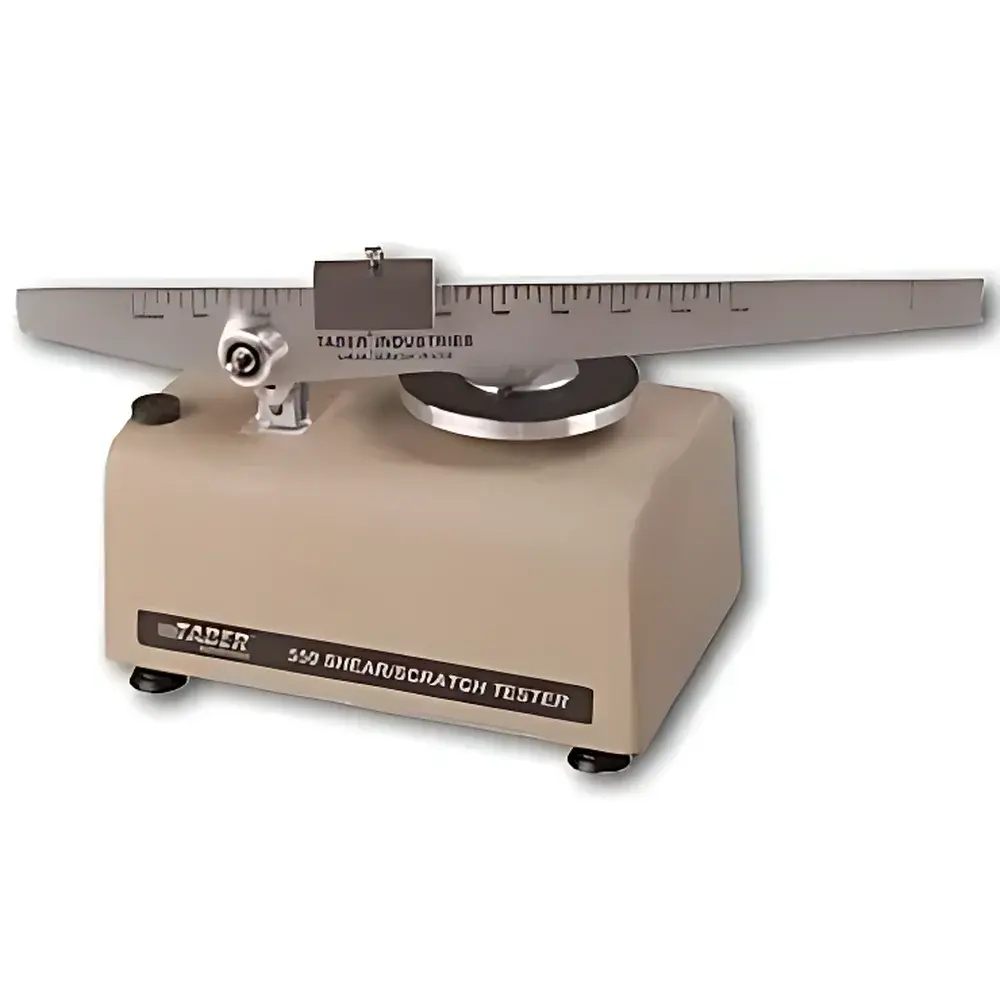
Taber 551 Scratch Tester
| Brand | Taber |
|---|---|
| Origin | USA |
| Model | Taber 551 |
| Sample Thickness Capacity | 0.5" to 4" (12.7 mm to 101.6 mm) |
| Adjustable Normal Load Range | 0–1000 g |
| Standard Compliant | ASTM D7027, ISO 4586-2, EN 438-2, JIS K6902, DIN 53799, AS/NZS 2924.2, CEN/TS 14688, UNI 9428, Federal Specifications L-F-00450A, L-T-00345, L-T-751, SS-T-307, SS-T-312 |
Overview
The Taber 551 Scratch Tester is a precision-engineered mechanical instrument designed to evaluate the resistance of rigid and semi-rigid materials to surface damage induced by controlled tangential forces—specifically scratching, gouging, scuffing, and abrasive cutting. Operating on the principle of standardized linear or rotational scratch testing under calibrated normal load, the instrument applies a defined geometric indenter (e.g., tungsten carbide stylus or diamond cone) across a rotating specimen platform at constant angular velocity. This configuration ensures repeatable kinematic conditions aligned with fundamental tribological test paradigms. The device is widely deployed in quality assurance laboratories for decorative laminates, coated metals, architectural panels, engineered stone, and high-performance plastics where surface integrity directly correlates with functional longevity and aesthetic retention.
Key Features
- Manually adjustable counterbalanced beam arm enabling precise vertical positioning relative to specimen thickness (range: 12.7 mm to 101.6 mm)
- Load adjustment via sliding counterweight mechanism delivering reproducible normal forces from 0 g to 1000 g with ±2 g resolution
- Horizontal beam alignment system ensuring consistent perpendicularity between stylus tip and test surface throughout operation
- Lift-and-lock beam mechanism facilitating rapid specimen loading/unloading without tool recalibration
- Interchangeable stylus holders compatible with standardized tungsten carbide tips (e.g., ASTM D7027 Type A) and conical diamond indenters (e.g., ISO 4586-2 compliant)
- Integrated turntable driven by a synchronous AC motor maintaining stable rotational speed (typically 6 rpm, configurable per method requirements)
- Robust cast-iron base and precision-machined aluminum components ensuring long-term dimensional stability and vibration damping
Sample Compatibility & Compliance
The Taber 551 accommodates flat, rigid specimens up to 4 inches (101.6 mm) in thickness and up to 6 inches (152.4 mm) in diameter—ideal for laminated composites, HPL (high-pressure laminate), anodized aluminum sheets, tempered glass substrates, powder-coated steel panels, and thermoset polymer tiles. It supports both square and circular sample geometries without fixture modification. The instrument conforms to multiple international test standards governing surface durability assessment, including ASTM D7027 (Standard Test Method for Scratch Resistance of Coatings Using a Scratch Hardness Tester), ISO 4586-2 (Laminates — High-pressure decorative laminates — Part 2: Determination of resistance to scratching), EN 438-2 (Decorative high-pressure laminates — Part 2: Determination of resistance to scratching), JIS K6902 (Testing methods for decorative laminates), and DIN 53799 (Determination of scratch resistance of coatings). Its mechanical design and operational protocol are validated for GLP-compliant environments requiring documented traceability and operator-defined test parameters.
Software & Data Management
While the Taber 551 operates as a standalone mechanical tester without embedded digital control, it is fully compatible with external metrology systems for objective result quantification. Users routinely integrate high-resolution optical microscopes (e.g., 10×–100× magnification) and digital image analysis software (such as ImageJ or commercial solutions compliant with FDA 21 CFR Part 11) to measure scratch width, depth, delamination extent, and coating fracture patterns. Test parameters—including applied load, stylus geometry, rotation speed, and dwell time—are recorded manually or via laboratory information management systems (LIMS) to support audit-ready documentation. Optional accessories include calibrated reference standards and certified stylus verification kits traceable to NIST standards.
Applications
- Quality control of high-pressure decorative laminates (HPL) and compact laminates used in furniture and architectural surfacing
- Evaluation of scratch resistance in automotive interior trim, appliance finishes, and electronic device housings
- Comparative assessment of coating adhesion and cohesive strength in powder-coated and liquid-applied industrial coatings
- Validation of surface hardening treatments on anodized aluminum and ceramic-coated substrates
- Development-stage screening of novel polymer blends and composite formulations for wear-prone applications
- Conformance testing for procurement specifications referencing Federal, ISO, EN, or ASTM surface durability clauses
FAQ
What types of indenters are supported by the Taber 551?
The instrument accepts interchangeable stylus holders for tungsten carbide tips (ASTM D7027 Type A, 1.0 mm radius) and conical diamond indenters (ISO 4586-2, 90° apex angle, 0.2 mm tip radius), both mounted on standardized 1/4″-28 threaded shanks.
Is the Taber 551 suitable for testing flexible or thin-film substrates?
No—the device is engineered exclusively for rigid, self-supporting specimens ≥12.7 mm thick; thin films, foils, or elastomeric sheets require alternative methodologies such as nano-scratch or micro-indentation platforms.
How is test repeatability ensured across operators?
Through strict adherence to beam leveling procedures, stylus tip certification prior to each test series, and documented load calibration using NIST-traceable weights—practices mandated in ISO/IEC 17025-accredited laboratories.
Can results be correlated to real-world service performance?
Yes—when conducted within standardized protocols (e.g., ASTM D7027), scratch morphology and failure thresholds show statistically significant correlation with field-reported abrasion resistance in architectural and transportation applications.
Does the Taber 551 meet regulatory requirements for pharmaceutical or medical device packaging validation?
While not intended for sterile barrier evaluation, its compliance with ISO 4586-2 and EN 438-2 makes it applicable for assessing scratch resistance of rigid secondary packaging components (e.g., blister card laminates, diagnostic housing materials) under ICH Q5E and ISO 11607-1 frameworks.







