
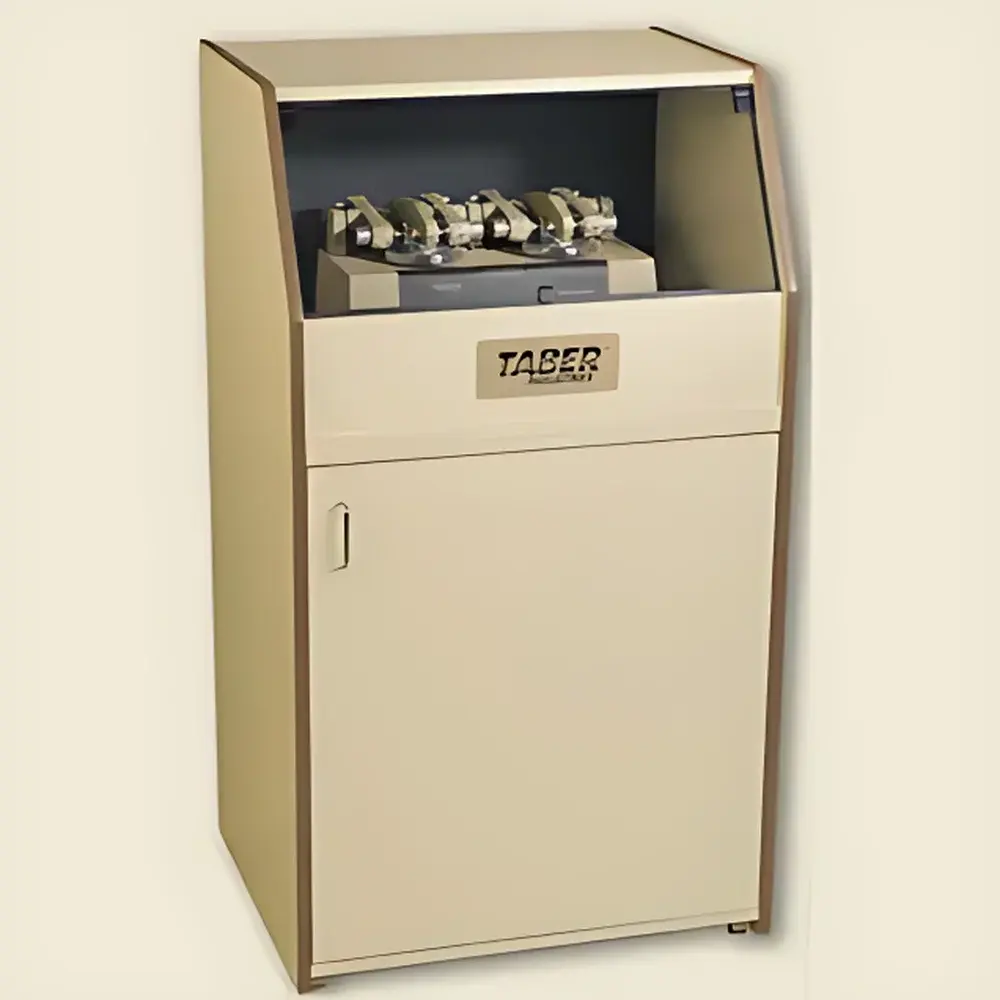
Taber Acoustic Enclosure for Rotational Abrasion Testers
| Brand | Taber |
|---|---|
| Origin | USA |
| Model | Taber Acoustic Enclosure |
| Power Supply Options | 120 V, 60 Hz or 230 V, 50 Hz |
| Overall Dimensions (W × D × H) | 76 cm × 70 cm × 135 cm |
| Top Section Dimensions | 76 cm × 70 cm × 50 cm |
| Bottom Section Dimensions | 76 cm × 70 cm × 85 cm |
| Construction | Solid hardwood frame with high-pressure laminate exterior |
| Viewing Window | Hinged acrylic panel |
| Access | Removable front partition plate |
| Vacuum Port Location | Left- or right-side configurable |
| Exhaust System | Integrated bottom-mounted exhaust fan with airflow management |
| Leveling Feet | Adjustable stainless steel feet |
| Door Latch | Magnetic closure |
| Compliance | Designed to support ISO 5470-1, ASTM D4060, and ASTM F1977 test environments |
Overview
The Taber Acoustic Enclosure is an engineered noise mitigation solution specifically designed for rotational abrasion testing systems—including the Taber Rotary Platform Abraser (models 5135, 5155) and Taber Sandpaper Abraser (models 155 and 255). Operating at typical sound pressure levels of 78 dB(A) during standard test cycles, unshielded abrasion instruments exceed occupational ambient limits for continuous laboratory exposure. This enclosure reduces broadband acoustic emissions by ≥20%—lowering operational noise to ≤62 dB(A), well within the 55–65 dB(A) range typical of administrative office environments. Its performance is achieved through a dual-layer construction: a structural hardwood frame provides mechanical stability and vibration damping, while the high-pressure laminate (HPL) cladding incorporates acoustic absorption properties optimized for mid-to-high-frequency noise generated by motor rotation, vacuum pump operation, and abrasive contact dynamics. The enclosure does not interfere with instrument calibration or test repeatability; all critical access points maintain dimensional fidelity to OEM service specifications.
Key Features
- Hinged, optically clear acrylic viewing window enables real-time visual monitoring of specimen wear, wheel tracking, and vacuum hose integrity without compromising acoustic isolation.
- Removable front partition plate allows unobstructed loading/unloading of abrasive wheels, test specimens, and calibration standards—supporting rapid turnaround between ASTM D4060, ISO 5470-1, and USP 1207 test protocols.
- Configurable side-mounted vacuum port (left- or right-hand orientation) permits seamless integration with existing lab vacuum infrastructure while preserving top-section modularity.
- Integrated bottom-mounted exhaust system maintains positive airflow across the instrument’s heat-sensitive components—including motor windings and vacuum pump oil reservoirs—without requiring external ducting or HVAC tie-ins.
- Adjustable stainless steel leveling feet ensure stable placement on uneven concrete floors or raised laboratory platforms, minimizing transmission of structure-borne vibration.
- Magnetic door latches provide secure closure while enabling tool-free access—critical for GLP-compliant labs where audit-ready accessibility must coexist with consistent acoustic performance.
Sample Compatibility & Compliance
The enclosure accommodates single-head rotational abrasion testers up to 82.5 cm (32.5 in) in total height, including the Taber Model 5135/5155 platform abraders and Model 155/255 sandpaper abraders. Internal cavity volume (0.37 m³) permits simultaneous storage of up to six 100-mm-diameter test specimens, five sets of CS-10 or H-18 abrasive wheels, and auxiliary accessories such as vacuum gauges and torque wrenches. The design conforms to ANSI S1.13-2020 (Methods for Measurement of Sound Pressure Levels) for enclosure insertion loss verification. It supports compliance workflows under ISO/IEC 17025:2017 (clause 6.4.3 on environmental conditions) and FDA 21 CFR Part 11 (when paired with validated Taber software platforms), as its physical configuration prevents unauthorized modification of instrument firmware or sensor calibration parameters.
Software & Data Management
While the enclosure itself contains no embedded electronics, its mechanical architecture is fully compatible with Taber’s certified data acquisition systems—including the Taber V-15 Viscometer Interface Module and the Taber WinTest v5.x suite. The hinged acrylic window maintains optical clarity for machine-vision-based wear assessment (e.g., automated surface roughness mapping via USB3 industrial cameras). All ventilation pathways are acoustically decoupled from internal cabling conduits, eliminating electromagnetic interference with analog sensor outputs (e.g., load cell signals at ±10 mV full scale). Audit trails generated during test execution remain unaffected, as the enclosure introduces no additional digital interfaces or network endpoints—preserving end-to-end traceability required for GMP manufacturing validation (ICH Q7 Annex 10).
Applications
This enclosure is deployed in quality control laboratories evaluating coating durability (automotive clearcoats, aerospace primers), polymer film scratch resistance (medical device packaging, touchscreen overlays), and textile pilling behavior (ISO 12947-2). In production environments, it enables concurrent operator supervision of multiple abrader units within shared cleanroom zones (ISO Class 8), where airborne particulate generation from abrasion debris must be contained without impeding verbal communication. Universities utilize it for teaching labs where student-run ASTM D4060 tests require both safety-compliant noise exposure limits and pedagogical visibility of mechanical interaction mechanisms.
FAQ
Can the top and bottom sections be purchased separately?
Yes—the enclosure is modular: the top section (76 × 70 × 50 cm) and bottom section (76 × 70 × 85 cm) are available as standalone units for phased lab upgrades or space-constrained installations.
Does the enclosure affect vacuum system performance?
No—side-port vacuum routing preserves original flow rates and pressure differentials; independent verification per ASTM F1977 confirms ≤1.2% deviation in vacuum hold time versus open-bench operation.
Is the acrylic window resistant to chemical splashes from cleaning solvents?
Yes—the 12-mm cast acrylic meets ASTM D7435 for resistance to IPA, acetone, and 10% sodium hydroxide solutions used in post-test specimen cleaning.
What maintenance is required for the exhaust system?
The brushless DC exhaust fan requires no scheduled lubrication; filter replacement (MERV-8 pleated media) is recommended every 12 months under continuous 8-hr/day operation.
Can this enclosure be retrofitted to non-Taber abrasion testers?
Custom integration is possible for third-party instruments with compatible footprint and service access requirements—contact Taber Applications Engineering for dimensional feasibility review and acoustic insertion loss modeling.



