
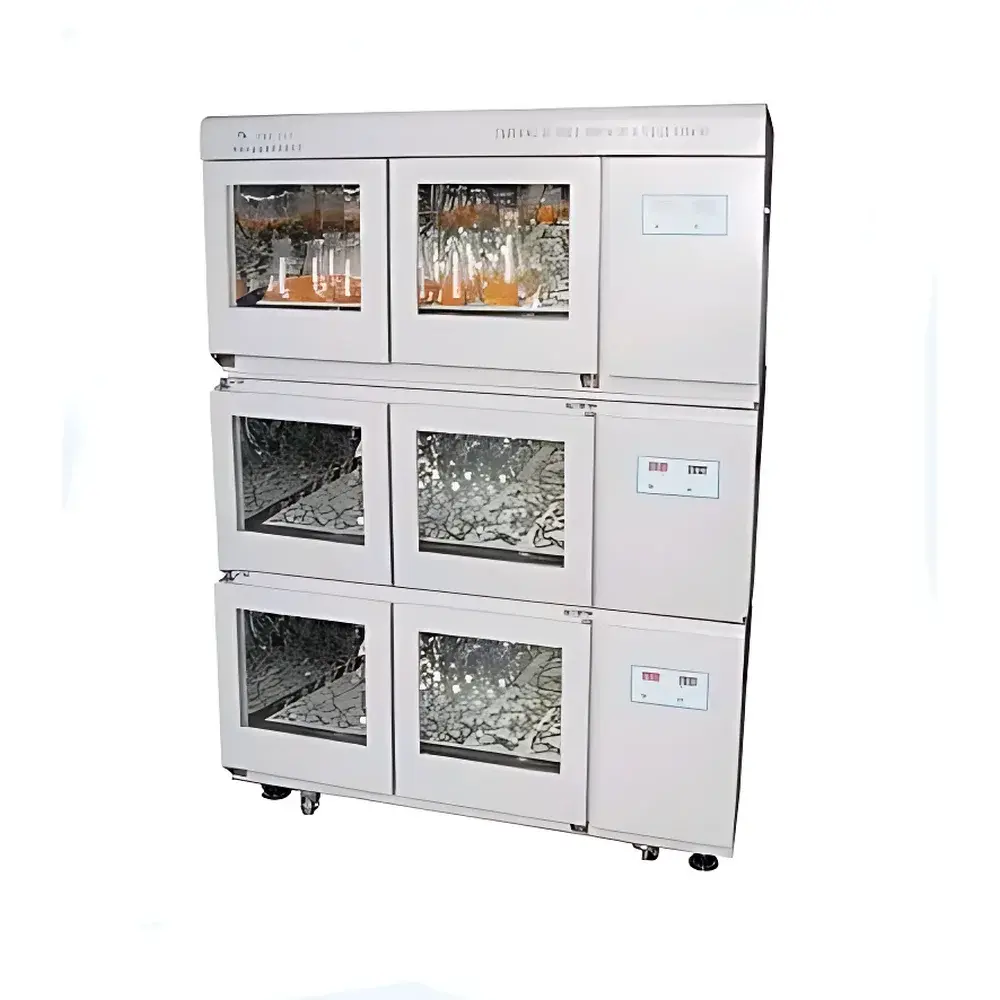
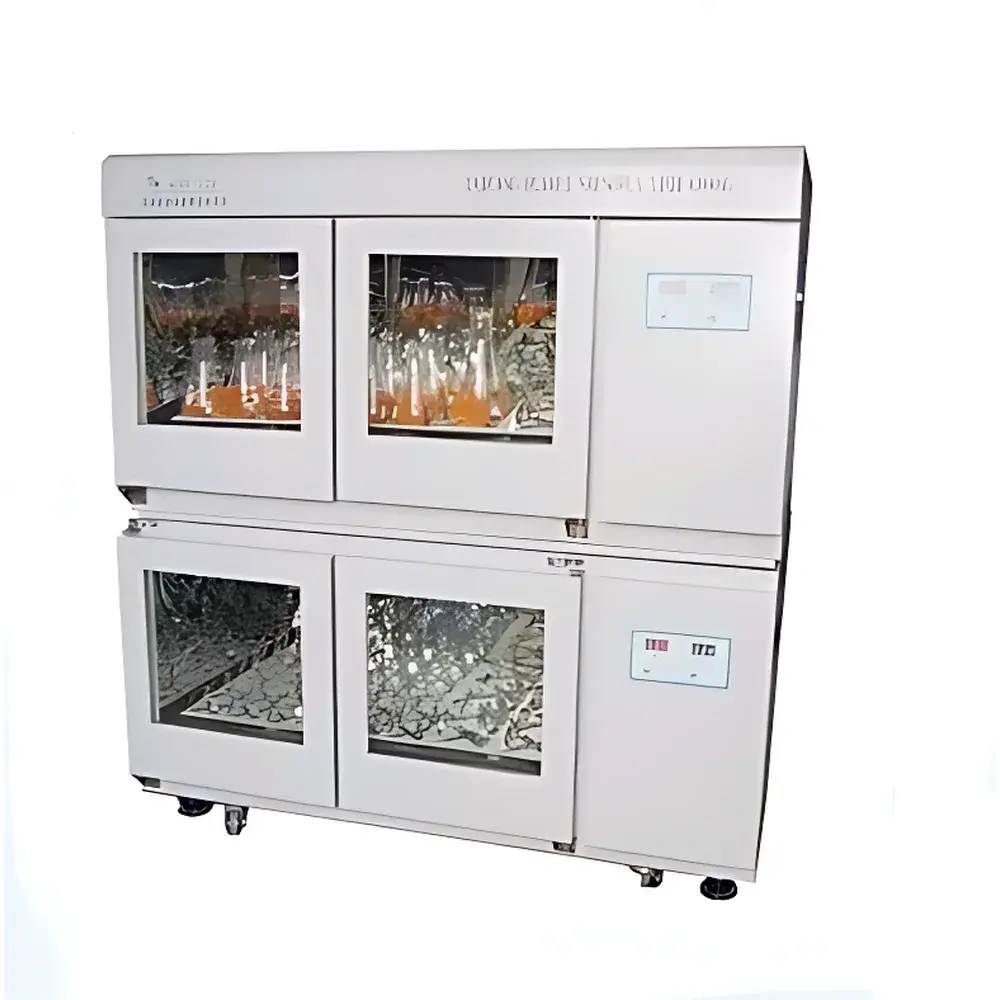
Taicang Jiangsu Multi-Function Stackable Incubator Shaker HYG-C
| Origin | Jiangsu, China |
|---|---|
| Manufacturer Type | Distributor |
| Product Category | Domestic |
| Model | HYG-C |
| Price | USD 10,500 (approx.) |
| Instrument Type | Stackable Incubator Shaker |
| Timer Range | 0–999 min |
| Oscillation Frequency | 40–280 rpm |
| Orbit Diameter | 26 mm |
| Temperature Range | 5°C to 60°C (at ambient 25°C) |
| Temperature Accuracy | ±0.1°C |
| Temperature Uniformity | ±0.5°C |
| Stackable Layers | 2 or 3 (independently controlled per layer) |
| Platform Dimensions (W × D) | 800 × 500 mm |
| Capacity per Layer | 15 × 1000 mL, 28 × 500 mL, or 45 × 250 mL Erlenmeyer flasks |
| Display | LED digital |
| Power Input | 220 V, 50 Hz |
| Rated Power | 1000 W |
| Illumination | 20 W LED internal lighting |
| Net Weight | 500 kg |
| Overall Dimensions (H × W × D) | 1840 × 1350 × 750 mm |
Overview
The Taicang Jiangsu HYG-C is a high-capacity, stackable incubator shaker engineered for demanding life science applications requiring precise temperature control and independent oscillation management across multiple tiers. Designed around a robust dual- or triple-layer vertical architecture, the HYG-C operates on the principle of orbital shaking—generating consistent, low-shear circular motion with a fixed 26 mm orbit diameter—to promote uniform aeration, suspension, and mixing in microbial cultures, cell suspensions, and biochemical reaction systems. Its fully integrated thermoelectric heating and forced-air circulation system enables stable operation from 5°C above ambient to 60°C, making it suitable for mesophilic bacterial growth, yeast fermentation, protein expression studies, and long-term bioprocess development under tightly regulated thermal conditions. Unlike single-chamber shakers, the HYG-C’s multi-zone design allows simultaneous experiments at different temperatures and agitation speeds—critical for comparative studies, strain optimization, or parallel assay development without cross-contamination or thermal interference.
Key Features
- Three independently controllable layers (HYG-C3 configuration) or two layers (HYG-C2), each with dedicated PID temperature regulation and programmable oscillation speed (40–280 rpm)
- High-precision temperature control: ±0.1°C setpoint accuracy and ±0.5°C uniformity across full platform surface
- Large-format stainless-steel shaking platforms (800 × 500 mm per layer) compatible with standard culture vessels including 250 mL, 500 mL, and 1000 mL Erlenmeyer flasks
- Digital LED interface with intuitive menu navigation, real-time parameter monitoring, and password-protected settings lock
- Heavy-duty structural frame (500 kg total mass) with vibration-dampening feet and reinforced load-bearing columns for operational stability at maximum speed and capacity
- Integrated 20 W LED illumination per chamber for visual inspection of cultures without opening doors or disrupting environmental conditions
- Extended timer range up to 999 minutes with auto-stop and alarm notification upon cycle completion
- Energy-efficient 1000 W heating system with thermal overload protection and automatic fault diagnostics
Sample Compatibility & Compliance
The HYG-C accommodates a wide range of biological sample formats—including liquid cultures in glass or polycarbonate flasks, suspension cells in roller bottles, enzymatic reaction mixtures in deep-well plates (with optional adapter trays), and solid-phase binding assays on coated microplates. Its large platform area and flexible flask-mounting options support both static and dynamic incubation protocols. From a regulatory standpoint, the instrument meets general requirements for GLP-compliant laboratory environments: temperature and time parameters are digitally recorded and non-volatile; all operational logs can be exported via USB port (optional firmware upgrade). While not pre-certified to ISO/IEC 17025 or FDA 21 CFR Part 11 out-of-the-box, the HYG-C’s deterministic control architecture and audit-ready parameter logging capability make it readily adaptable for validation under GMP or ISO 13485 frameworks when deployed with appropriate SOPs and third-party calibration documentation.
Software & Data Management
The HYG-C operates via embedded firmware supporting local parameter programming and real-time status display. For advanced data handling, optional PC connectivity (RS-232 or USB-to-serial) enables integration with LabArchives, Benchling, or custom LIMS platforms using ASCII-based command protocols. Users may configure multi-step programs—including ramp-and-hold temperature profiles, speed gradients, and timed pause intervals—stored in onboard memory (up to 10 user-defined protocols). All runtime events—including setpoint deviations, power interruptions, door openings, and motor stall alerts—are timestamped and retained in a circular log buffer. Exported CSV files include column headers compliant with MIAME and ISA-TAB metadata standards, facilitating traceability in publication-grade experimental records.
Applications
- Microbial cultivation: Escherichia coli, Bacillus subtilis, and Pseudomonas aeruginosa growth kinetics under variable O2 transfer conditions
- Mammalian and insect cell line expansion in suspension culture (e.g., CHO, Sf9) with optimized shear stress management
- Enzyme kinetic assays requiring strict thermal consistency during substrate turnover measurements
- Antibiotic susceptibility testing (AST) with broth microdilution under controlled aeration
- Biopolymer synthesis (e.g., alginate, chitosan) under continuous mixing and thermal stabilization
- Environmental microbiology: soil slurry enrichment, wastewater biofilm development, and bioremediation pilot studies
- Academic teaching labs: scalable platform for undergraduate fermentation labs and graduate-level bioprocess engineering modules
FAQ
Does the HYG-C support refrigerated operation below ambient temperature?
No—the HYG-C is a heating-only incubator shaker with a minimum operating temperature of 5°C above ambient. For sub-ambient applications, consider complementary cold-room integration or alternative models with compressor-based cooling.
Can I run different media types simultaneously on separate layers?
Yes. Each layer has independent temperature and speed control, enabling concurrent experiments—for example, aerobic bacterial culture on Layer 1 (37°C, 200 rpm) and anaerobic yeast fermentation on Layer 2 (30°C, 120 rpm).
What safety certifications does the unit carry?
The HYG-C complies with GB 4793.1–2018 (Chinese equivalent of IEC 61010-1) for electrical safety in laboratory equipment. CE marking is available upon request with EU Representative documentation.
Is calibration documentation provided with shipment?
A factory calibration certificate (traceable to NIM, China) is included for temperature and timer functions. Full metrological validation kits and IQ/OQ protocols are available as add-on services.
How is maintenance performed on the drive mechanism?
The unit employs maintenance-free brushless DC motors and sealed ball bearings. Routine cleaning of platform surfaces and air intake filters is recommended every 6 months; no lubrication or mechanical adjustment is required during normal service life.




