
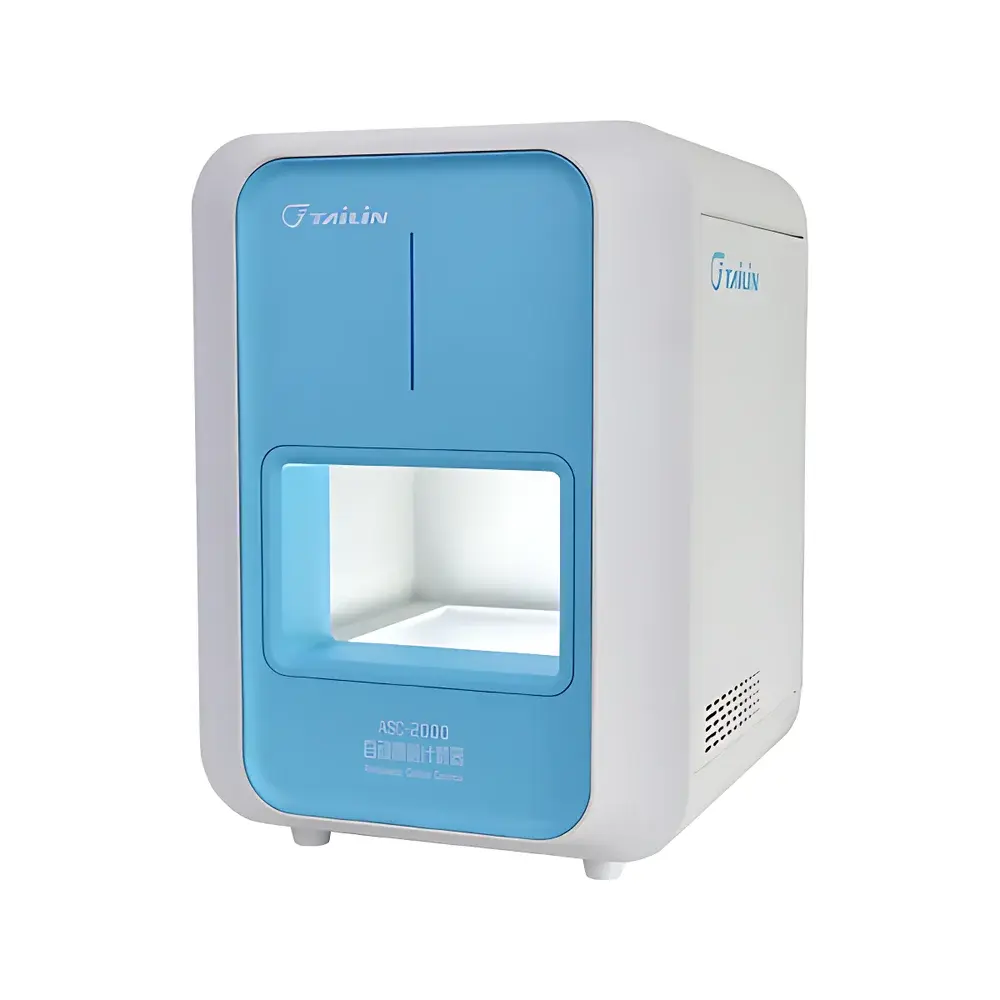
Tailin ASC-2000 Automated Colony Counter
| Brand | Tailin |
|---|---|
| Origin | Zhejiang, China |
| Manufacturer Type | Manufacturer |
| Product Type | Fully Automated Colony Counter |
| Model | ASC-2000 |
| Camera Sensor | Sony 20 MP CMOS |
| Counting Speed | ≥1000 CFU/sec |
| Plate Compatibility | Standard Petri dishes (Ø50–150 mm), including stacked or nested plates |
| Detection Algorithm | Adaptive watershed segmentation with edge-aware region partitioning for confluent colonies |
| Sterilization | Integrated UV-C lamp (254 nm, ≥15 mW/cm² irradiance) |
| Data Compliance | Audit trail, electronic signatures, and role-based three-tier user permissions (Administrator/Operator/Reviewer) |
| Connectivity | LIMS integration via ASTM E1384-compliant HL7 or RESTful API |
| Input Method | QR/barcode scanning (GS1-128, Code 128, DataMatrix) |
| Sample Handling | Non-contact imaging |
Overview
The Tailin ASC-2000 Automated Colony Counter is an ISO 17025-aligned digital imaging system engineered for high-throughput, objective, and traceable microbial enumeration in regulated laboratory environments. It operates on the principle of high-resolution monochrome optical imaging combined with adaptive pixel-intensity thresholding and topological segmentation algorithms to distinguish individual colony-forming units (CFUs) from background agar, condensation artifacts, and confluent growth zones. Unlike manual counting or semi-automated systems relying on fixed thresholds, the ASC-2000 dynamically calibrates illumination uniformity and contrast response per image—enabling robust performance across diverse media types (e.g., TSA, PCA, VRBA, Sabouraud Dextrose Agar) and incubation conditions (aerobic/anaerobic, 24–72 h). Its core architecture supports quantitative microbiology workflows compliant with pharmacopoeial standards including USP , EP 2.6.12, and ISO 4833-1:2013.
Key Features
- “Zero-Click” Imaging Workflow: Automatic detection of Petri dish boundaries and optimal focus plane without user-defined ROI selection or manual calibration steps.
- Real-Time High-Speed Enumeration: Processes standard 90 mm plates in ≤1.2 seconds with sustained throughput of ≥1000 CFU/sec under continuous operation.
- Confluence-Resolving Algorithm: Implements gradient-weighted watershed segmentation with morphological reconstruction to separate touching or overlapping colonies while preserving original colony morphology metrics (area, circularity, eccentricity).
- Multi-Protocol Plate Support: Validated for spread-plating, membrane filtration, pour-plating, settle-plate (air monitoring), and active air sampling (impaction) methods per ISO 14698-1 and EU GMP Annex 1.
- Integrated UV-C Decontamination: 254 nm germicidal lamp with programmable exposure cycles (1–10 min), validated to achieve ≥3-log reduction of Bacillus atrophaeus spores on chamber surfaces.
- Regulatory-Grade Software Architecture: Complies with FDA 21 CFR Part 11 requirements through immutable audit trail logging, biometric or PKI-based electronic signatures, and configurable three-level access control (Administrator, Operator, Reviewer).
Sample Compatibility & Compliance
The ASC-2000 accommodates Petri dishes ranging from Ø50 mm (mini-plates) to Ø150 mm (large-format), including polystyrene, polypropylene, and glass-bottom variants. It accepts plates with opaque or translucent lids, agar thicknesses up to 12 mm, and surface moisture levels typical of post-incubation handling. All image acquisition and analysis protocols are documented per GLP and GMP principles. System validation packages include IQ/OQ documentation templates aligned with ASTM E2921-22 (Standard Guide for Validation of Microbial Enumeration Methods) and support for periodic requalification per ISO/IEC 17025:2017 Clause 7.7.
Software & Data Management
The embedded firmware runs on a Linux-based real-time OS with deterministic image processing latency. Counting results export in CSV, PDF (with embedded metadata), and XML formats compliant with ASTM E1384-21 (Standard Guide for Laboratory Information Management Systems). Native LIMS integration supports bidirectional data exchange—including sample ID, operator ID, instrument ID, timestamp, plate dimensions, medium type, and raw image hashes—for full chain-of-custody tracking. All image files are stored with SHA-256 checksums and timestamped EXIF metadata, ensuring data integrity during archival or regulatory inspection.
Applications
The ASC-2000 serves as a primary enumeration tool in quality control laboratories performing environmental monitoring (EM) in sterile manufacturing facilities, sterility testing of pharmaceutical intermediates, bioburden assessment of medical devices per ISO 11737-1, water microbiology (coliforms, Pseudomonas aeruginosa), food safety testing (total viable count, pathogens), and R&D studies requiring reproducible colony morphology classification. Its non-destructive imaging modality also enables longitudinal tracking of colony growth kinetics when used with time-lapse incubator-compatible plate holders (optional accessory).
FAQ
Does the ASC-2000 require daily calibration?
No. The system performs automatic white-balance and illumination homogeneity correction before each imaging cycle using built-in reference targets.
Can it differentiate between mold and bacterial colonies?
It classifies colonies by size, texture, and grayscale intensity gradients; species-level identification requires integration with MALDI-TOF or sequencing platforms.
Is the UV sterilization cycle validated against specific microorganisms?
Yes—validation reports for Geobacillus stearothermophilus and Aspergillus niger spores are available upon request.
What is the maximum number of plates processed per hour?
Up to 3,200 standard 90 mm plates per 8-hour shift, assuming continuous loading via optional conveyor interface (ASC-2000-LT variant).
Does the software support multi-language UI and report generation?
English and Chinese language interfaces are pre-installed; additional languages (German, Japanese, Spanish) can be enabled via firmware update.
Related Products




