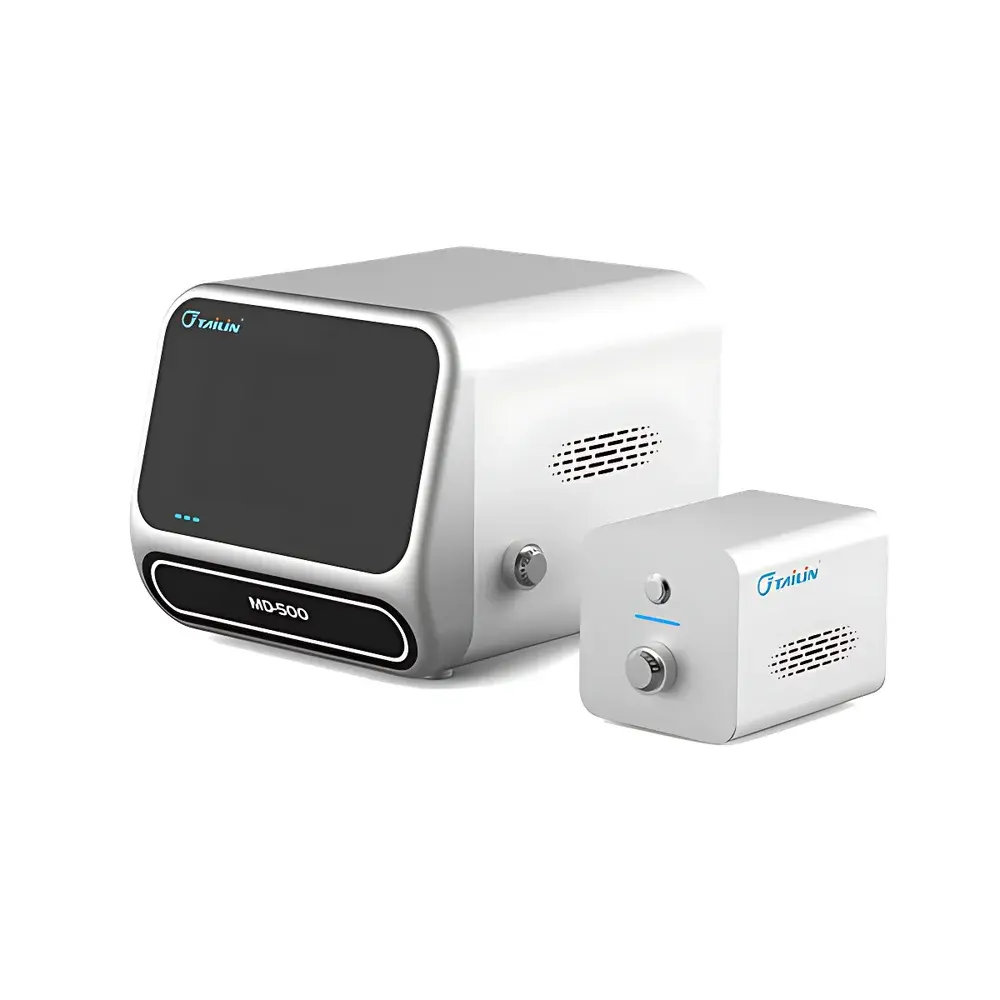
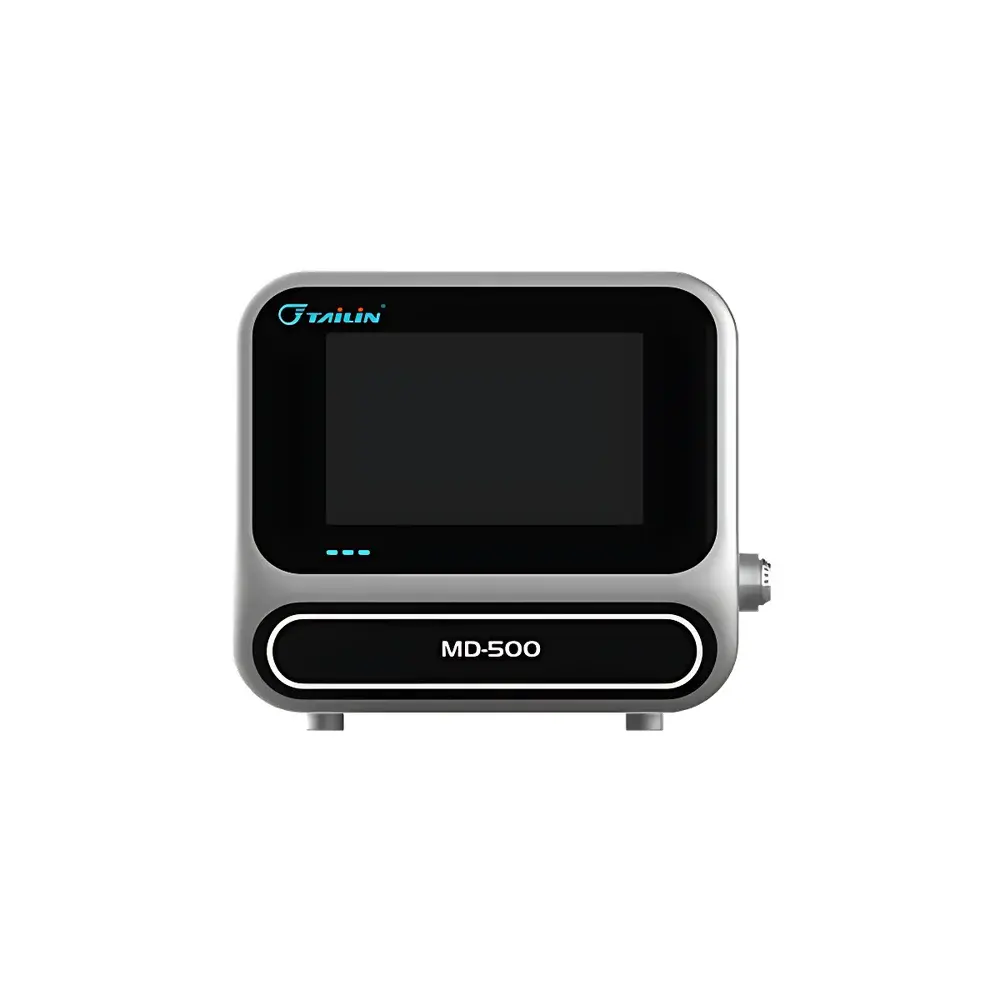
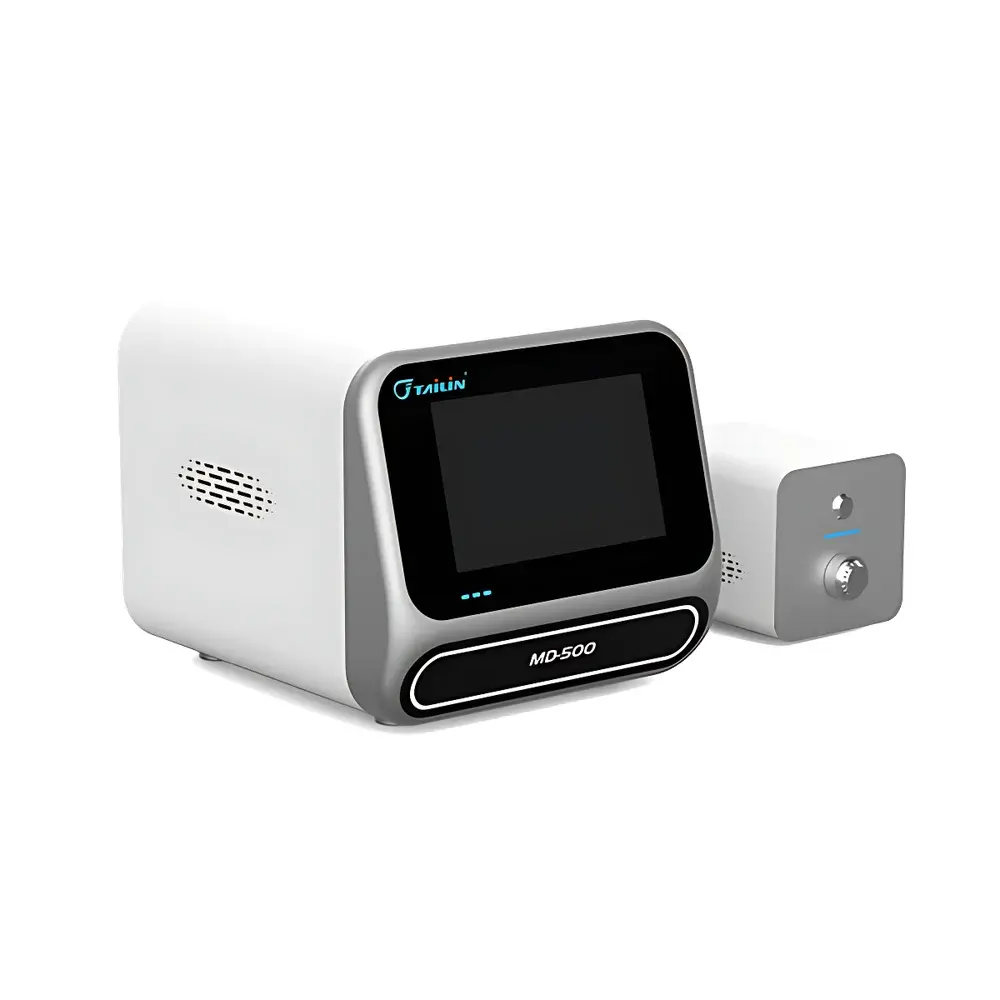
Tailin Biotech MD500/MD500e Offline Microbial Rapid Detection Analyzer
| Brand | Tailin Biotech |
|---|---|
| Origin | Zhejiang, China |
| Manufacturer Type | Direct Manufacturer |
| Product Category | Domestic |
| Model | MD500 / MD500e Offline |
| Instrument Type | Fully Automated |
| Detection Scope | Relatively Pure Aqueous Samples in All Microbial Control Scenarios |
| Measurement Range | 0–10,000 AFU/mL |
| Detection Limit | 1 AFU (Auto-Fluorescence Unit) |
| Analysis Mode | Continuous Operation |
| Flow Rate | 3–15 mL/min |
| Channel Capacity | 1–10 Built-in Channels (Expandable to 100) |
| Inlet/Outlet Connection | 1/8″ OD (3.2 mm) |
| Dimensions | 38 cm × 44 cm × 31 cm |
| Minimum Detectable Particle Size | 0.5 µm |
| Response Time | 2 seconds |
| Sample Temperature Range | 5–99 °C |
| Operating Environment | 0–50 °C / ≤80% RH |
| Power Supply | 100–240 VAC, 50/60 Hz |
| Weight | 15 kg |
Overview
The Tailin Biotech MD500/MD500e Offline Microbial Rapid Detection Analyzer is a fully automated, flow-based microbial enumeration system engineered for real-time, culture-independent assessment of viable microorganisms in relatively pure aqueous matrices. Unlike conventional plate-count or ATP-bioluminescence methods, the MD500/MD500e employs auto-fluorescence detection (AFU) — a label-free optical technique that identifies metabolically active cells based on intrinsic fluorophores (e.g., NAD(P)H, riboflavins, and aromatic amino acids) excited by UV-blue light. This principle enables direct quantification of both culturable and viable-but-non-culturable (VBNC) microorganisms without enrichment, incubation, or reagent addition. Designed specifically for offline (non-integrated, batch-mode) operation, the analyzer supports discrete sample analysis in quality control laboratories, pharmaceutical water monitoring stations, and bioprocess support environments where regulatory-grade traceability and operational flexibility are required.
Key Features
- Label-free, reagent-free detection: Eliminates consumables such as culture media, dyes, or enzymatic substrates — reducing total cost of ownership and eliminating lot-to-lot variability.
- VBNC-capable enumeration: Quantifies microorganisms in the viable-but-non-culturable state, addressing a critical gap in traditional microbiological methods per ISO 11731, USP , and EU GMP Annex 1 requirements for water system validation.
- Sub-second response time: Delivers a complete AFU/mL result within 2 seconds per measurement cycle, enabling high-throughput screening of multiple samples across expanded channel configurations (up to 100 channels with external manifold integration).
- Wide dynamic range: Accurately resolves microbial concentrations from 1 AFU/mL (detection limit) to 10,000 AFU/mL — suitable for purified water (PW), water for injection (WFI), clean steam condensate, and other low-bioburden aqueous streams.
- Robust fluidic architecture: Precision-engineered flow path with 0.5 µm minimum detectable particle size and stable 3–15 mL/min volumetric control ensures reproducible hydrodynamic focusing and optical interrogation.
- Flexible signal output: Provides analog (4–20 mA, 0–5 V) and digital (RS-485, Modbus RTU) interfaces for seamless integration with SCADA, MES, or LIMS platforms — supporting 21 CFR Part 11-compliant data capture when paired with validated software.
Sample Compatibility & Compliance
The MD500/MD500e is validated for use with low-turbidity, low-particulate aqueous samples meeting pharmacopeial specifications for Purified Water (USP , Ph. Eur. 2.2.47) and Water for Injection (USP , JP 2.05). It is not intended for turbid, viscous, or particulate-rich matrices (e.g., fermentation broth, cell lysates, or wastewater) without pre-filtration or dilution. The system complies with IEC 61000-6-3 (EMC) and IEC 61010-1 (safety). Its VBNC detection capability aligns with emerging guidance from the Parenteral Drug Association (PDA) Technical Report No. 82 on alternative microbiological methods and supports GLP/GMP audit readiness through configurable audit trails, user access controls, and electronic signature support in companion software.
Software & Data Management
The MD500/MD500e operates with Tailin’s proprietary TailinView™ offline analysis suite — a Windows-based application offering method configuration, calibration management, trend visualization, and PDF report generation. Data files are stored in encrypted SQLite format with timestamped metadata (operator ID, sample ID, instrument serial number, environmental logs). When deployed in regulated environments, the software can be configured to meet 21 CFR Part 11 requirements, including role-based permissions, electronic signatures, and immutable audit trails. Raw AFU signals and processed counts are exportable in CSV and XML formats for third-party statistical process control (SPC) or enterprise analytics platforms.
Applications
- Pharmaceutical water system monitoring: Routine verification of PW/WFI distribution loops during commissioning, qualification, and routine surveillance.
- Biotechnology process water testing: Final rinse water, buffer preparation water, and clean-in-place (CIP) final rinse verification.
- Medical device manufacturing: Monitoring of ultrapure water used in component cleaning and sterilization processes.
- Academic and contract research labs: Rapid comparative studies of disinfection efficacy, filtration integrity, and biofilm shedding kinetics.
- Regulatory submission support: Generation of supplementary microbial load data to complement traditional membrane filtration results in validation protocols.
FAQ
Does the MD500/MD500e require calibration with certified reference microorganisms?
No — the system is factory-calibrated using NIST-traceable fluorescent microsphere standards; routine verification uses standardized AFU check solutions (provided annually with maintenance kits).
Can it differentiate between bacterial species or only provide total viable count?
It provides total AFU-based viable count only; species identification requires orthogonal techniques such as MALDI-TOF MS or sequencing.
Is the 2-second response time achievable across all 100 expanded channels?
The 2-second per-sample response applies to single-channel operation; multi-channel sequential analysis maintains sub-5-second cycle time per channel with synchronized flow control.
What validation documentation is supplied with the instrument?
Each unit ships with Factory Acceptance Test (FAT) report, IQ/OQ protocol templates, and a Performance Qualification (PQ) guide aligned with ASTM E2921 and ISO 17025 principles.
How is temperature control managed for samples between 5 °C and 99 °C?
The analyzer does not include active heating or cooling; users must precondition samples externally and maintain thermal stability upstream of the inlet port via insulated tubing or inline Peltier modules.