
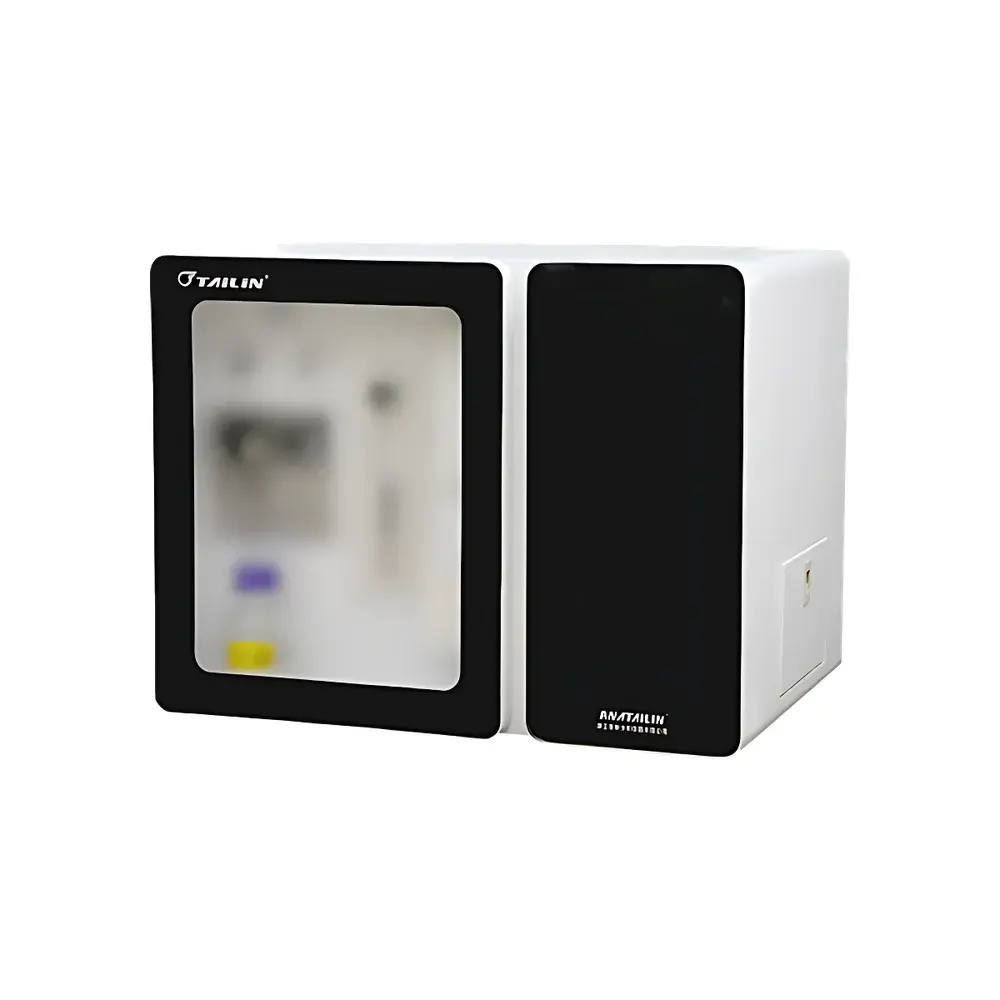
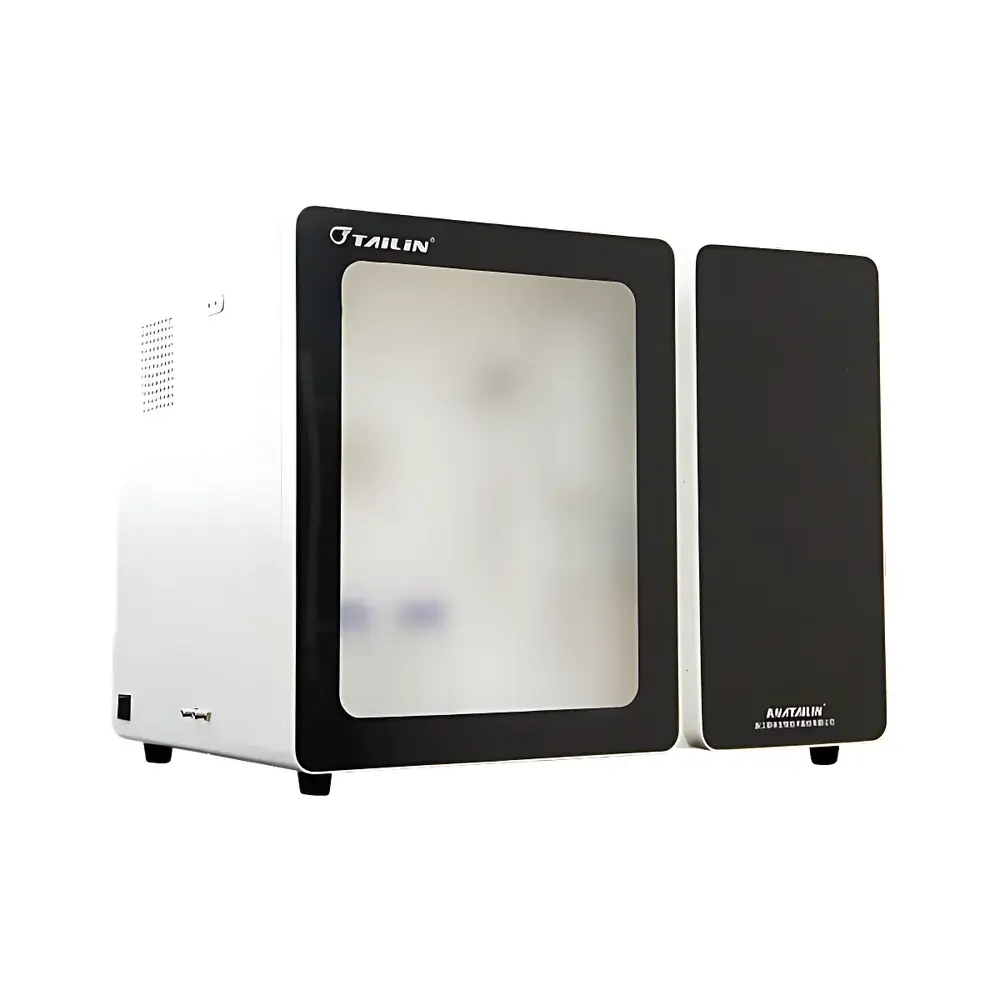
Tailin HTY-CT1000B High-Temperature Catalytic Oxidation Total Organic Carbon Analyzer
| Brand | Tailin |
|---|---|
| Origin | Zhejiang, China |
| Manufacturer Type | Manufacturer |
| Instrument Type | Laboratory TOC Analyzer |
| Detection Principle | Non-Dispersive Infrared (NDIR) Absorption |
| Oxidation Method | High-Temperature Catalytic Combustion |
| Sample Volume Range | 0.1–1.0 mL (recommended: 0.3 mL) |
| Measurable TOC Range | 0–1000 mg/L |
| Repeatability | ≤3% (at 50% of full scale, per JJG 821–2005) |
| Accuracy | TC ±5%, IC ±4% (at 20%, 50%, and 80% of full scale, per JJG 821–2005) |
| LOD | ≤0.1 mg/L (per HJ 501–2009) |
| LOQ | ≤0.5 mg/L (per HJ 501–2009) |
| Maximum Salt Tolerance | ≤90 g/L |
| Dimensions | 650 × 450 × 495 mm |
Overview
The Tailin HTY-CT1000B is a laboratory-grade Total Organic Carbon (TOC) analyzer engineered for precision quantification of organic carbon content in aqueous samples via high-temperature catalytic oxidation coupled with non-dispersive infrared (NDIR) detection. It operates on the principle that organic compounds are completely oxidized to CO₂ at temperatures up to 680 °C in the presence of a platinum-based catalyst, followed by selective, interference-free measurement of generated CO₂ using an NDIR sensor. This method ensures high specificity, minimal matrix interference, and compliance with internationally recognized performance benchmarks including ISO 8245, USP , and EPA Method 415.3. The system is optimized for routine analysis in environmental monitoring laboratories, pharmaceutical water quality control (PW/UPW), municipal wastewater treatment plants, and industrial effluent compliance testing—where regulatory traceability, reproducibility, and robust salt tolerance are critical.
Key Features
- High-temperature catalytic combustion module operating at 680 °C, enabling complete oxidation of refractory organics—including humic substances, surfactants, and nitrogen-containing compounds—without requiring acid pretreatment or persulfate addition.
- Integrated NDIR CO₂ detector with temperature-stabilized optical path and dual-beam compensation, delivering stable baseline response and minimizing drift over extended operation cycles.
- Automated multi-curve calibration architecture: eight pre-validated linear calibration curves stored internally; instrument automatically selects optimal curve based on real-time sample signal amplitude, ensuring accuracy across the full 0–1000 mg/L range without manual range switching.
- Modular hardware interface supporting seamless integration with third-party accessories—including autosamplers (up to 120-position), solid-sample combustion modules for filter-retained particulates, and centrifuge-coupled pre-treatment stations—enabling method flexibility for complex matrices.
- Embedded control firmware with Ethernet and RS-232 connectivity, enabling remote status monitoring, parameter logging, and event-triggered alerts via standard TCP/IP protocols.
Sample Compatibility & Compliance
The HTY-CT1000B accommodates a broad spectrum of liquid matrices, including ultrapure water (UPW), pharmaceutical process water, surface water, groundwater, treated wastewater, and high-salinity brines (up to 90 g/L total dissolved solids). Its oxidation efficiency remains unaffected by chloride, sulfate, or carbonate interferences due to integrated in-line acidification and sparging prior to combustion. The analyzer meets metrological requirements specified in Chinese national verification regulation JJG 821–2005 and environmental monitoring standard HJ 501–2009. For regulated environments, raw data files include embedded timestamps, operator ID fields, and audit-ready metadata—supporting GLP/GMP-aligned workflows and facilitating FDA 21 CFR Part 11-compliant electronic record retention when deployed with validated LIMS integration.
Software & Data Management
The proprietary Tailin TOC Control Suite provides a Windows-based graphical interface for instrument configuration, method development, real-time chromatogram visualization, and report generation. All analytical parameters—including injection volume, oxidation temperature ramp profiles, purge duration, and calibration history—are programmable and stored with version-controlled method templates. Data export supports CSV, PDF, and XML formats compatible with ELN systems. Audit trail functionality logs every user action (e.g., calibration initiation, method modification, result approval) with immutable timestamps and operator credentials. Software validation documentation (IQ/OQ/PQ protocols) is available upon request for regulated laboratory deployment.
Applications
- Pharmaceutical water systems: Routine TOC verification of purified water (PW), water for injection (WFI), and UPW per USP and EU Ph. Eur. 2.2.44.
- Environmental compliance: Monitoring of discharge permits under EPA NPDES, China’s GB 3838–2002, and EU WFD reporting requirements.
- Research & development: Kinetic studies of organic pollutant degradation, biofilm formation assays, and carbon mass balance validation in bioreactor systems.
- Industrial process control: In-line QC of cooling tower water, boiler feedwater, and semiconductor rinse water where low-level organic contamination impacts equipment integrity.
FAQ
What oxidation temperature does the HTY-CT1000B use, and is it adjustable?
The system employs a fixed high-temperature catalytic oxidation zone at 680 °C, optimized for >99% oxidation efficiency across diverse organic structures. Temperature is not user-adjustable but is continuously monitored and stabilized via PID feedback control.
Can the instrument measure both TC and IC separately?
Yes—the analyzer performs sequential analysis: IC is measured first via acidification and sparging, followed by TC after high-temperature oxidation. Inorganic carbon subtraction yields accurate TOC values.
Is the software compliant with FDA 21 CFR Part 11 requirements?
Out-of-the-box, the software supports electronic signatures, audit trails, and role-based access control. Full Part 11 compliance requires site-specific validation performed by the end user or authorized service partner.
What maintenance intervals are recommended for the catalyst and NDIR cell?
The platinum catalyst cartridge is rated for ≥10,000 injections under normal use; NDIR optical components require annual inspection and cleaning per the maintenance manual. Preventive maintenance kits and certified replacement parts are available directly from Tailin.
Does the system support external LIMS integration?
Yes—via ASTM E1384-compliant ASCII file export, HL7 messaging, or direct database write-through using ODBC drivers. Integration protocols are documented in the Application Programmer’s Guide.







