
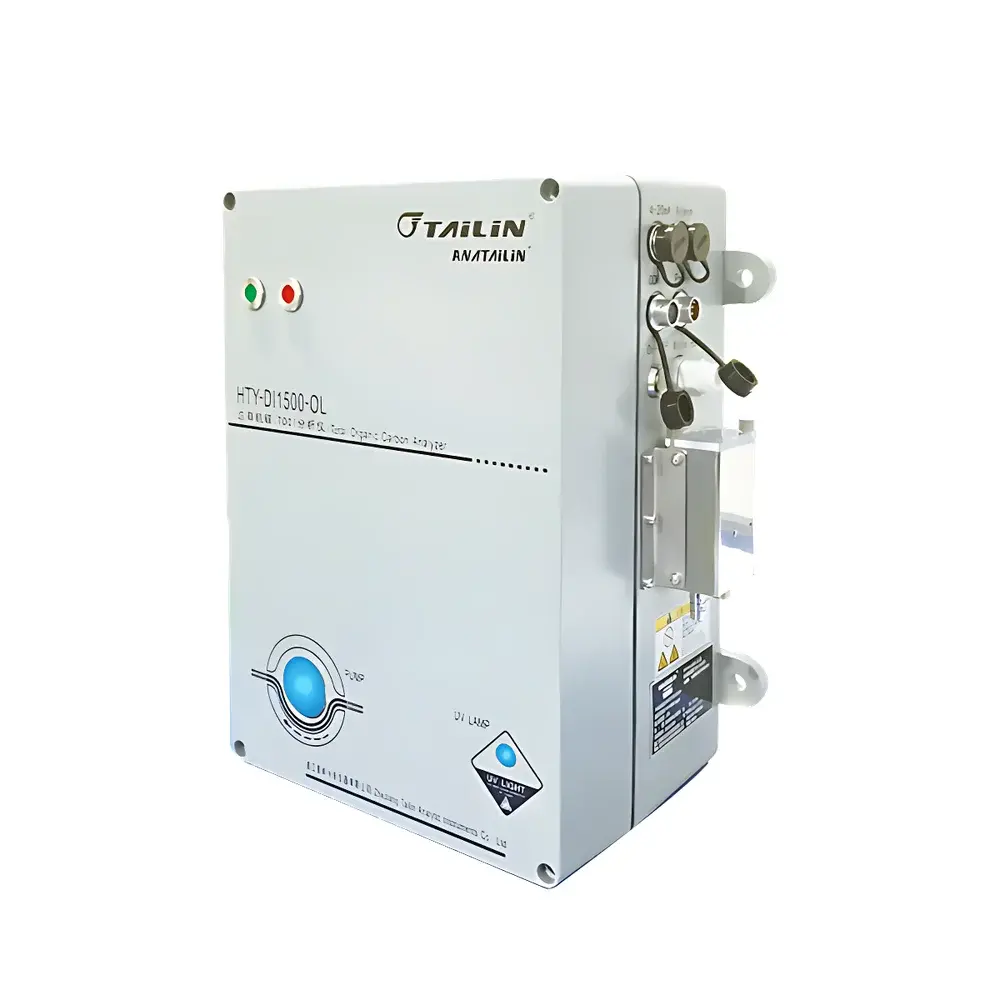
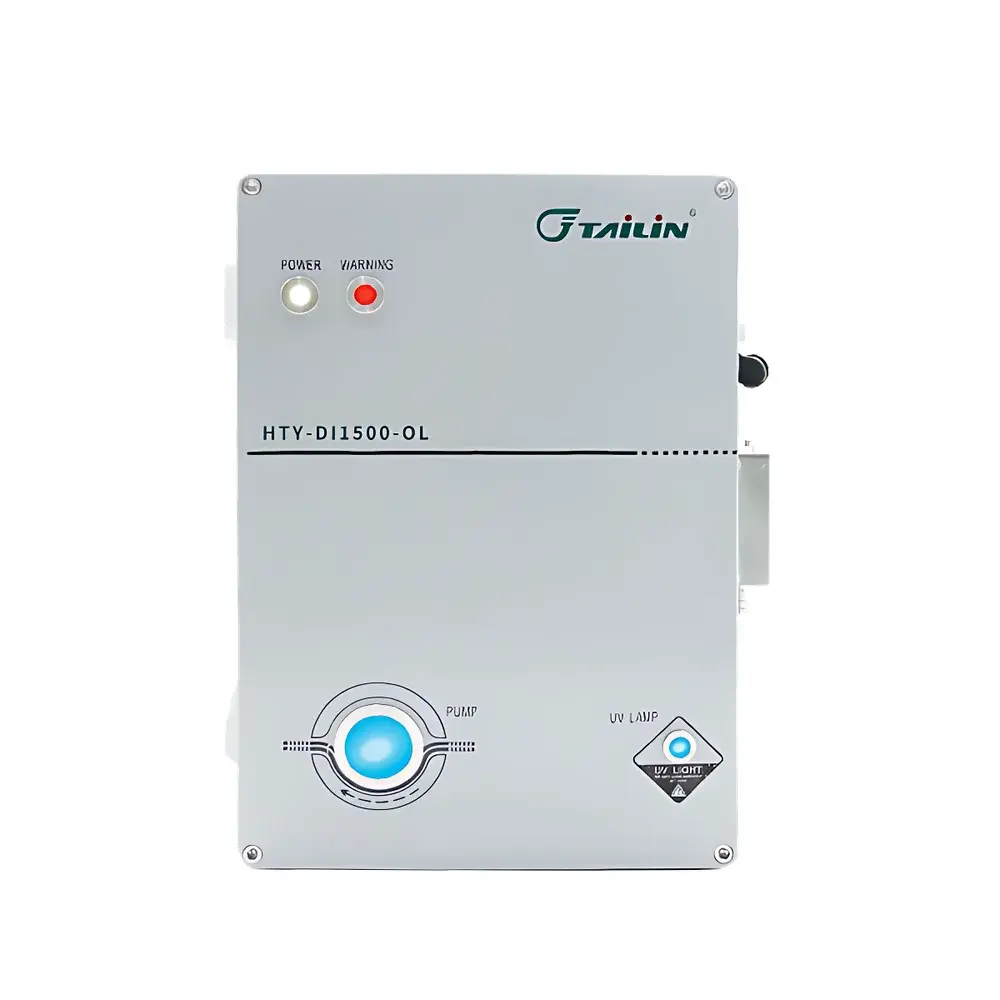
Tailin HTY-DI1500-OL Online Total Organic Carbon (TOC) Analyzer Using Direct Conductivity Detection
| Brand | Tailin |
|---|---|
| Origin | Zhejiang, China |
| Manufacturer Type | Original Equipment Manufacturer (OEM) |
| Product Category | Domestic |
| Model | HTY-DI1500-OL |
| Instrument Type | Online TOC Analyzer |
| Detection Principle | Direct Conductivity Method |
| Oxidation Method | UV Photolysis (185/254 nm) |
| Measurement Range | 0.000–1500.0 µg/L |
| Repeatability | ≤2% (per JB/T 20178–2017) |
| Accuracy | ±5% (per JJG (Zhejiang) 98–2007) |
| Recommended Sample Conductivity | 0–5.1 µS/cm @ 25 °C |
| Analysis Cycle Time | 4 minutes |
| Sample Flow Rate | 0.5 mL/min |
| Dimensions | 240 × 340 × 160 mm |
| Enclosure Rating | IP65 |
| Interface | RS485/Ethernet for multi-unit centralized control |
| Data Integrity Features | Electronic Signatures, Audit Trail, User Access Levels |
Overview
The Tailin HTY-DI1500-OL is an online Total Organic Carbon (TOC) analyzer engineered for continuous, real-time monitoring of ultrapure water (UPW), purified water (PW), and clean process water in pharmaceutical, biotechnology, and semiconductor manufacturing facilities. It employs the direct conductivity detection method—where organic carbon compounds are oxidized to CO₂ via low-pressure UV lamps (185/254 nm), followed by dissolution into the aqueous matrix and subsequent measurement of the resulting increase in solution conductivity. This principle eliminates the need for carrier gas, catalysts, or post-oxidation reagents, reducing operational complexity and long-term maintenance burden while maintaining compliance with pharmacopeial requirements including USP , EP 2.2.44, and JP 2.59. Designed for integration into critical water distribution systems (e.g., WFI loops, PW storage tanks, and point-of-use locations), the HTY-DI1500-OL delivers stable, trace-level quantification from 0.000 to 1500.0 µg/L with a typical analysis cycle of four minutes.
Key Features
- IP65-rated enclosure for reliable operation in humid, dusty, or washdown-prone environments—suitable for installation in Grade C/D cleanrooms or utility corridors without additional housing.
- Modular, non-invasive design enables visual inspection and routine maintenance (e.g., UV lamp replacement, tubing verification) without disassembly—minimizing system downtime and eliminating risk of cross-contamination during service.
- Centralized control architecture: single Ethernet or RS485 interface supports configuration, calibration, and data retrieval from up to 16 analyzers via standard OPC UA or Modbus TCP protocols.
- Regulatory-compliant software stack featuring role-based user authentication, electronic signatures per 21 CFR Part 11, and immutable audit trail logging—including timestamped records of method changes, calibration events, alarm triggers, and manual interventions.
- Dual-wavelength UV oxidation module ensures consistent conversion efficiency across diverse organic species (e.g., methanol, sucrose, benzene derivatives) while minimizing interference from residual chlorine or nitrate.
Sample Compatibility & Compliance
The HTY-DI1500-OL is validated for use with water matrices meeting ISO 8573-1 Class 1 compressed air purity specifications (for optional purge gas interfaces) and complies with electrical safety standards IEC 61010-1 and EMC directive 2014/30/EU. Its conductivity-based detection mechanism requires feedwater conductivity below 5.1 µS/cm at 25 °C; samples exceeding this threshold must be pre-diluted or conditioned using inline deionization. The analyzer meets the performance criteria outlined in JB/T 20178–2017 (Chinese pharmaceutical equipment standard) and JJG (Zhejiang) 98–2007 (regional metrological verification regulation). It supports GLP/GMP-aligned workflows through configurable calibration intervals (daily, weekly, or event-triggered), automatic blank subtraction, and integrated spike recovery validation sequences.
Software & Data Management
Embedded firmware runs on a Linux-based real-time OS with dual-channel data buffering (volatile RAM + non-volatile flash) to prevent loss during power interruption. Local HMI includes a 5.7-inch resistive touchscreen with multilingual UI (English, Chinese, Japanese). Remote access is enabled via HTTPS-secured web server supporting CSV export, PDF report generation (with header metadata, trend plots, and pass/fail annotations), and SNMP v3 trap notifications. All raw sensor outputs (conductivity delta, UV intensity, temperature, flow status) are time-stamped with microsecond resolution and stored with SHA-256 hash integrity verification. Data archives are exportable in ASTM E2500-compliant format for third-party LIMS or MES integration.
Applications
- Continuous TOC surveillance in pharmaceutical water-for-injection (WFI) and purified water (PW) distribution loops per EU GMP Annex 1 and FDA guidance on process validation.
- Monitoring of pretreatment effluent and final rinse water in medical device cleaning validation studies.
- Supporting ASTM D8079-17 (Standard Guide for TOC Monitoring in Semiconductor Ultrapure Water Systems) through rapid-cycle trending and excursion alerting.
- Integration into PAT (Process Analytical Technology) frameworks for real-time release testing (RTRT) of water quality attributes.
- Environmental compliance reporting for regulated wastewater discharge points where TOC serves as a surrogate for non-specific organic load.
FAQ
What sample conductivity range is acceptable for accurate TOC measurement?
The instrument requires feedwater conductivity ≤5.1 µS/cm at 25 °C. Higher conductivity may suppress CO₂ dissolution kinetics and reduce sensitivity; inline mixed-bed polishing is recommended if native water exceeds this limit.
Is the UV lamp replaceable without recalibration?
Yes—the lamp module is field-swappable and retains factory calibration coefficients in EEPROM. Post-replacement verification is performed automatically during the next system self-test sequence.
Does the analyzer support 21 CFR Part 11-compliant electronic records?
Yes—audit trail, electronic signatures, and role-based access control are fully implemented and validated per Part 11 Annex A guidance. Full traceability is maintained for all data modifications.
Can multiple HTY-DI1500-OL units be synchronized for comparative trending?
Yes—using the built-in NTP client and shared reference clock over Ethernet, up to 16 units can maintain sub-second time alignment for cross-location correlation analysis.
What maintenance intervals are recommended for routine operation?
UV lamp replacement every 12 months (or after 8,000 hours), quartz reaction cell cleaning every 3 months, and full system verification semiannually using certified TOC standards (e.g., potassium hydrogen phthalate).
Related Products







