
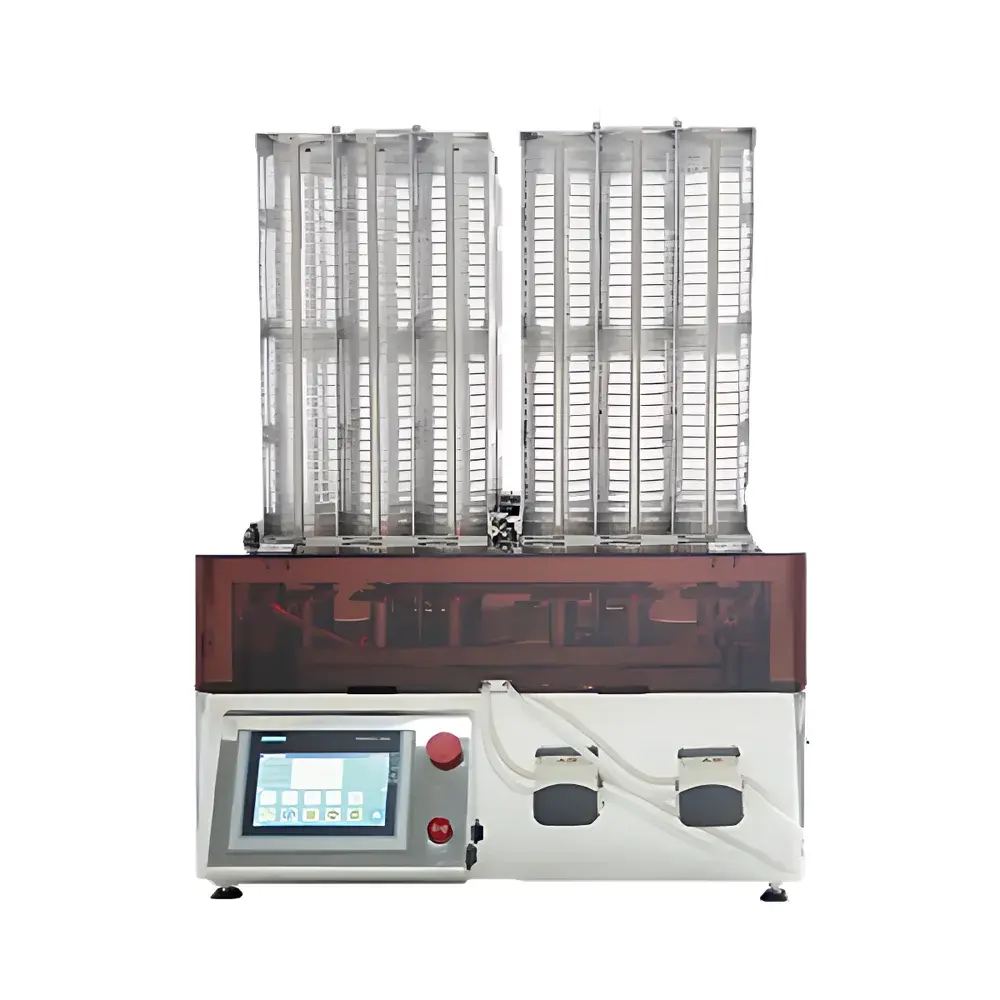
Tailin HTY-MFS03 Automated Culture Medium Plate Dispenser
| Brand | Tailin |
|---|---|
| Origin | Zhejiang, China |
| Manufacturer Type | Original Equipment Manufacturer (OEM) |
| Product Category | Domestic |
| Model | HTY-MFS03 |
| Price Range | USD 1,400 – 7,200 |
| Input Voltage | AC 220 V / 50 Hz |
| Power Consumption | 500 W |
| Dispensing Volume Range | 1–1000 mL |
| Compatible Petri Dish Diameter | 90 mm |
| Dispensing Accuracy | ±1% at 20 mL |
| Throughput | 1200 dishes/h (at 20 mL/dish) |
| Dimensions (W×D×H) | 740 × 550 × 430 mm |
Overview
The Tailin HTY-MFS03 Automated Culture Medium Plate Dispenser is an engineered solution for high-throughput, reproducible preparation of microbiological culture plates in regulated and research laboratory environments. Designed around positive-displacement peristaltic pumping technology, the system delivers precise volumetric dispensing into standard 90 mm Petri dishes without contact between the fluid path and mechanical actuation components—ensuring sterility integrity and minimizing cross-contamination risk. Its operational architecture integrates plate handling, medium delivery, and environmental control within a single compact footprint, supporting routine QC microbiology, pharmaceutical environmental monitoring, and academic microbial assay workflows. The system complies with core design principles aligned with ISO 13485–certified manufacturing practices and supports implementation under GLP- and GMP-aligned SOPs where traceability, repeatability, and contamination control are critical.
Key Features
- Patented linear push-feed plate transfer mechanism ensures smooth, low-vibration dish indexing—reducing mechanical stress on agar media and improving positional consistency across high-volume runs.
- 7-inch high-resolution color touchscreen interface with intuitive icon-based navigation and multilingual support (English, Chinese), enabling rapid method selection and real-time status monitoring.
- Built-in dispensing protocols—including preconfigured modes for Tryptic Soy Agar (TSA), Sabouraud Dextrose Agar (SDA), and R2A—allow immediate deployment; users may define, save, and recall up to 99 custom methods with independent volume, speed, and pause parameters.
- High-precision peristaltic pump with dual-roller compression and calibrated tubing sets delivers ±1% volumetric accuracy at 20 mL, validated per ASTM E29–22 guidelines for measurement uncertainty reporting.
- Modular, autoclavable petri dish carrier frame (designed for 120 °C/30 min steam sterilization) enables seamless integration with cleanroom gowning protocols and reduces downtime between batches.
- Dedicated UV-C irradiation zone (254 nm, ≥100 µW/cm² intensity) operates independently during idle periods or between dispensing cycles, maintaining bioburden levels below ISO 14644–1 Class 5 in the dispensing chamber.
- Smooth-surface stainless steel and medical-grade polymer construction eliminates crevices and recesses, facilitating efficient cleaning validation per USP Analytical Instrument Qualification requirements.
Sample Compatibility & Compliance
The HTY-MFS03 accommodates standard polystyrene and polypropylene 90 mm Petri dishes, including vented and non-vented configurations. It handles aqueous and semi-viscous microbiological media—including molten agar (up to 55 °C), buffered saline solutions, and selective enrichment broths—without clogging or flow deviation. All wetted materials comply with USP Class VI biological reactivity standards and FDA 21 CFR 177.2440 for food-contact polymers. The system supports audit-ready documentation generation when paired with optional external LIMS interfaces and meets essential requirements for Annex 1 (EU GMP) sterile processing controls, particularly regarding aseptic plate preparation and environmental monitoring plate production.
Software & Data Management
Onboard firmware (v3.2+) provides full audit trail functionality, logging operator ID, timestamp, method name, dispense volume, cycle count, and UV exposure duration for every run. Data export is supported via USB 2.0 port in CSV format for integration with ELN systems or statistical process control (SPC) platforms. Optional Ethernet connectivity enables remote monitoring and centralized fleet management in multi-instrument labs. All electronic records adhere to ALCOA+ principles (Attributable, Legible, Contemporaneous, Original, Accurate, Complete, Consistent, Enduring, Available) and support compliance with FDA 21 CFR Part 11 when deployed with appropriate access controls and digital signature configuration.
Applications
- Routine preparation of environmental monitoring (EM) plates for Grade A/B cleanrooms per ISO 14644–2 and EU GMP Annex 1.
- QC release testing of sterile products using membrane filtration or pour-plate methodologies.
- Antimicrobial susceptibility testing (AST) plate standardization in clinical microbiology laboratories.
- Research-scale screening of microbial isolates requiring uniform agar thickness and inoculum distribution.
- Training and proficiency testing programs requiring high inter-operator consistency in plate preparation.
FAQ
What is the maximum operating temperature for media compatibility?
The system supports continuous dispensing of pre-warmed media up to 55 °C; higher temperatures require external cooling or dwell time prior to loading.
Can the HTY-MFS03 be integrated with a laboratory information management system (LIMS)?
Yes—via USB data export or optional TCP/IP module, enabling automated transfer of run metadata and compliance with 21 CFR Part 11 when configured with role-based authentication.
Is calibration verification required before each use?
No—routine verification is performed quarterly per internal SOP; however, daily performance checks (e.g., gravimetric volume confirmation at 20 mL) are recommended for GMP environments.
Does the UV disinfection cycle meet regulatory requirements for sterile plate preparation?
UV exposure is supplementary—not sterilizing—and must be combined with aseptic technique and pre-sterilized consumables; it reduces surface bioburden by ≥3-log₁₀ CFU reduction per ISO 15714:2019.
What maintenance intervals are specified for the peristaltic pump tubing?
Tubing replacement is recommended every 6 months under normal use (≤8 h/day); frequency increases proportionally with viscosity and particulate load of dispensed media.




