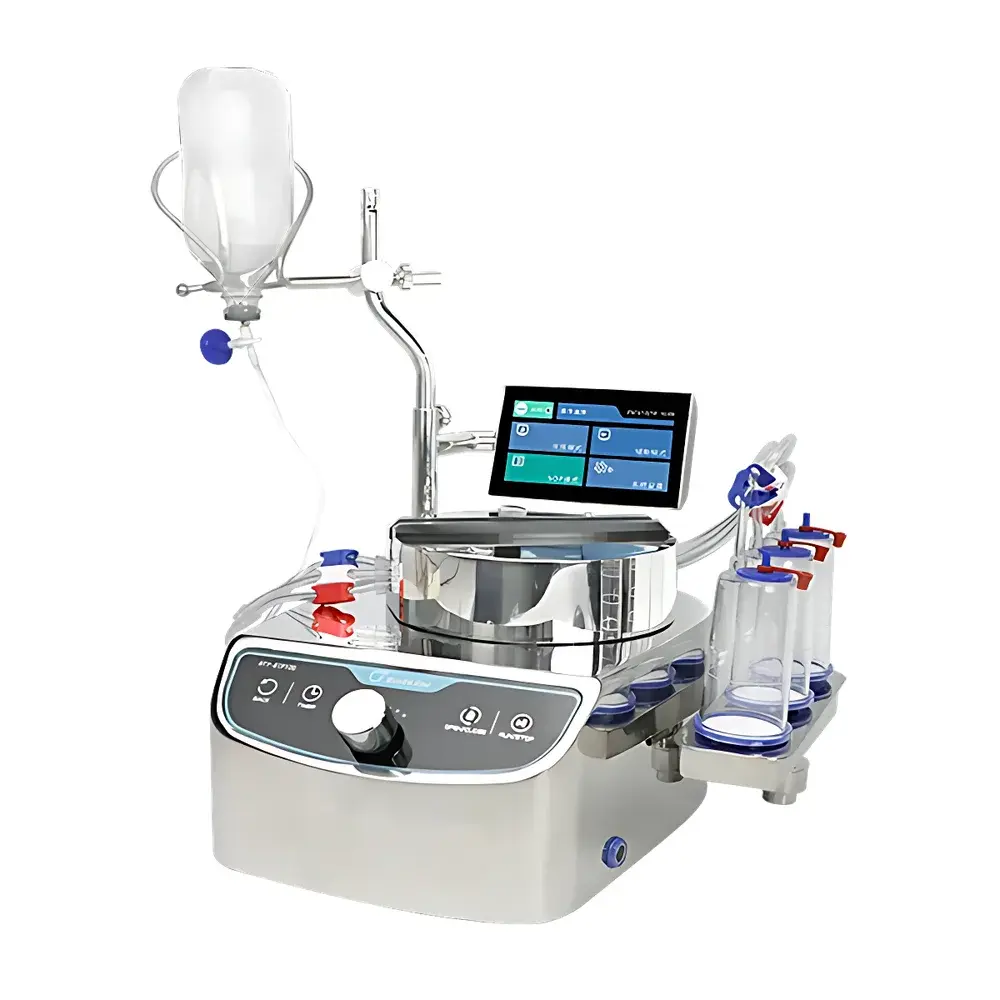
Tailin HTY-STP100 Intelligent Microbial Collection System
| Brand | Tailin |
|---|---|
| Origin | Zhejiang, China |
| Manufacturer Type | Manufacturer |
| Product Category | Domestic |
| Model | HTY-STP100 |
| Pricing | Upon Request |
| Power Supply | 95–260 VAC, 50–60 Hz |
| Housing Material | 316L Stainless Steel |
| Power Consumption | ≤150 W |
| Rotational Speed Range | 0–300 rpm |
| Total Suspension Height | 53 cm |
| Weight | 19 kg |
| Timer Range | 1–999 s |
| Dimensions (W×D×H) | 25.2 × 35.2 × 13.0 cm |
| SOP Storage Capacity | 300 protocols |
| Display | 5.0-inch high-resolution color LCD with tempered glass touch panel |
| Operating Ambient Temperature | 15–35 °C |
| Relative Humidity | ≤75% RH (non-condensing) |
| Pressure Modes | Alarm Mode / Adjustment Mode / Off Mode |
| Protection Features | Overcurrent, Overvoltage, Overload, and Stall Detection |
| Safety | Pump Head & Protective Cover Interlock, Waterproof Footswitch Interface, High-Temperature Operation Alert, Maintenance Reminder |
Overview
The Tailin HTY-STP100 Intelligent Microbial Collection System is a fully integrated, GMP-aligned sterile filtration and microbial recovery instrument engineered for pharmaceutical quality control laboratories conducting membrane filtration-based sterility testing per USP , EP 2.6.1, and ISO 11737-1. It operates on the principle of vacuum-assisted, controlled-speed peristaltic pumping to draw test samples—such as injectables, ophthalmic solutions, and lyophilized powders—through sterilized 0.45 µm or 0.22 µm pore-size membranes under aseptic conditions. Unlike conventional manual or semi-automated systems, the HTY-STP100 embeds real-time pressure monitoring, digital pulse-controlled motor regulation, and programmable operational logic to ensure consistent volumetric flow, minimize membrane clogging risk, and eliminate operator-induced variability in filter loading and rinsing steps.
Key Features
- Intelligent voice recognition interface enabling hands-free operation via standardized command sets (e.g., “Start filtration”, “Pause”, “Load SOP #27”), reducing glove contact and contamination potential in ISO Class 5 environments.
- 5.0-inch high-resolution color LCD with tempered glass capacitive touchscreen and adjustable viewing angle (±30°), supporting intuitive navigation across three operational modes: Standard, Assisted, and SOP-driven workflows.
- Redesigned peristaltic pump head with thermally optimized housing and low-friction rotor geometry, reducing operational heat generation by up to 40% compared to prior-generation units and extending tubing service life.
- Digital pulse encoder-based speed control delivering true stepless adjustment from 0 to 300 rpm with automatic speed memory retention between sessions.
- Triple-pressure-mode architecture: Alarm Mode triggers audible/visual alerts upon exceeding user-defined vacuum thresholds; Adjustment Mode permits fine-tuning during method development; Off Mode disables pressure feedback for legacy protocol compatibility.
- Comprehensive hardware-level safety suite including overcurrent, overvoltage, overload, and stall detection—each logged with timestamps in the internal audit trail—and integrated high-temperature warning with automatic thermal rollback.
Sample Compatibility & Compliance
The HTY-STP100 accommodates standard 47 mm and 50 mm diameter sterile filtration assemblies, including dual- and triple-filter manifolds for parallel testing of multiple batches or product variants. Its stainless steel 316L chassis meets ASME BPE surface finish requirements (Ra ≤ 0.8 µm) and supports cleanroom-compatible wipe-down validation. All firmware and operational logic comply with FDA 21 CFR Part 11 for electronic records and signatures, including role-based access control, biometric or PIN-authenticated login, and immutable audit logs covering SOP execution, parameter changes, and maintenance events. The system is validated for use in GLP and GMP environments and supports IQ/OQ/PQ documentation packages aligned with Annex 15 and ASTM E2500-13.
Software & Data Management
The embedded operating system stores up to 300 user-defined SOPs with full parameterization—including target volume, rotation speed profile, rinse cycle count, dwell time, and pressure setpoints—each timestamped and digitally signed upon activation. All run data (start/stop times, actual vs. setpoint rpm, real-time vacuum readings, error codes, and operator ID) are exported in CSV or PDF format via USB 2.0 port. Optional Ethernet connectivity enables integration into LIMS platforms using HL7 or ASTM E1384-compliant messaging. Audit trails meet ALCOA+ principles (Attributable, Legible, Contemporaneous, Original, Accurate, Complete, Consistent, Enduring, Available) and support regulatory inspection readiness without third-party middleware.
Applications
- Sterility testing of parenteral drugs, vaccines, and biologics per USP and Ph. Eur. 2.6.1.
- Microbial limit testing (MLT) of non-sterile pharmaceuticals and excipients per USP .
- Environmental monitoring sample processing (e.g., water for injection, compressed gases, HVAC effluents).
- Validation of filter integrity (bubble point, diffusion, pressure hold) following filtration cycles.
- Method transfer and routine QC in contract manufacturing organizations (CMOs) and API production facilities.
FAQ
Does the HTY-STP100 support 21 CFR Part 11-compliant electronic signatures?
Yes—the system implements role-based authentication, digital signature capture, and immutable audit logging for all critical actions, fulfilling both signature and record retention requirements.
Can SOPs be edited remotely via network connection?
SOP editing must occur locally via touchscreen or USB import; remote modification is disabled by design to preserve data integrity and prevent unauthorized configuration changes.
What tubing materials are validated for use with the HTY-STP100 pump head?
Silicone tubing meeting USP Class VI and ISO 10993-5 specifications (inner diameter 3.2 mm, wall thickness 1.6 mm) is factory-validated; alternative formulations require user qualification per PQ protocol.
Is pressure calibration traceable to national standards?
Yes—integrated pressure sensors are calibrated using NIST-traceable deadweight testers during factory OQ, with recalibration intervals defined in the maintenance schedule (typically every 12 months or after 500 operating hours).
How does the voice recognition system handle ambient noise in shared lab spaces?
The microphone array employs adaptive noise suppression and speaker-dependent acoustic modeling; optimal performance requires <65 dB(A) background noise and enrollment in a quiet environment per installation SOP.