
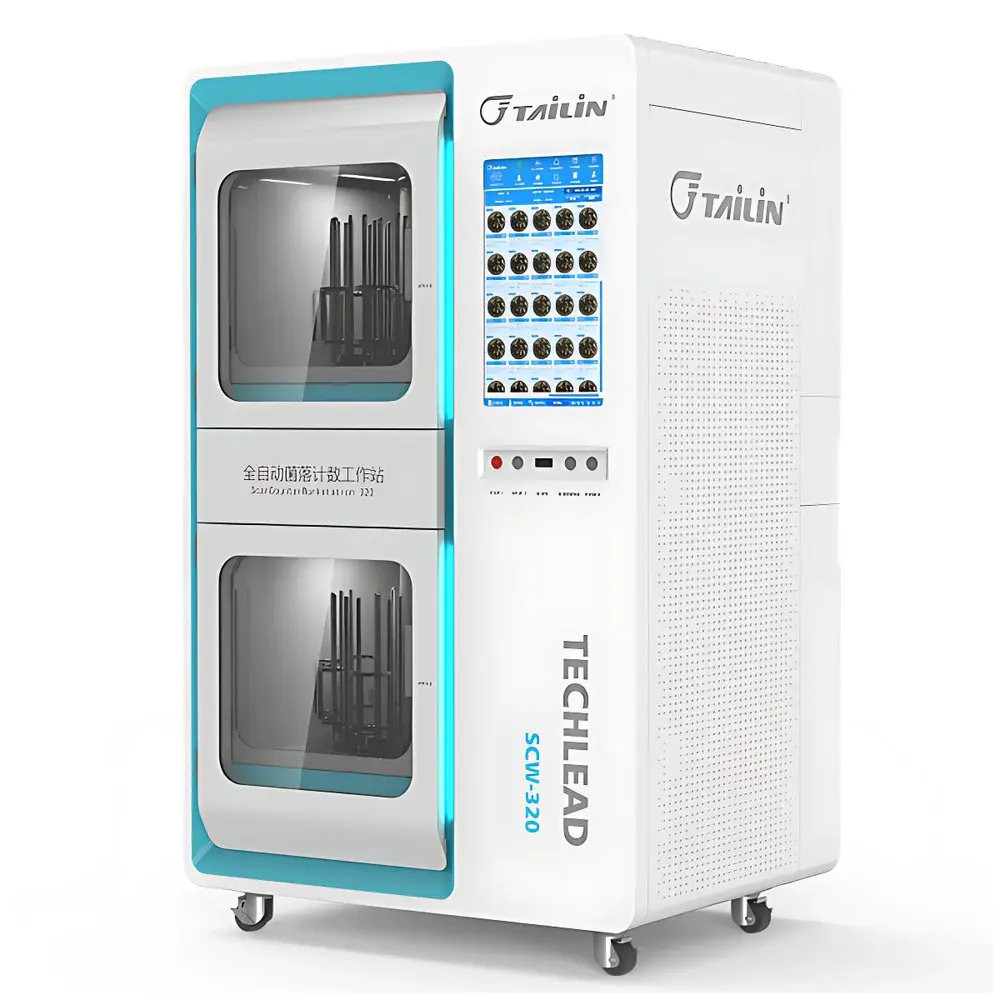
Tailin SCW-320 Automated Colony Counting Workstation
| Brand | Tailin |
|---|---|
| Origin | Zhejiang, China |
| Manufacturer Type | Direct Manufacturer |
| Instrument Type | Fully Automated Colony Counter & Incubation Workstation |
| Maximum Sample Capacity | 320 Petri Dishes |
| Compliance | Designed for ISO 4833-1:2013, ISO 7218, USP <61>, EU Pharmacopoeia 2.6.12, and FDA Bacteriological Analytical Manual (BAM) workflows |
| Connectivity | Ethernet, USB, Wi-Fi |
| Data Export Formats | PDF, XLSX, CSV, TIFF, JPEG |
| Imaging System | High-resolution monochrome CMOS sensor (5 MP), motorized focus, uniform LED illumination with glare-free coaxial lighting |
| Algorithm Engine | Proprietary deep neural network trained on >10,000 annotated colony images across 12 microbial species and 7 substrate types |
| Growth Monitoring | Time-lapse imaging at user-defined intervals (1–24 h) |
| Environmental Control | Integrated incubation chamber (range: 20–45 °C, ±0.3 °C stability), humidity monitoring (optional sensor) |
Overview
The Tailin SCW-320 Automated Colony Counting Workstation is an integrated microbiological analysis platform that unifies controlled incubation and real-time digital colony enumeration within a single enclosed architecture. Unlike standalone colony counters or conventional incubators, the SCW-320 implements a closed-loop, time-resolved imaging paradigm grounded in morphokinetic analysis—capturing sequential high-fidelity images of microbial colonies as they evolve through characteristic growth phases (lag, exponential, stationary). This temporal dimension enables algorithmic discrimination between viable colonies and non-biological artifacts (e.g., precipitates, scratches, condensation droplets) based on spatial expansion rate, edge morphology, and grayscale intensity kinetics. The system is engineered for precision compliance with international microbiological testing standards, including ISO 4833-1:2013 (horizontal method for colony count at 30 °C), ISO 7218 (microbiology of food and animal feeding stuffs), USP (Microbiological Examination of Nonsterile Products), and EU Ph. Eur. 2.6.12 (Microbiological Quality of Nonsterile Products). Its design prioritizes reproducibility in regulated environments—pharmaceutical QC labs, contract testing facilities, and public health reference laboratories—where auditability, traceability, and operator-independent results are mandatory.
Key Features
- Simultaneous incubation and automated enumeration of up to 320 standard 90 mm Petri dishes per cycle, with programmable temperature setpoints from 20 °C to 45 °C and thermal stability of ±0.3 °C.
- Time-lapse imaging engine with adjustable capture frequency (1–24 hour intervals), generating time-series image stacks and quantifiable growth curves annotated with phase transition markers.
- Proprietary convolutional neural network (CNN) algorithm trained on over 10,000 manually validated colony images spanning Gram-positive/negative bacteria, yeasts, molds, and lactic acid bacteria across agar types (TSA, PCA, VRBA, SDA, MRS).
- Robust artifact rejection logic: distinguishes fused colonies using watershed segmentation combined with growth-vector modeling; filters debris via multi-scale texture analysis and temporal persistence thresholds.
- Full remote operation and alerting: configurable notifications via SMTP email, SMS gateway, RESTful webhook, or WeChat Official Account API—triggered by completion, anomaly detection, or threshold breaches.
- Modular hardware interface: supports all common plating methods—spread plate, pour plate, spiral plater (with optional adapter), membrane filtration (on gridded or non-gridded filters), and settle plate assays.
Sample Compatibility & Compliance
The SCW-320 accommodates standard 90 mm and 100 mm Petri dishes (including vented, non-vented, and gamma-irradiated variants), as well as 47 mm membrane filters mounted on filter holders. It maintains full compatibility with regulatory-compliant workflows for pharmaceutical microbiological testing (e.g., bioburden, sterility test support), food safety validation (ISO 4833-2:2016 for spiral plating), environmental monitoring (EU GMP Annex 1, ISO 14644-1), and clinical microbiology (CLSI M07-A11). All image acquisition, processing logs, and result outputs are timestamped, digitally signed, and stored with immutable metadata—including incubation parameters, user ID, instrument serial number, and software version—enabling full 21 CFR Part 11 compliance when deployed with validated electronic signature modules.
Software & Data Management
The workstation runs Tailin ColonyVision™ v4.2 firmware, a Windows-based application supporting role-based access control (RBAC), audit trail logging (per ALCOA+ principles), and electronic signature enforcement. Raw TIFF image sequences, processed colony maps, growth kinetics data, and summary reports are archived in a local SQL Server database with automatic daily backup to network storage. Integration with laboratory information management systems (LIMS) is achieved via ASTM E1384-compliant messaging, HL7 v2.x ADT/ORU messages, or direct ODBC connectivity. Export formats include PDF (with embedded digital signatures), Excel (.xlsx), CSV (UTF-8 encoded), and lossless TIFF for third-party reanalysis.
Applications
- Pharmaceutical: Environmental monitoring (EM) of Grade A–D cleanrooms; media fill test colony enumeration; microbial limit testing per USP /.
- Food & Beverage: Total viable count (TVC), coliforms, E. coli, yeast/mold, and lactic acid bacteria enumeration under ISO, AOAC, or FDA BAM protocols.
- Clinical & Public Health: Hospital-acquired infection (HAI) surveillance; waterborne pathogen screening (e.g., Legionella, Pseudomonas aeruginosa); antimicrobial susceptibility assay support.
- Cosmetics & Personal Care: Preservative efficacy testing (PET), challenge testing per ISO 11930, raw material and finished product microbial qualification.
- Water & Wastewater: Membrane filtration counts for total coliforms, fecal coliforms, and heterotrophic plate count (HPC) per EPA Method 1603/1681.
- Academic & R&D: High-throughput strain isolation, growth phenotype profiling, and antibiotic synergy studies requiring longitudinal colony dynamics.
FAQ
Does the SCW-320 require manual intervention during incubation or counting?
No. Once plates are loaded and the protocol is initiated, the system operates fully autonomously—including temperature ramping, image acquisition, real-time analysis, report generation, and data export.
Can the system differentiate between bacterial and fungal colonies on mixed plates?
Yes. The neural network model includes class-specific training for bacteria, yeasts, and filamentous fungi, enabling taxon-level classification with ≥92% sensitivity and ≥89% specificity under validated conditions.
Is calibration traceable to national standards?
Imaging calibration is performed using NIST-traceable resolution test targets (ANSI IT8.7/2); temperature uniformity is verified annually per ISO/IEC 17025-accredited procedures.
How is data integrity ensured during long-term deployments?
All operations generate SHA-256 hashed audit records; image files are write-once, read-many (WORM) archived; database backups include cryptographic checksums and versioned schema migration logs.
What maintenance is required for sustained accuracy?
Annual optical alignment verification and illumination uniformity mapping are recommended; no consumables or proprietary reagents are required for core functionality.



