
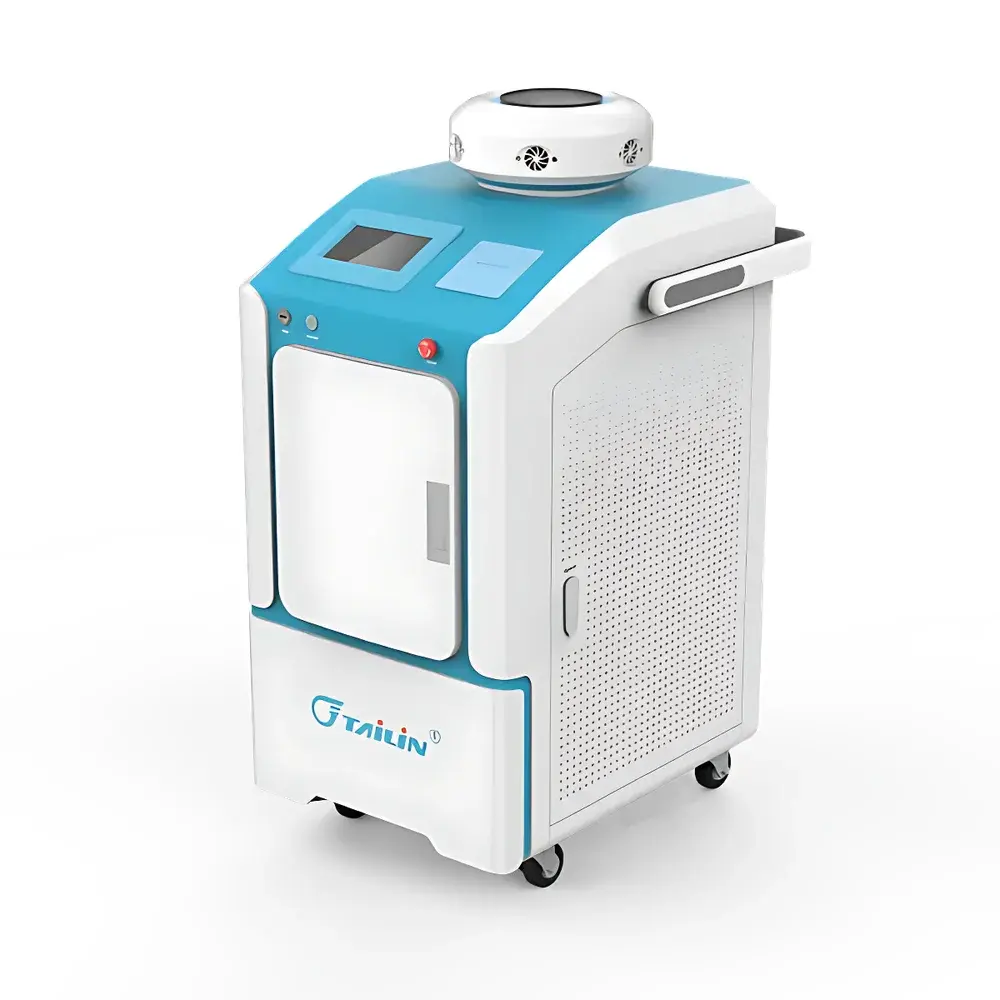
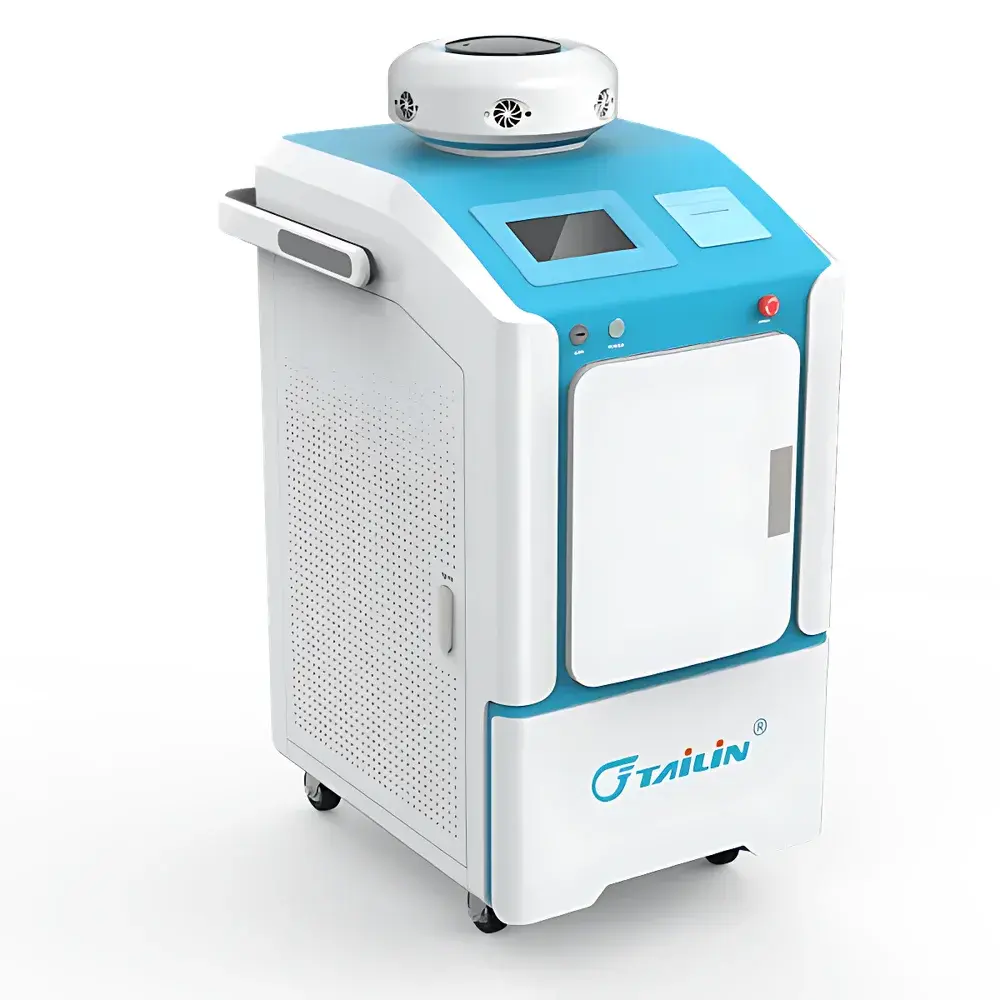
Tailin VHPS-Classic & Basic Vaporized Hydrogen Peroxide (VHP®) Sterilization System
| Brand | Tailin |
|---|---|
| Origin | Zhejiang, China |
| Manufacturer Type | Direct Manufacturer |
| Model | VHPS-Classic & Basic |
| Airflow Rate | 350 m³/h |
| Sterilization Volume | VHPS-Classic ≥ 300 m³ |
| Filtration Efficiency | 99.9% |
| Sterilant | 30–35% aqueous hydrogen peroxide solution |
| Log Reduction | ≥6-log for Geobacillus stearothermophilus spores |
Overview
The Tailin VHPS-Classic & Basic Vaporized Hydrogen Peroxide (VHP®) Sterilization System is an engineered solution for low-temperature, residue-free terminal sterilization of enclosed environments. It operates on the principle of controlled vapor-phase hydrogen peroxide delivery—utilizing proprietary flash-vaporization and dynamic saturation control algorithms—to generate a stable, uniformly distributed VHP cloud with precise concentration modulation. Unlike thermal or ethylene oxide methods, this system achieves microbiological lethality without thermal stress or toxic residuals, making it suitable for heat-sensitive equipment, electronics, and polymer-based containment systems. The core architecture integrates real-time environmental feedback (humidity, temperature, pressure differential) to maintain optimal VHP concentration windows (typically 100–1,200 ppm) throughout the exposure phase, ensuring reproducible 6-log reduction of resistant bacterial spores—including Geobacillus stearothermophilus—in accordance with ISO 14644-3, ISO 14698-1, and EU GMP Annex 1 requirements for sterile manufacturing environments.
Key Features
- Patented VHPS® flash-vaporization module with variable-rate control enables consistent aerosol generation at up to 25 g/min, minimizing condensation risk while maximizing spatial homogeneity.
- Dual-mode operation: supports both direct chamber sterilization (e.g., isolators, BIBO units, biosafety cabinets) and whole-space decontamination (cleanrooms, BSL-2/3 laboratories, hospital isolation rooms).
- Automated integrity verification: built-in leak detection protocols perform pre-cycle pressure decay testing on connected enclosures and internal fluidic pathways to confirm system tightness prior to H2O2 injection.
- Integrated platinum-group multi-element catalytic converter reduces residual H2O2 concentrations to ≤1 ppm post-cycle—without catalyst degradation or scheduled replacement—ensuring operator safety and rapid room re-entry.
- Cold-dry air integration delivers continuous desiccation during conditioning and aeration phases, eliminating reliance on external dehumidification infrastructure.
- Scalable control architecture: one unit functions as master controller coordinating up to three additional VHPS units in synchronized multi-device campaigns—ideal for large-volume or segmented facility decontamination.
Sample Compatibility & Compliance
The VHPS-Classic & Basic system is validated for use with stainless steel, borosilicate glass, polypropylene, polycarbonate, and other common pharmaceutical and laboratory-grade materials. It complies with material compatibility standards outlined in USP , ISO 14937, and EN 17125. All sterilization cycles generate full audit trails compliant with FDA 21 CFR Part 11 (electronic records and signatures), supporting GLP and GMP environments. Process parameters—including vapor concentration, dwell time, relative saturation, and aeration duration—are fully configurable and locked within user-defined protocols subject to role-based access control.
Software & Data Management
The embedded sterilization management interface provides cycle programming, real-time parameter visualization (H2O2 ppm, RH%, temperature, pressure), and automated report generation in PDF and CSV formats. Historical data is stored locally with optional Ethernet/IP or Modbus TCP connectivity for integration into SCADA or MES platforms. Cycle logs include timestamps, operator ID, deviation flags, and pass/fail status per ISO 13485 traceability requirements. Firmware updates are performed via secure USB or network push with cryptographic signature validation.
Applications
- Decontamination of rigid-wall and flexible-film isolators in aseptic fill-finish suites
- Terminal sterilization of Class II/III biosafety cabinets and gloveboxes prior to maintenance
- Recovery-phase disinfection of BSL-2 and BSL-3 laboratories after high-consequence pathogen handling
- Pre-use conditioning of cleanroom transfer hatches, RABS, and material airlocks
- Emergency response decontamination in healthcare settings following C. difficile or SARS-CoV-2 contamination events
FAQ
What is the maximum recommended volume for the VHPS-Basic model?
The VHPS-Basic is validated for volumes up to and exceeding 500 m³ when operated under standard environmental conditions (20–25°C, ≤60% RH). Larger volumes may be addressed via multi-unit synchronization.
Does the system require periodic calibration or certification?
Yes—annual performance qualification (PQ) is recommended per ISO 14644-3 and EU GMP Annex 1. Calibration of integrated sensors (RH, temperature, H2O2 ppm) must be verified using NIST-traceable references.
Can the VHPS system be integrated with building management systems (BMS)?
Yes—via Modbus TCP or Ethernet/IP, enabling remote start/stop commands, status monitoring, and alarm forwarding to centralized facility control networks.
Is the 30–35% hydrogen peroxide solution supplied by Tailin or sourced separately?
Tailin provides certified, pharmaceutical-grade 35% hydrogen peroxide solution meeting USP/EP specifications; alternative suppliers must demonstrate equivalent purity and stabilizer profiles to ensure consistent vapor-phase behavior.
How does the system handle ambient humidity fluctuations during conditioning?
The integrated cold-dry air module actively regulates inlet dew point to ≤−20°C, decoupling process stability from ambient RH variations and enabling reliable cycle execution across seasonal climate shifts.



