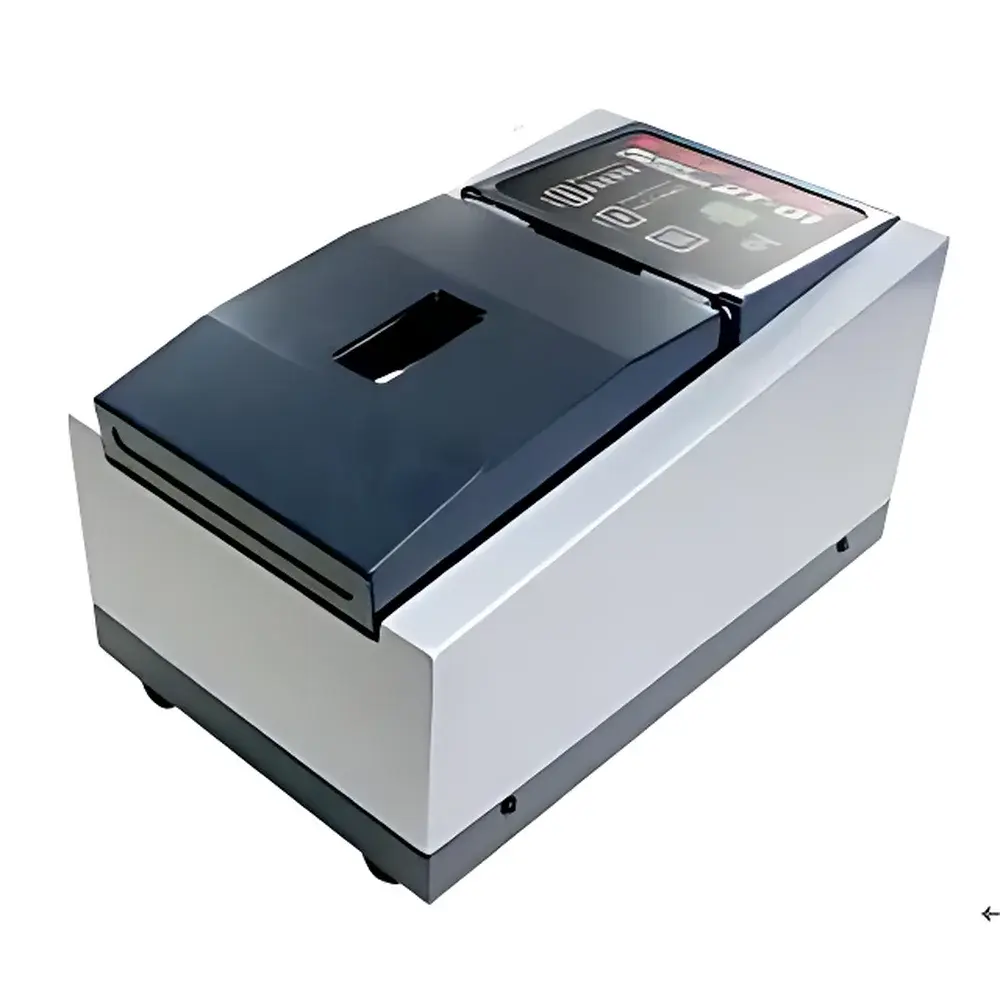
TAITEC μT-01 Horizontal Umbrella-Shaped Bead Mill Cell Disruptor
| Brand | TAITEC |
|---|---|
| Origin | Japan |
| Model | μT-01 |
| Disruption Principle | Horizontal umbrella-shaped oscillation |
| Speed Range | 2,500–4,600 rpm (6 preset steps) |
| Sample Volume | 2 mL |
| Sample Capacity | 1 tube per run |
| Compatible Beads | Glass, zirconia, stainless steel beads (φ0.15–6 mm), metal mortars |
| Operating Temperature | +5 to +35 °C |
| Vibration Frequency | 40–78 Hz |
| Timer Range | 5–60 s (6 presets) |
| Safety Features | Lid interlock stop, overload current protection |
| Dimensions | 172 × 280 × 160 mm (W × D × H) |
| Weight | ~5 kg |
| Power Supply | AC 100 V, 0.5 A |
Overview
The TAITEC μT-01 is a compact, high-efficiency bead mill cell disruptor engineered for reproducible mechanical lysis of diverse biological samples—including animal tissues, plant materials, microbial cells, and recalcitrant solid specimens—without cryogenic pretreatment. Unlike ultrasonic or high-pressure homogenization methods, the μT-01 employs a proprietary horizontal umbrella-shaped oscillation mechanism that delivers intense lateral kinetic energy to the sample tube, enabling efficient energy transfer to beads and subsequent cell wall/membrane disruption via impact and shear forces. This principle avoids localized heating common in continuous ultrasonic systems and eliminates the need for external cooling baths during standard operation. Designed for benchtop use in molecular biology, proteomics, and metabolomics laboratories, the μT-01 prioritizes precision, operator safety, and compatibility with downstream analytical workflows such as Western blotting, ELISA, qPCR, and mass spectrometry.
Key Features
- Horizontal umbrella-shaped oscillation drive delivering up to 4,600 rpm—optimized for high-energy transfer while minimizing tube displacement and acoustic noise (operating noise reduced to 1/7–1/10 of conventional disruptors).
- Six-step digital speed control (2,500 / 3,000 / 3,600 / 4,000 / 4,200 / 4,600 rpm) and six programmable time settings (5 / 10 / 15 / 30 / 45 / 60 seconds) for method reproducibility across sample types.
- Single-tube operation using standard 1.5–2.0 mL threaded microcentrifuge tubes—compatible with both sealed tubes featuring O-ring gaskets and high-impact variants (e.g., SSI 2641-0B) for rigorous tissue disruption.
- Universal bead compatibility: supports glass (density ~2.5 g/cm³), zirconia (density ~6.0 g/cm³), stainless steel (SUS), and custom metal mortars—enabling optimization of lysis efficiency based on sample toughness and downstream requirements.
- Integrated safety architecture including lid-activated vibration cutoff and electronic overload current protection—ensuring compliance with IEC 61010-1 for laboratory equipment safety.
- Robust aluminum-alloy chassis and precision-balanced rotor assembly ensure long-term mechanical stability under repeated high-rpm cycling.
Sample Compatibility & Compliance
The μT-01 has been validated for lysis of challenging matrices including murine lung and spleen tissue, porcine myocardium, avian skeletal muscle and bone, fungal mycelia (e.g., Grifola frondosa), cruciferous plant material (broccoli), chitinous structures (shark fin), and cellulose-based substrates (filter paper). Lysis efficiency correlates strongly with bead density, size, and number—as demonstrated by enhanced bacterial (E. coli HB101) disruption using zirconia (ρ = 6.0 g/cm³) versus glass beads (ρ = 2.5 g/cm³) under identical speed/time conditions. The instrument operates within ambient temperature ranges (+5 to +35 °C) and meets ISO 13485-aligned manufacturing standards. While not certified to FDA 21 CFR Part 11 out-of-the-box, its deterministic timer and fixed-speed presets support GLP/GMP-compliant protocol documentation when paired with laboratory information management systems (LIMS).
Software & Data Management
The μT-01 is a standalone hardware platform with no embedded software or network interface. All operational parameters are set via front-panel digital controls, ensuring deterministic, audit-ready execution without firmware dependencies. Time and speed settings are retained across power cycles, and the absence of data logging or cloud connectivity simplifies validation in regulated environments. Users are advised to document run parameters manually or integrate the device into electronic lab notebooks (ELNs) compliant with ALCOA+ principles. For traceability, batch-specific lysis protocols—including bead type, quantity, buffer composition, and post-lysis centrifugation conditions—should be recorded alongside instrument serial number and calibration status.
Applications
- Rapid lysis of Gram-negative and Gram-positive bacteria for plasmid extraction, protein solubilization, or enzyme activity assays.
- Homogenization of fibrous or collagen-rich tissues (e.g., skeletal muscle, lung, gastric mucosa) without cryo-embedding or enzymatic pre-digestion.
- Extraction of intracellular metabolites and nucleic acids from plant seeds and lignocellulosic biomass.
- Preparation of subcellular fractions where membrane integrity must be preserved until mechanical disruption.
- High-throughput sample prep for multi-omics studies requiring consistent input material quality across hundreds of replicates.
FAQ
Can the μT-01 be used with non-threaded or non-O-ring microtubes?
No. Only threaded microcentrifuge tubes with integrated sealing gaskets are recommended to prevent leakage under high-speed oscillation. Non-sealed or snap-cap tubes pose contamination and aerosolization risks.
What is the maximum recommended bead diameter for standard Watson tubes?
For Watson 1392-200 tubes, φ4–5 mm stainless steel beads require strict adherence to speed limits (≤3,000 rpm without buffer; ≤4,200 rpm with half-volume buffer) and single-bead loading to avoid tube fracture.
Does the μT-01 generate significant heat during operation?
Yes—continuous 60-second runs induce measurable thermal rise. For thermosensitive analytes, implement 30-second on/30-second off cycles or perform disruption on ice-chilled aluminum blocks.
Is the μT-01 suitable for RNA isolation workflows?
Yes—when combined with RNase-inhibiting buffers and chilled operation, it achieves >90% lysis efficiency for mammalian tissues while preserving RNA integrity (RIN > 8.5 confirmed via Bioanalyzer).
Are replacement parts and consumables available globally?
Stainless steel beads (φ2–6 mm), zirconia spheres (0.22–10 mm), and SSI/Boatwell high-impact tubes are distributed through TAITEC’s authorized global channel partners and comply with REACH and RoHS directives.