
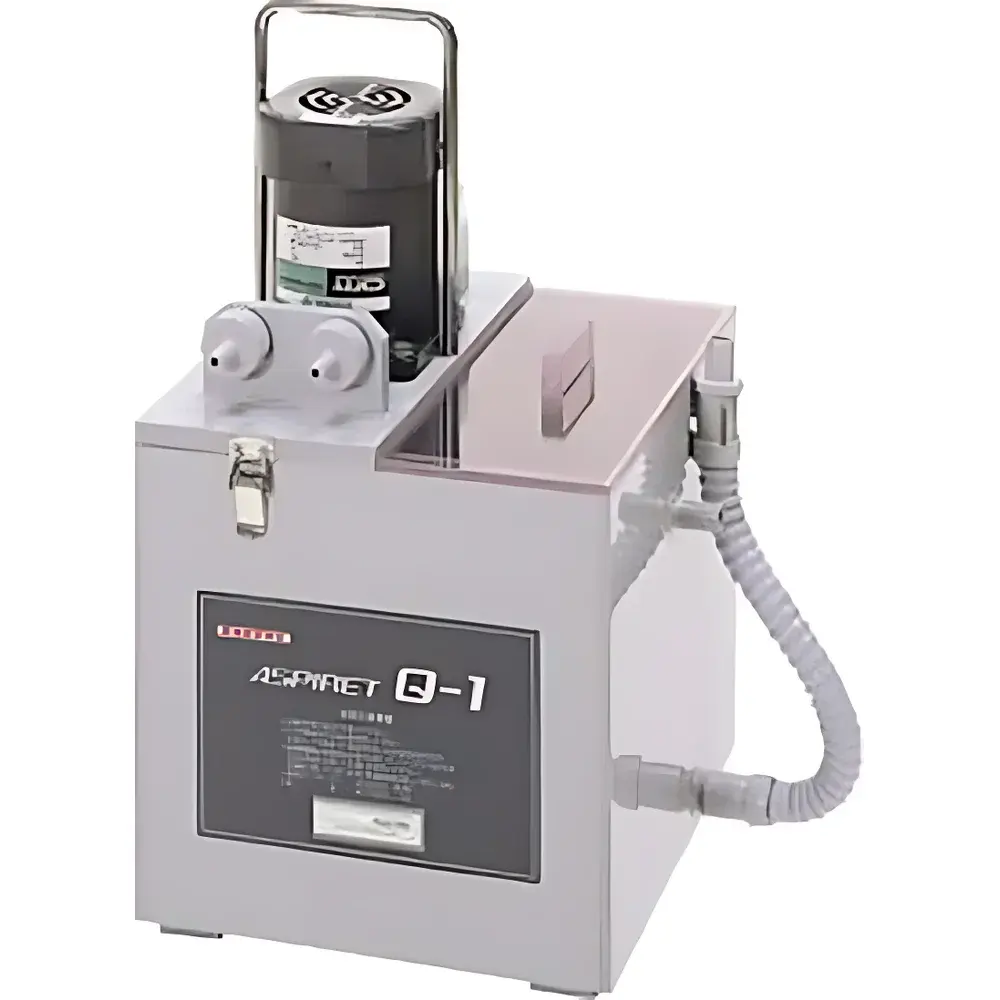
TAITEC Q-1 Circulating Water Vacuum Pump
| Brand | TAITEC |
|---|---|
| Origin | Japan |
| Manufacturer Status | Authorized Distributor |
| Origin Category | Imported |
| Model | Q-1 |
| Instrument Type | Circulating Water Vacuum Pump |
| Product Type | Oil-Free Pump |
| Air Displacement Rate | 7 L/min |
| Ultimate Vacuum | 70 mbar |
| External Dimensions | 230 × 260 × 425 mm |
| Weight | 9 kg |
| Motor Power | 200 W |
| Water Reservoir Capacity | ~10 L |
| Inlet Nozzle | Dual 5 mm OD metal ports |
| Power Supply | AC 100 V, 2 A |
| Standard Accessory | Transparent PVC Lid × 1 |
Overview
The TAITEC Q-1 Circulating Water Vacuum Pump is an oil-free, water-aspirated vacuum source engineered for stable, low-maintenance operation in academic, pharmaceutical, and industrial laboratory environments. Unlike mechanical or diaphragm vacuum pumps, the Q-1 employs the Venturi principle: pressurized water flow through a constricted nozzle generates localized negative pressure—enabling continuous vacuum generation without lubricants, exhaust gases, or hydrocarbon contamination. Its ultimate vacuum level (70 mbar) is thermodynamically governed by the vapor pressure of circulating water at operating temperature—a key design constraint that ensures predictable performance across routine applications such as solvent evaporation, filtration under reduced pressure, and vacuum-assisted concentration in centrifugal or tube-based concentrators. The integrated 10 L reservoir and closed-loop recirculation system eliminate dependence on continuous tap water supply, reducing resource consumption and enabling extended unattended operation—particularly advantageous where municipal water pressure or temperature fluctuates.
Key Features
- Oil-free, environmentally compliant vacuum generation with zero hydrocarbon emission—ideal for GLP/GMP-compliant labs handling sensitive organic or biological samples.
- Dual independent 5 mm OD stainless steel suction ports allow simultaneous connection to multiple apparatuses; each port supports optional vacuum regulation valves (sold separately) for precise, application-specific pressure control.
- Integrated water reservoir (220 × 250 × 220 mm, ~10 L capacity) enables stable thermal mass; users may introduce ice packs or connect external chillers to suppress water temperature rise—critical for maintaining consistent vacuum during prolonged operation (>2 hr).
- Robust 200 W motor drives reliable water circulation while minimizing heat transfer to the reservoir; motor housing incorporates thermal overload protection per IEC 60034 standards.
- Compact footprint (230 × 260 × 425 mm) and lightweight design (9 kg) facilitate benchtop integration in space-constrained fume hoods or multi-instrument workstations.
- Transparent PVC lid included as standard—provides visual monitoring of water level and circulation status while mitigating aerosol escape during volatile solvent use.
Sample Compatibility & Compliance
The Q-1 is compatible with aqueous, polar organic, and low-volatility solvent systems commonly used in rotary evaporation, Büchner filtration, and lyophilization pre-chilling. It is not recommended for highly corrosive media (e.g., concentrated HCl, HF, or oxidizing acids) or solvents immiscible with water that may phase-separate in the reservoir. For regulated environments, the pump meets basic electrical safety requirements per JIS C 61010-1 (equivalent to IEC 61010-1) and supports audit-ready workflows when paired with calibrated vacuum gauges and log-enabled controllers. While the Q-1 itself does not incorporate FDA 21 CFR Part 11-compliant software, its analog operation allows seamless integration into validated systems where vacuum setpoints are externally monitored and recorded.
Software & Data Management
The TAITEC Q-1 operates as a standalone analog device with no embedded firmware, display, or digital interface—ensuring long-term reliability, electromagnetic compatibility in RF-sensitive labs, and immunity to cybersecurity vulnerabilities. Vacuum stability is maintained mechanically via water temperature control and flow regulation; users may integrate third-party digital manometers (e.g., MKS Baratron series) or programmable PID controllers for closed-loop feedback in automated protocols. No proprietary drivers or cloud connectivity are required—reducing IT validation burden in regulated QC/QA settings.
Applications
- Routine vacuum filtration of cell cultures, precipitates, or particulate suspensions using Buchner or Hirsch funnels.
- Reduced-pressure solvent removal in rotary evaporators (R-100/R-210 class) and cold trap configurations.
- Vacuum-assisted drying of thin-layer chromatography (TLC) plates or gel electrophoresis membranes.
- Pre-concentration of dilute protein or nucleic acid samples in centrifugal concentrators (e.g., Eppendorf Concentrator Plus) requiring stable sub-100 mbar conditions.
- Supporting vacuum desiccation of hygroscopic reagents or calibration standards in analytical balance rooms.
FAQ
What determines the ultimate vacuum achievable with the Q-1?
The lowest attainable pressure is dictated by the saturated vapor pressure of water at its current temperature—e.g., ~32 mbar at 25°C, ~12 mbar at 15°C. Cooling the reservoir extends practical vacuum range but does not override thermodynamic limits.
Can the Q-1 be used continuously for 8+ hours?
Yes—provided water temperature is actively stabilized (e.g., via ice packs or chiller), reservoir volume remains ≥70% full, and ambient lab temperature stays below 30°C. Evaporation loss averages <150 mL/hr under typical load.
Is the pump compatible with ASTM D86 or ISO 3405 distillation setups?
It satisfies vacuum requirements for atmospheric distillation support but lacks pressure-certified calibration traceability; users must validate system-level vacuum accuracy with NIST-traceable gauges per method specifications.
Does the dual-port configuration support differential vacuum control?
Each port operates independently at the same system vacuum unless fitted with separate vacuum regulators—enabling parallel processes at identical or individually adjusted pressures.
What maintenance is required beyond water replacement?
Annual inspection of impeller integrity, O-ring sealing surfaces, and inlet strainer cleanliness is recommended. No lubrication, belt replacement, or carbon brush servicing is necessary due to brushless motor architecture.



