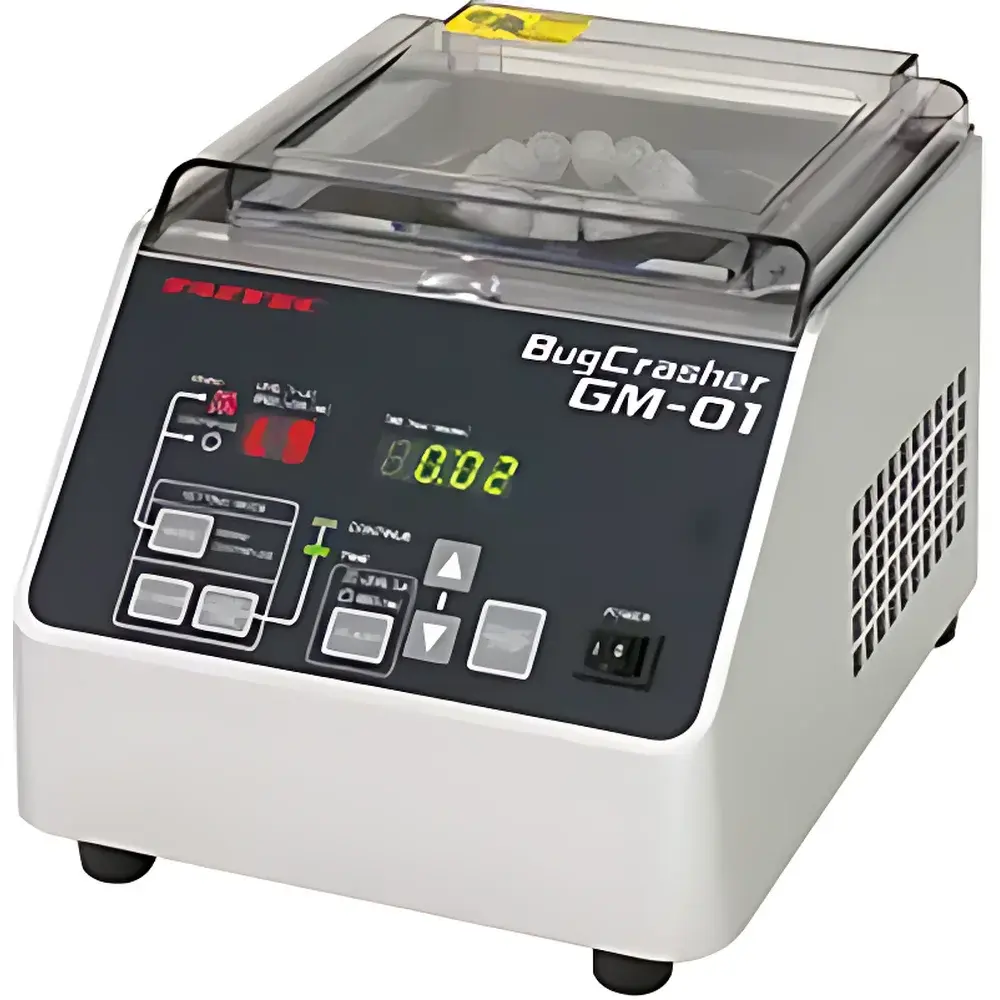
TAITEC GM-01 Multi-Function Bead Mill Cell Disruptor
| Brand | TAITEC |
|---|---|
| Origin | Japan |
| Model | GM-01 |
| Instrument Type | Bead Mill Cell Disruptor |
| Temperature Range | 0 °C to 40 °C |
| Sample Volume | 2.0 mL per tube |
| Throughput | Up to 12 samples (6 with metal beads) |
| Maximum Centrifugal Force | 1300 × g |
| Speed Range | 500–4500 rpm |
| Vortex Mixing Intensity | 10 levels (Level 10 ≈ 2600 rpm equivalent shear) |
| Timer Range | 0–50 sec, or 1 min–99 h 50 min |
| Dimensions | 210 × 268 × 176 mm (W × D × H) |
| Weight | ~3.5 kg |
| Power Supply | AC 100–125 V, 0.5 A |
Overview
The TAITEC GM-01 Multi-Function Bead Mill Cell Disruptor is an engineered platform for mechanical lysis of microbial and plant cells through high-energy bead milling, integrated with programmable vortex mixing and centrifugal sedimentation in a single compact benchtop unit. Unlike ultrasonic or enzymatic lysis methods, the GM-01 employs controlled kinetic energy transfer via oscillatory motion and high-speed rotational agitation—principally leveraging the Couette flow dynamics between dense grinding media (e.g., zirconia or stainless-steel beads) and biological samples in sealed microcentrifuge tubes. This mechanism ensures reproducible cell wall disruption while minimizing thermal denaturation and nucleic acid shearing, particularly critical for intact RNA isolation from thermolabile tissues such as Arabidopsis thaliana leaves or yeast cultures. The system operates within a tightly regulated ambient temperature envelope (0–40 °C), supporting cryogenic workflows when paired with pre-chilled tubes or liquid nitrogen-treated samples.
Key Features
- Integrated dual-mode operation: independent selection of bead-based disruption, vortex mixing (10 adjustable intensity levels), and centrifugal sedimentation (500–4500 rpm; max 1300 × g)
- High-throughput processing: accommodates up to 12 × 1.5/2.0 mL microtubes simultaneously; configuration supports up to 6 tubes when using denser metal beads to maintain mechanical balance and rotor integrity
- Precision programmability: timer spans discrete short pulses (0–50 sec) or extended durations (1 min–99 h 50 min); all modes support continuous, timed, or intermittent cycling
- Digital interface with real-time display of speed, mixing level, elapsed time, and operational status
- Comprehensive safety architecture: includes overcurrent/overvoltage protection, phase-loss detection, thermal cutoff at 60 °C ±5 °C, overspeed limiting, lid-safety interlock (auto-pause on opening), and motor fault monitoring
- Compact footprint (210 × 268 × 176 mm) and lightweight design (~3.5 kg) for flexible placement in biosafety cabinets, cold rooms, or shared core facility benches
Sample Compatibility & Compliance
The GM-01 is validated for lysis of Gram-negative bacteria (e.g., E. coli), yeasts (Saccharomyces cerevisiae), cyanobacteria, and fibrous plant tissues—including leaf material from model organisms such as Arabidopsis. Compatibility extends to common lysis buffers (e.g., guanidine thiocyanate-based, RLT, or CTAB formulations) and cryoprotective additives (e.g., β-mercaptoethanol, RNase inhibitors). While not certified to ISO 13485 or FDA 21 CFR Part 11 out-of-the-box, the device supports GLP/GMP-aligned workflows when used with documented SOPs, calibrated timers, and audit-trail-capable lab notebooks. Its mechanical lysis principle aligns with ASTM D7217-16 (standard guide for nucleic acid extraction validation) and complements ISO/IEC 17025-compliant quality management systems where sample integrity and operator reproducibility are prioritized.
Software & Data Management
The GM-01 operates as a standalone instrument without embedded firmware-based data logging or network connectivity. All parameter settings—including speed, duration, mode selection, and mixing intensity—are manually configured via front-panel controls and retained only during active operation. For traceability, users are advised to record settings in electronic lab notebooks (ELNs) compliant with 21 CFR Part 11 requirements (e.g., LabArchives, Benchling) or paper-based logs adhering to ALCOA+ principles (Attributable, Legible, Contemporaneous, Original, Accurate, Complete, Consistent, Enduring, Available). No proprietary software driver or USB interface is provided; however, the unit’s stable analog control architecture ensures long-term operational consistency across laboratory environments.
Applications
- Routine extraction of high-molecular-weight genomic DNA from bacterial pellets and fungal mycelia
- Isolation of intact total RNA from plant tissues requiring rapid mechanical homogenization prior to phenol-chloroform phase separation
- Preparation of whole-cell lysates for downstream SDS-PAGE and Western blotting of soluble and membrane-associated proteins
- High-efficiency lysis of recalcitrant cyanobacterial strains for metagenomic library construction
- Parallel processing of clinical or environmental isolates in microbiology screening pipelines
- Combined lysis–pellet consolidation workflows: immediate post-disruption centrifugation eliminates manual transfer steps and reduces RNase contamination risk
FAQ
Can the GM-01 be used for protein extraction without significant degradation?
Yes—when operated at lower mixing intensities (Levels 3–5) and chilled tube adapters, the GM-01 minimizes proteolytic activity and preserves native conformation for subsequent affinity purification.
Is it possible to process samples below 0 °C?
The unit itself is rated for ambient operation between 0–40 °C; however, pre-frozen samples (e.g., snap-frozen in liquid nitrogen) may be loaded and processed briefly, provided condensation and thermal shock to internal components are mitigated.
What bead types are compatible with the GM-01?
Standard configurations use 0.1–0.5 mm glass or 0.5–1.0 mm zirconia beads; stainless-steel beads (0.5–1.0 mm) are supported but reduce maximum tube capacity to six due to mass-induced imbalance.
Does the GM-01 meet IEC 61000-4 electromagnetic compatibility standards?
As a Class B industrial scientific device, it complies with IEC 61000-4-2 (ESD), -4-3 (radiated RF), and -4-4 (electrical fast transients) per manufacturer specifications for laboratory environments.
How is calibration verified for speed and timing accuracy?
Users should perform periodic verification using a handheld tachometer (for rpm) and NIST-traceable stopwatch (for timer function); no factory recalibration service is offered, but mechanical wear is minimal under standard usage protocols.