
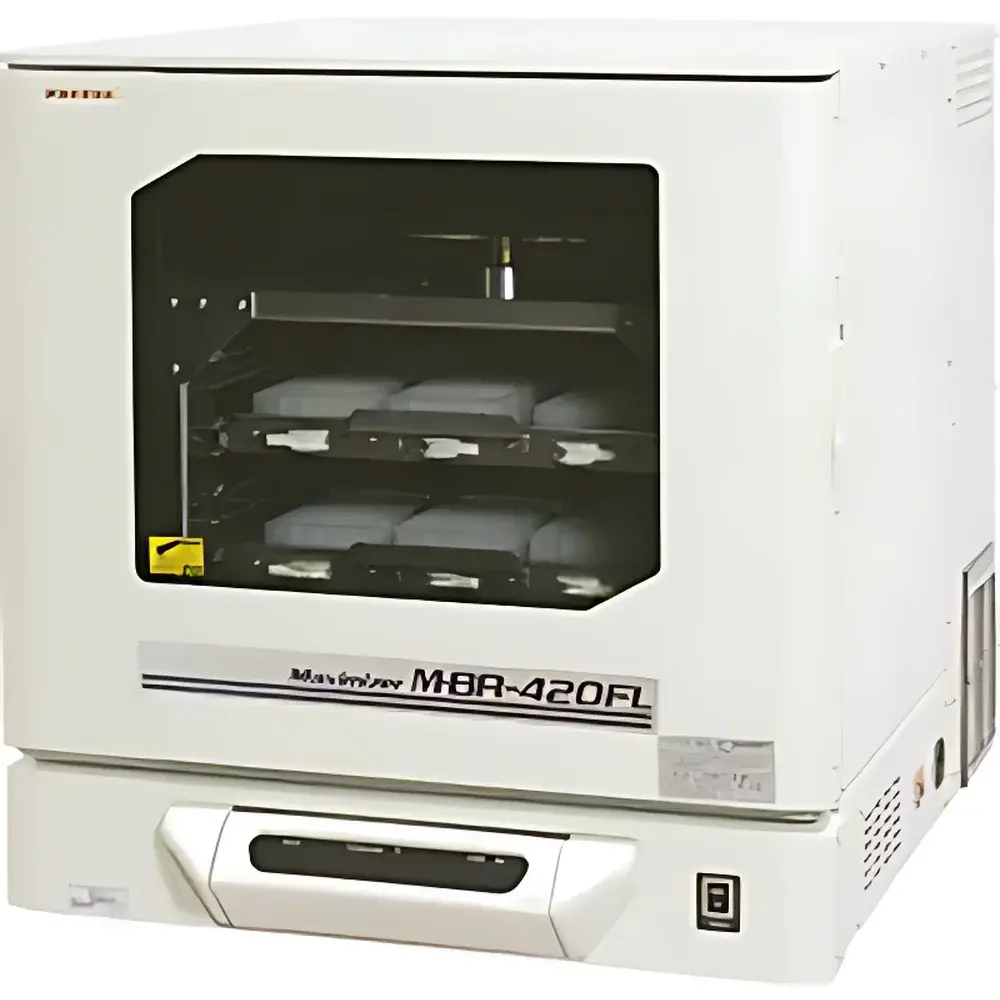
TAITEC M·BR-420FL Refrigerated Orbital Shaker Incubator
| Brand | TAITEC |
|---|---|
| Origin | Japan |
| Model | M·BR-420FL |
| Temperature Range | +4°C to +70°C |
| Temperature Accuracy | ±0.3°C to ±1.0°C |
| Oscillation Speed | 200–1500 rpm (reversible mode ≤1000 rpm) |
| Timer Range | 00h00m to 99h59m |
| Oscillation Mode | Horizontal eccentric motion with reversible function |
| Heating Power | 800 W |
| Cooling System | Compressor-based refrigeration (140 W) |
| Display | Digital LED for temperature and speed |
| Programmable Profiles | 4 programs × 9 steps (temperature, speed, time, hold function) |
| Dimensions (W×D×H) | 600 × 732 × 643 mm |
| Weight | ~100 kg |
| Electrical Supply | AC 100 V, 12 A |
| Platform Capacity | Up to 24 microplates (4 layers × 6 positions) or 12 deep-well plates (2 layers × 6 positions) |
| Operating Ambient Temperature | +5°C to +35°C |
| Compliance | Designed for GLP-compliant labs |
Overview
The TAITEC M·BR-420FL Refrigerated Orbital Shaker Incubator is an engineered solution for precision-controlled, temperature-regulated agitation in life science laboratories. It integrates active refrigeration and high-speed orbital shaking within a single compact chassis—enabling stable thermal environments from +4°C to +70°C while delivering consistent horizontal eccentric motion across a broad speed range (200–1500 rpm). Unlike ambient-only shakers, the M·BR-420FL employs a dedicated compressor-based cooling system (140 W), allowing reliable low-temperature operation essential for cold-sensitive enzymatic reactions, protein stability assays, and bacterial culture synchronization. Its dual-platform architecture supports parallel processing of standardized microplate formats—including 96-well, 384-well, and deep-well plates—without compromising mechanical reproducibility or thermal uniformity. The unit operates under closed-loop PID temperature control, achieving ±0.3°C to ±1.0°C accuracy depending on setpoint and load configuration, and is calibrated to meet routine verification requirements aligned with ISO 17025 technical competence criteria.
Key Features
- Refrigerated incubation capability from +4°C to +70°C—enabled by integrated compressor cooling and high-efficiency heating (800 W)
- Orbital shaking with reversible motion function (ON/OFF programmable; max 1000 rpm in reverse mode), enhancing mass transfer in viscous or particulate-laden samples
- Dual independent platform support: up to 24 standard microplates (4-layer stack, 6 per layer) or 12 deep-well plates (2-layer stack, 6 per layer)
- Programmable multi-step protocols: 4 user-defined programs, each with up to 9 sequential steps covering temperature, speed, duration, and hold activation
- Digital LED interface with real-time display of setpoint and actual values for both temperature and rpm
- Robust mechanical architecture rated for continuous operation at full load; weight-distributed base minimizes vibration transmission to adjacent instrumentation
- Compliance-ready design: supports audit trails via external logging devices; compatible with laboratory information management systems (LIMS) through RS-232 or optional analog output modules
Sample Compatibility & Compliance
The M·BR-420FL accommodates a wide range of vessel types through interchangeable platform accessories—including DWP-2412 (deep-well plate), MTP-2412 (microplate), SR-2412 (slip-resistant platform for Petri dishes), and EN1524 (microcentrifuge tube adapters). All platforms maintain traceable mechanical alignment and are validated for uniform motion distribution across the working surface (per ASTM E2500-13 guidance for equipment qualification). The unit meets electrical safety standards IEC 61010-1 and is designed for use in environments compliant with Good Laboratory Practice (GLP) and current Good Manufacturing Practice (cGMP) frameworks. While not inherently 21 CFR Part 11–certified, its programmable logic and digital interface support integration into validated workflows requiring electronic record retention, provided supplementary access controls and audit trail mechanisms are implemented at the system level.
Software & Data Management
The M·BR-420FL operates as a standalone instrument with embedded firmware controlling all thermal and mechanical parameters. No proprietary software is required for basic operation; however, optional RS-232 connectivity enables remote parameter setting and status polling using third-party SCADA or LIMS interfaces. Time-stamped operational logs—including start/stop events, temperature deviations exceeding ±1.5°C, and speed fluctuation alerts—can be exported manually via serial dump. For regulated environments, users may deploy external data loggers compliant with ISO/IEC 17025 clause 7.5.2 to capture and archive performance records. Firmware updates are distributed by TAITEC Japan upon notification of critical calibration or safety enhancements.
Applications
- Bacterial and yeast cultivation in 96-well or deep-well plates—enabling high-throughput growth curve generation equivalent to flask-based methods
- ELISA assay development and phage display panning, where controlled agitation improves antigen-antibody binding kinetics
- Enzymatic digestion of collagen-rich tissues (e.g., mouse tail tendons) under precisely maintained sub-physiological temperatures
- Solubilization of hydrophobic compounds or inclusion bodies, leveraging reversible oscillation to disrupt particle aggregation
- Cell-based screening assays requiring synchronized thermal and mechanical stress inputs
- Pre-incubation of PCR master mixes or NGS library preparations prior to thermocycling
FAQ
What is the minimum operating temperature, and how is it maintained?
The unit achieves +4°C using a dedicated refrigeration compressor; this is the lowest stable setpoint under standard ambient conditions (+5°C to +35°C). Frost accumulation is managed automatically during extended low-temperature operation.
Can the reversible oscillation function be scheduled within a program step?
Yes—reversal mode (ON/OFF), reversal interval, and reversal speed are configurable per step in the 9-step program sequence.
Is the temperature uniformity verified across the entire platform surface?
TAITEC specifies ±0.8°C maximum deviation across the working area at 37°C under no-load conditions; validation under load requires user-performed mapping per ISO/IEC 17025 Annex A.3.
Are platform accessories included or optional?
All plate-specific platforms (DWP-2412, MTP-2412, etc.) are optional accessories; the base unit ships with mounting hardware only.
Does the unit support networked monitoring or Ethernet connectivity?
No native Ethernet or Wi-Fi interface is provided; RS-232 remains the sole digital communication port. Integration with building management systems requires external protocol converters.





