
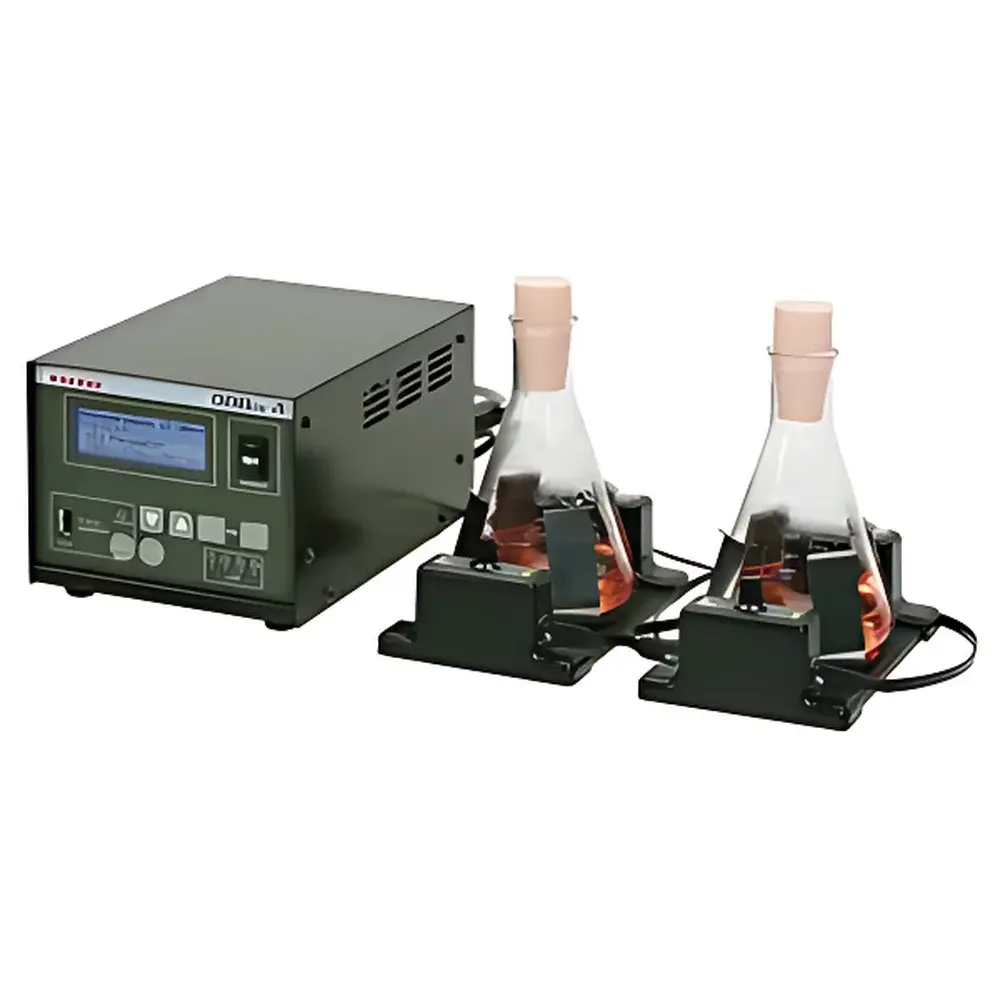
TAITEC OD-Monitor A&S Non-Contact Optical Density Monitor for Oscillatory Cultivation
| Brand | TAITEC |
|---|---|
| Origin | Japan |
| Model | OD-Monitor A&S |
| Measurement Range | 0.00–2.55 OD / 0.00–9.99 OD |
| Resolution | 0.1 NTU (OD-equivalent) |
| Operating Temperature | +15°C to +50°C |
| Accuracy | ±0.5% to ±1.5% (at specified OD range) |
| Configuration | Benchtop Laboratory System |
| Detection Principle | Near-Infrared Transmittance (950 nm) |
| Output Interface | USB 2.0, RS-232C |
| Channel Capacity | 8-channel simultaneous measurement |
| Calibration | User-adjustable correction factor (0.01–2.55) referenced to E. coli OD₆₀₀ |
Overview
The TAITEC OD-Monitor A&S is a benchtop, non-contact optical density monitor engineered specifically for real-time, in-situ turbidity measurement during oscillatory liquid culture in microbiological and bioprocess laboratories. Unlike conventional spectrophotometers requiring manual sampling and cuvette handling—processes that introduce contamination risk, workflow interruption, and measurement inconsistency—the OD-Monitor A&S employs a fixed-position near-infrared (950 nm) transmittance detection system that operates continuously while cultures rotate or reciprocate inside standard glass Erlenmeyer flasks (100–3000 mL). Its core principle relies on calibrated infrared light transmission through the culture medium, with signal conversion to OD₆₀₀-equivalent values based on empirical correlation with Escherichia coli growth profiles. The system is designed exclusively for integration with TAITEC’s BR-series rotary shakers and NR-series dual-platform oscillators, ensuring mechanical synchronization, vibration-dampened optical alignment, and stable signal acquisition under dynamic motion conditions. This eliminates the need for centrifugation, dilution, or offline sampling—enabling true continuous monitoring of microbial growth kinetics under aerobic, microaerobic, or controlled-gas environments.
Key Features
- Non-contact, real-time OD monitoring during active oscillation—no sampling, no contamination, no process interruption
- Dual-range optical detection: 0.00–2.55 OD (high-resolution mode) and 0.00–9.99 OD (extended-range mode), both referenced to E. coli OD₆₀₀ at 600 nm
- 8-channel parallel measurement capability with synchronized timing and independent calibration per channel
- User-configurable measurement intervals: 1, 5, 10, 30, 60, 120, or 240 minutes
- Adjustable sensor tilt angles (0°, 30°, 45°) to accommodate flask geometry and meniscus dynamics during rotation
- Integrated alarm function: audible alert triggered when measured OD exceeds user-defined threshold
- Data logging via USB 2.0 flash drive (TXT format), compatible with Excel-based post-processing and kinetic modeling
- Correction coefficient input (0.01–2.55) to align readings with lab-specific spectrophotometer baselines (e.g., BPM-10Bio or third-party UV-Vis systems)
- Grounded electrical architecture to minimize electromagnetic interference from shaker motors
Sample Compatibility & Compliance
The OD-Monitor A&S supports transparent borosilicate glass Erlenmeyer flasks (100, 200, 300, 500, 1000, 2000, and 3000 mL) filled to 20% ±10% nominal volume. Flasks must be free of colorants, baffles, or ground-glass side ports—features that distort infrared beam path integrity. For tube-based applications, φ16.5 mm and φ18 mm round-bottom glass tubes (5–10 mL volume) are supported using magnetic adapter plates. The system complies with standard laboratory safety and electromagnetic compatibility directives (IEC 61326-1). While not certified to ISO 9001 or FDA 21 CFR Part 11 out-of-the-box, its deterministic data output (timestamped TXT logs), audit-ready calibration logs, and deterministic trigger logic make it suitable for GLP-compliant workflows when paired with documented SOPs and version-controlled correction factors. It is routinely deployed in academic labs adhering to ASTM E2577 (Standard Practice for Bioprocess Monitoring) and ISO 20776-1 (Antimicrobial susceptibility testing).
Software & Data Management
No proprietary software installation is required. Raw OD values, timestamps, and channel identifiers are written directly to USB 2.0 storage devices in plain-text ASCII format (UTF-8 encoded), enabling immediate import into MATLAB, Python (pandas), R, or Excel for growth curve fitting (e.g., Gompertz, Logistic, or Baranyi models). Each log entry includes: [YYYY-MM-DD HH:MM:SS], [Channel ID], [OD Value], [Status Flag]. Optional RS-232C interface permits integration with custom LabVIEW or Python-based SCADA layers for automated feedback control (e.g., linking OD thresholds to external pump triggers via APU-01). All calibration parameters—including correction factor, zero offset, and slope—are stored in non-volatile memory within the ODBox-A control unit and persist across power cycles.
Applications
- High-temporal-resolution monitoring of slow-growing bacteria (e.g., Mycobacterium smegmatis, Streptomyces coelicolor) without perturbation
- Induction timing control in recombinant protein expression (e.g., IPTG addition at precise OD₆₀₀ setpoints)
- Competence development profiling in E. coli and Bacillus subtilis transformation protocols
- Algal biomass quantification in photobioreactor screening for biofuel feedstock optimization
- Pathogen growth kinetics under anaerobic or low-oxygen conditions (e.g., Clostridioides difficile, Helicobacter pylori)
- Quality-by-Design (QbD) implementation in early-stage bioprocess development
- Microbial inhibition assays where repeated sampling would alter metabolite gradients or redox potential
FAQ
Can the OD-Monitor A&S be used with non-TAITEC shakers?
No. Mechanical and electrical synchronization is only guaranteed with TAITEC BR-series rotary shakers and NR-series dual-platform oscillators. Third-party shakers introduce uncontrolled vibration harmonics and positional drift that compromise optical alignment and measurement repeatability.
Is the 950 nm wavelength affected by media coloration or pigment accumulation?
Yes—strongly absorbing or scattering components (e.g., hemin, melanin, chlorophyll-rich lysates) may require empirical correction. The built-in correction factor accommodates such deviations when validated against reference spectrophotometric measurements.
What is the minimum viable culture volume for reliable measurement?
For 100–500 mL flasks: ≥20% fill volume (±10%). For 1000–3000 mL flasks: ≥350 mL (for 1000 mL flask), ≥700 mL (for 2000 mL flask), ≥1000 mL (for 3000 mL flask). Lower volumes increase meniscus-induced signal noise.
Does the system support FDA 21 CFR Part 11 compliance?
The hardware provides traceable, time-stamped, immutable data export; however, full Part 11 compliance requires supplementary procedural controls (electronic signatures, audit trails, access logs), which must be implemented at the institutional level via LIMS or validated custom software.
How frequently should the system be recalibrated?
Calibration stability is verified during initial setup using a reference suspension (e.g., NIST-traceable latex microspheres). Under normal lab conditions, annual verification is recommended. Recalibration is required after mechanical impact, sensor repositioning, or change in flask type or media composition.





