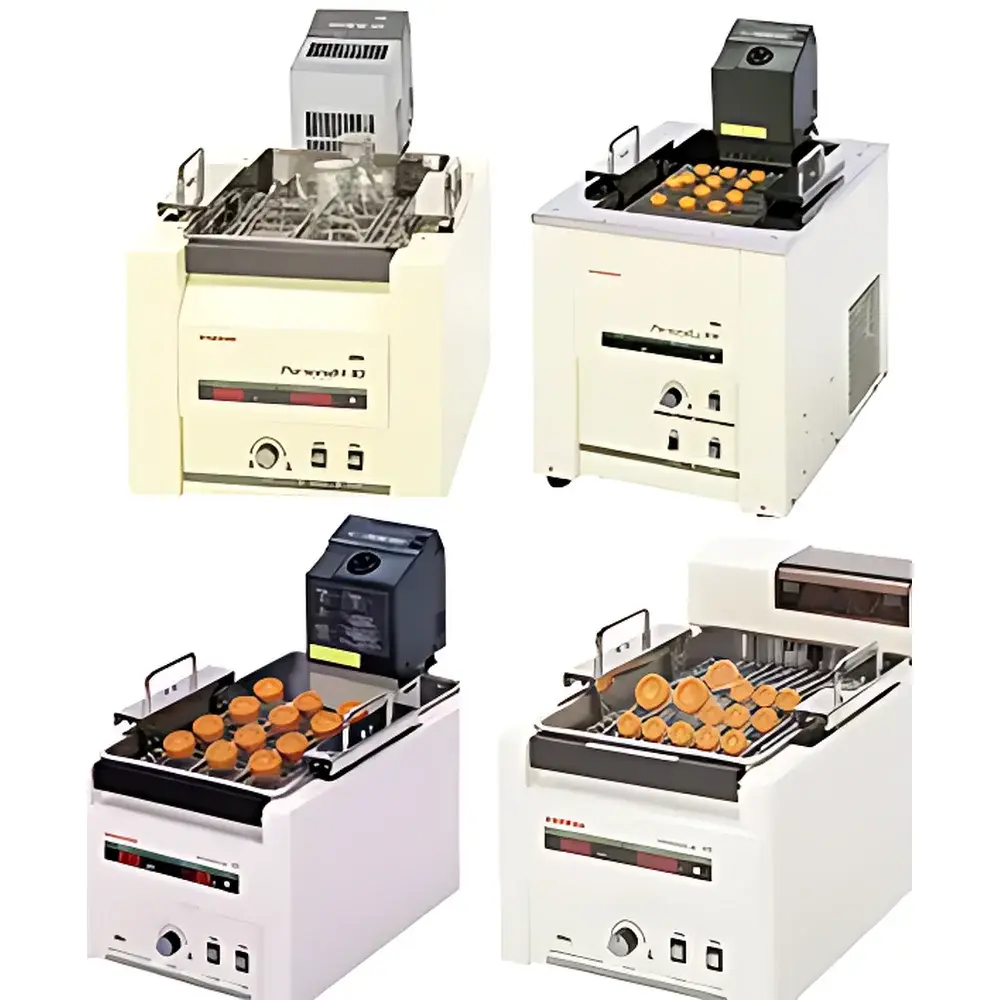
TAITEC Personal-11 Benchtop Orbital Shaking Incubator Water Bath
| Brand | TAITEC |
|---|---|
| Origin | Japan |
| Model | Personal-11 |
| Temperature Range | Room Temp +5°C to +85°C |
| Oscillation Frequency | 20–160 rpm |
| Oscillation Amplitude | 10–40 mm (infinitely adjustable) |
| Timer Range | 0.1–999.9 h |
| Chamber Capacity | ~11 L (at 80% fill level) |
| Platform Dimensions | 220 × 310 mm |
| Construction | Stainless steel wetted parts |
| Power Supply | AC 100 V, 7 A |
| Weight | ~19 kg |
Overview
The TAITEC Personal-11 Benchtop Orbital Shaking Incubator Water Bath is an engineered platform for precise temperature-controlled agitation of biological and biochemical samples. Designed around a robust thermal management architecture, it integrates PID-controlled heating with orbital shaking mechanics to maintain stable thermal environments while delivering reproducible mixing performance. Its core operating principle relies on resistive heating coupled with forced-air internal circulation and precision feedback via platinum RTD sensors—ensuring ±0.1°C temperature stability across its operational range (room temperature +5°C to +85°C). Unlike conventional water baths, the Personal-11 incorporates a low-power (500 W), high-efficiency heater—reducing energy consumption by approximately 50% without compromising thermal response or uniformity. This design enables consistent incubation of microbial cultures (e.g., E. coli, yeast), enzymatic assays, antigen-antibody reactions, and asbestos sample preparation workflows under controlled, auditable conditions.
Key Features
- Energy-efficient thermal control system with 500 W heating capacity—engineered for laboratory sustainability without sacrificing performance
- Five-user-programmable memory slots for rapid recall of frequently used temperature setpoints
- Infinitely variable oscillation amplitude (10–40 mm) and speed (20–160 rpm), both mechanically adjustable for method optimization
- Modular, tool-free assembly: detachable stainless steel water bath tank, oscillation platform, and temperature controller facilitate cleaning, maintenance, and sterilization
- Stainless steel wetted surfaces—including tank interior, platform, and fluid-contact components—resist corrosion and support ISO 14644-compliant cleanroom-compatible handling
- Digital display with dual-mode readout: simultaneous viewing of setpoint and real-time bath temperature
- Integrated safety suite including float-type overheat protection, low-water-level detection, thermal runaway monitoring, and sensor fault diagnostics
Sample Compatibility & Compliance
The Personal-11 accommodates standard labware via its spring-grid oscillation platform (included), supporting up to 187 × 11 mm test tubes, 12 × 50 mL centrifuge tubes, 6 × 250 mL Erlenmeyer flasks, or 3 × 500 mL flasks. Its 11 L working volume (at 80% fill) ensures sufficient liquid mass for thermal inertia and uniform heat distribution. The system complies with general-purpose laboratory safety standards (IEC 61010-1) and supports GLP/GMP-aligned operation through traceable temperature logging (when paired with optional external data loggers). While not inherently 21 CFR Part 11 compliant, its deterministic timer functionality (0.1–999.9 h, auto-reset) and stable PID regulation enable validation-ready protocols per ASTM D5296 (for enzyme kinetics) or USP (for endotoxin testing preparations).
Software & Data Management
The Personal-11 operates as a standalone hardware platform with no embedded firmware-based software stack. All controls are executed via physical UP/DOWN keys and a digital LCD interface. Temperature and timing parameters are stored in non-volatile memory and retain settings after power cycling. For auditability, users may integrate third-party USB or RS-232 data loggers (e.g., Omega OM-DAQPRO-5300) to record time-stamped temperature and oscillation status. The system’s deterministic behavior—combined with its ±0.1°C thermal accuracy and mechanical repeatability—supports IQ/OQ documentation per ISO/IEC 17025 requirements. No cloud connectivity, remote access, or proprietary drivers are required or supported.
Applications
- Microbial cultivation: aerobic growth of E. coli, Bacillus subtilis, and yeast strains under defined temperature and aeration conditions
- Enzyme kinetics studies requiring precise thermal control during substrate incubation (e.g., restriction digests, ligations, phosphatase assays)
- Sample homogenization and solubilization prior to analytical testing—including asbestos fiber dispersion per EPA Method IO-3.2
- Hybridization protocols for DNA/RNA blotting where uniform agitation prevents membrane drying and improves probe binding efficiency
- Cell suspension maintenance during transient transfection or metabolic labeling experiments
- Pre-analytical sample conditioning for HPLC, GC-MS, or ELISA workflows where thermal history must remain within validated bounds
FAQ
Does the Personal-11 support refrigerated operation?
No—the Personal-11 is a heating-only unit. For sub-ambient applications, TAITEC offers the Personal LT-10F.SX set (-10°C to +50°C), which integrates a sealed-air refrigeration module.
Can I use silicone oil instead of water in the bath?
Silicone oil is compatible only with the Personal H-10.SH set (rated to +180°C). Using oil in the Personal-11 voids warranty and compromises thermal calibration due to differing heat capacity and convection dynamics.
Is the oscillation motion truly orbital, or is it reciprocating?
The Personal-11 employs a circular orbital motion—not linear reciprocation—ensuring gentle yet effective suspension of cells and particles without excessive shear stress.
What is the maximum load capacity of the oscillation platform?
The platform supports up to 5 kg distributed load; exceeding this may degrade amplitude consistency and accelerate mechanical wear.
How often does the system require calibration verification?
Per ISO/IEC 17025 guidance, annual verification against NIST-traceable RTD references is recommended—particularly before critical validation runs or after extended continuous operation (>500 h).