
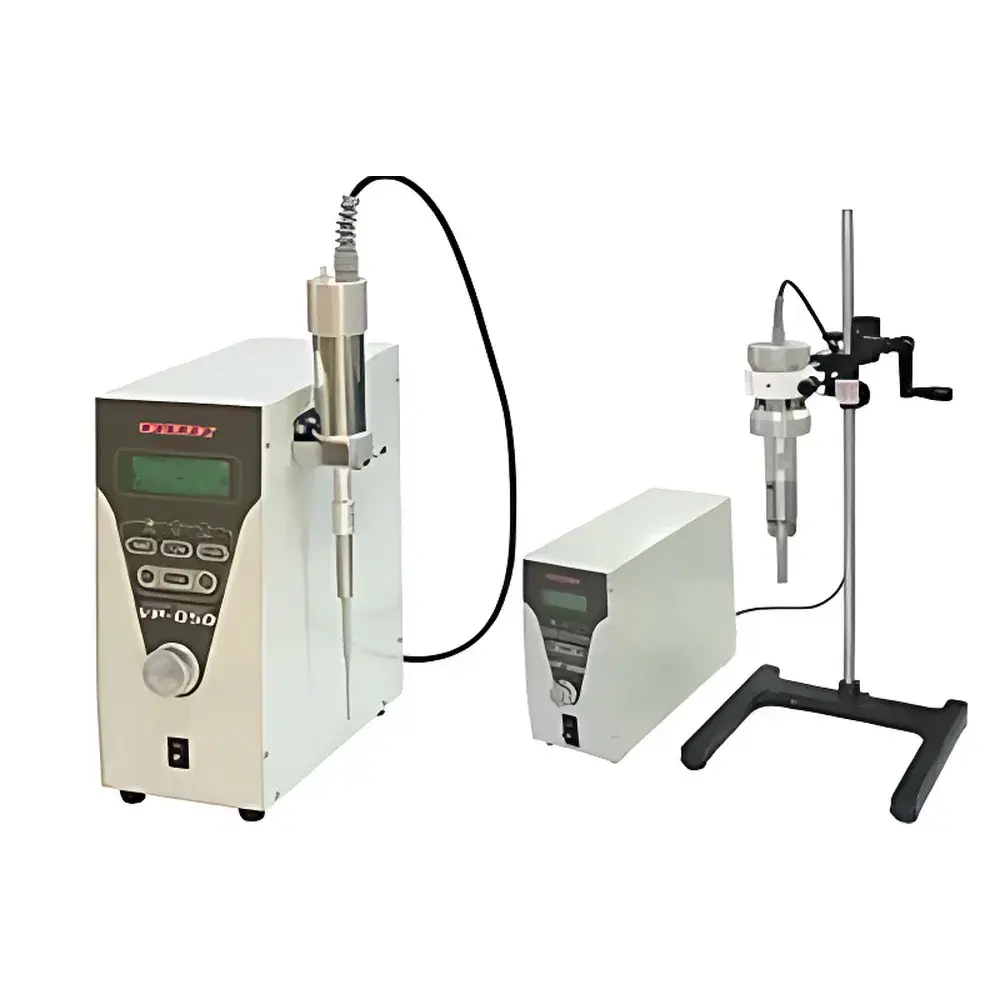
TAITEC VP-050N & VP-300N Ultrasonic Cell Disruptors
| Brand | TAITEC |
|---|---|
| Origin | Japan |
| Model | VP-050N / VP-300N |
| Output Power | 50 W (VP-050N), 300 W (VP-300N) |
| Frequency Range | 19.5–20.5 kHz (VP-050N), 19–21 kHz (VP-300N) |
| Transducer Interface | Integrated horn-type piezoelectric converter with auto-tuning |
| Control | Digital LCD interface with real-time % output, current, temperature (*optional sensor), timer (1 s–120 min), and pulse mode (ON/OFF: 0.1–60 s) |
| Probe Options | Φ2 mm, Φ3 mm, Φ6 mm stepped microprobes (VP-050N) |
| Dimensions (W×D×H) | 122×288×283 mm (VP-050N), 143×360×283 mm (VP-300N) |
| Weight | 4.5 kg (VP-050N), 6.7 kg (VP-300N) |
| Power Supply | AC 100 V, 1 A (VP-050N), AC 100 V, 5 A (VP-300N) |
| Compliance | Designed for GLP-compliant lab environments |
Overview
The TAITEC VP-050N and VP-300N Ultrasonic Cell Disruptors are precision-engineered benchtop sonicators designed for reproducible, controllable lysis of biological samples under defined acoustic energy delivery. Based on piezoelectric transduction at frequencies near 20 kHz, these instruments generate high-intensity cavitation in liquid media—inducing shear forces sufficient to disrupt bacterial cell walls (e.g., E. coli), solubilize inclusion bodies, fragment genomic DNA randomly, homogenize viscous suspensions, and emulsify immiscible phases. The VP-050N serves low-volume applications (0.1–10 mL) using handheld microprobes, while the VP-300N delivers scalable power (up to 300 W) for multi-sample processing, flow-through configurations, or non-contact cup-horn operation—enabling consistent throughput across R&D, QC, and process development workflows in molecular biology, biopharmaceutical manufacturing, and academic core facilities.
Key Features
- Auto-Frequency Tracking (AFT): Both models continuously monitor and adjust operating frequency in real time to maintain resonance despite changes in sample viscosity, temperature, or probe loading—ensuring stable acoustic output and minimizing transducer stress.
- Digital Output Control & Monitoring: Intuitive LCD interface displays real-time values for set output (%), actual current output (%), initial burst output (%), and optional temperature feedback—supporting traceable parameter recording per run.
- Intelligent Auto-Power Regulation: Dynamically modulates delivered power during operation to compensate for load variations, preserving constant energy density at the probe tip—a critical factor for reproducible lysis efficiency and biomolecule integrity.
- Programmable Pulse Sequencing: Configurable ON/OFF intervals (0.1–60 s resolution) and total runtime (1 s–120 min) allow precise control over thermal accumulation and cavitation duty cycle—essential for heat-sensitive proteins or nucleic acids.
- Modular Probe Architecture: VP-050N accepts interchangeable stepped microprobes (Φ2/Φ3/Φ6 mm) for microcentrifuge tubes; VP-300N supports standardized horns (Φ12/Φ20 mm), conical probes, cup transducers (Φ32/Φ51 mm), and continuous-flow cells—enabling method transfer from small-scale optimization to pilot-scale processing.
Sample Compatibility & Compliance
These disruptors accommodate a broad range of biological matrices—including Gram-negative and Gram-positive bacteria, yeast, mammalian cell pellets, tissue homogenates, and synthetic emulsions—without requiring chemical lysis reagents. All probe geometries are manufactured from titanium alloy (Grade 5) for corrosion resistance and acoustic efficiency. The systems comply with IEC 61000-6-3 (EMC emission standards) and are engineered for use in ISO 17025-accredited laboratories. Optional RS-232 connectivity enables integration with LIMS or electronic lab notebooks supporting 21 CFR Part 11-compliant audit trails when paired with validated software. Temperature monitoring (via optional external sensor) facilitates adherence to USP & EP guidelines for controlled lysis protocols.
Software & Data Management
While standalone operation requires no PC, the RS-232 port (standard on VP-300N, optional on VP-050N) permits remote command execution and real-time parameter logging—including timestamped output %, elapsed time, pulse count, and thermal feedback. Custom scripts or third-party SCADA platforms can trigger sequences, archive run logs, and generate CSV reports for batch record review. Firmware updates preserve backward compatibility with existing probe libraries and calibration profiles—ensuring long-term method consistency across instrument lifecycles.
Applications
- Preparation of soluble recombinant protein extracts from E. coli BL21(DE3) cultures
- Shearing chromatin for ChIP-seq and ATAC-seq library construction
- Homogenization of fibrous tissues (e.g., liver, muscle) prior to RNA isolation
- Emulsification of lipid nanoparticles (LNPs) for mRNA delivery system development
- Disaggregation of amyloid fibrils or protein aggregates in neurodegenerative disease research
- Cell lysis validation studies under GMP-aligned process characterization protocols
FAQ
What is the difference between the VP-050N and VP-300N in terms of scalability?
The VP-050N is optimized for single-tube, low-volume (<10 mL), manual operation using handheld microprobes; the VP-300N supports fixed-position mounting, multiple probe types, cup-horn configurations, and continuous-flow processing—making it suitable for method development, parallel sample handling, and early-stage process scale-up.
Can these instruments be used for sterilization or microbial inactivation?
No—these devices are not validated for sterilization. Their primary function is mechanical disruption via acoustic cavitation, not microbial kill kinetics. Sterility assurance requires complementary methods (e.g., filtration, autoclaving, or chemical treatment).
Is temperature control integrated into the system?
Real-time temperature monitoring is available only as an optional add-on via external sensor input; active cooling (e.g., recirculating chiller coupling) must be implemented externally using jacketed vessels or ice baths per protocol requirements.
Are calibration certificates provided with purchase?
TAITEC supplies factory calibration documentation traceable to JIS Z 8015 standards; users may perform periodic verification using calibrated hydrophones or calorimetric methods per ISO 18592:2018 guidelines for ultrasonic power measurement.
How often does the titanium probe require replacement?
Probe lifetime depends on usage intensity and sample abrasiveness; typical service life exceeds 500 hours under recommended duty cycles. Visual inspection for pitting, erosion, or diameter reduction >5% warrants replacement to maintain acoustic coupling efficiency and reproducibility.





