
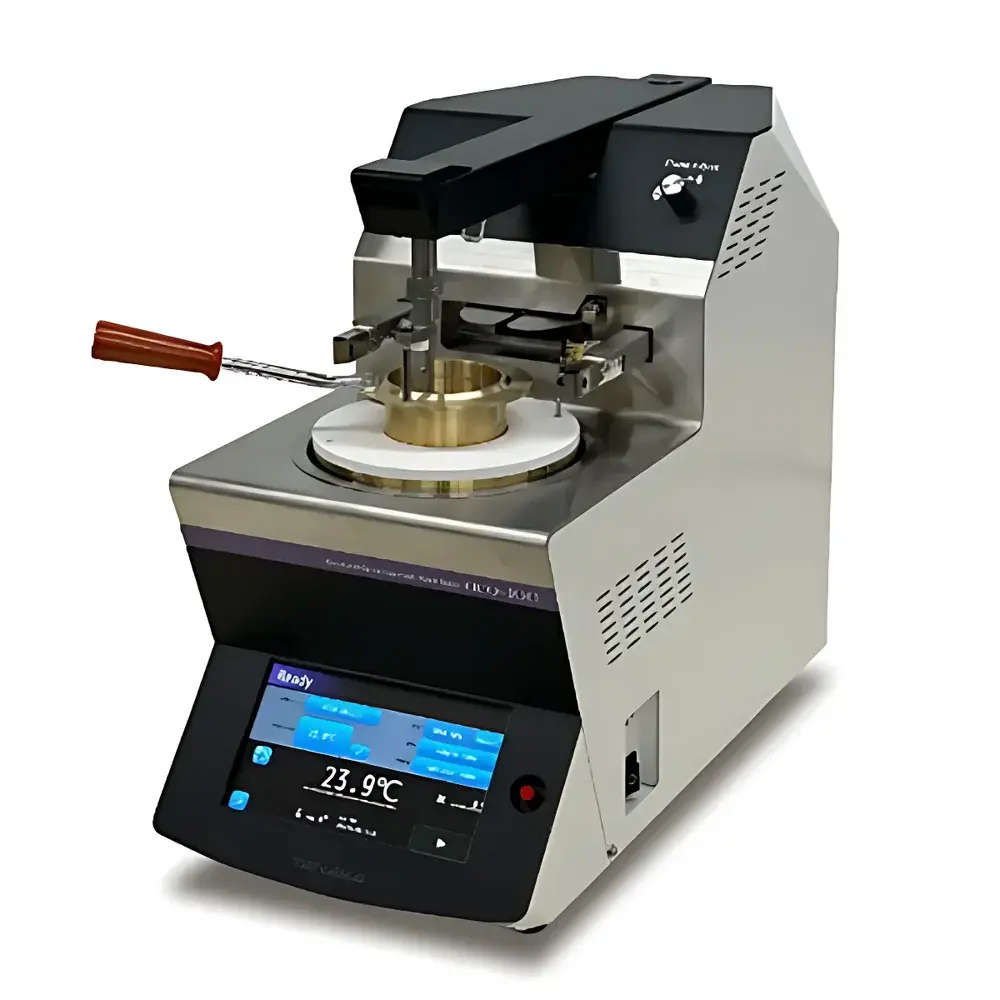
TANAKA ACO-100 Cleveland Open Cup Flash Point Tester
| Brand | TANAKA |
|---|---|
| Origin | Japan |
| Model | ACO-100 |
| Test Method | Cleveland Open Cup (COC) |
| Operation Mode | Fully Automatic |
| Applicable Standards | ISO 2592, ASTM D92, IP 36 |
| Ignition Source | Electric or Gas Pilot Flame |
| Temperature Range | Ambient to 400 °C |
| Data Storage Capacity | 200 test records |
| Interface Options | USB, RS-232 |
| Optional Accessories | Thermal Printer, USB Keyboard, USB Flash Drive |
| Security | Password-protected test program |
| Safety Features | Auto-ignition detection, auto-extinguishing system (activated upon flash point confirmation or sustained flame ≥5 s) |
Overview
The TANAKA ACO-100 Cleveland Open Cup Flash Point Tester is an engineered solution for precise and repeatable determination of flash point and fire point of petroleum products, bituminous materials, lubricants, and other combustible liquids according to internationally recognized open-cup methodologies. Based on the Cleveland Open Cup (COC) principle—where a sample is heated in a standardized brass cup while an ignition source is periodically passed across the surface—the ACO-100 measures the lowest temperature at which vapors above the sample ignite momentarily (flash point) and the temperature at which combustion sustains for at least five seconds (fire point). Designed for compliance-driven laboratories, the instrument implements strict thermal ramping profiles, real-time vapor monitoring, and closed-loop temperature control to ensure adherence to ISO 2592, ASTM D92, and IP 36 test protocols without operator intervention.
Key Features
- Fully automated operation with single-action setup: integrated flash point detection ring and Pt100 temperature sensor mounted on a precision-balanced test arm for consistent sample positioning and minimal thermal lag.
- Dual-point thermal calibration traceable to NIST-certified reference standards, supporting ambient-to-400 °C measurement range with ±0.5 °C accuracy in the critical 100–400 °C interval.
- Intelligent ignition management: selectable electric spark or pilot gas flame ignition, with automatic timing synchronization relative to ASTM D92-defined sweep intervals.
- Integrated safety architecture: flame detection via optical sensor triggers immediate activation of a CO₂-based extinguishing mechanism—designed to suppress ignition within <1.2 seconds of flame onset or confirmed fire point attainment.
- Password-protected method configuration prevents unauthorized modification of test parameters, supporting GLP-compliant workflow integrity and audit readiness.
- Lightweight monocoque chassis—approximately 30% lighter than its predecessor (ACO-7)—optimized for benchtop stability and reduced mechanical resonance during high-temperature ramping.
Sample Compatibility & Compliance
The ACO-100 accommodates standard 100-mL Cleveland cups and supports viscous samples up to 500 cSt at 40 °C without preheating or dilution. It is validated for use with crude oils, fuel oils, residual fuels, asphalt binders, transformer oils, and industrial solvents. All operational sequences—including heating rate (14–17 °C/min per ASTM D92), ignition frequency (every 2 °C after 23 °C), and dwell time—are firmware-locked to match clause-specific requirements of ISO 2592, ASTM D92, and IP 36. The system includes built-in compliance verification logs that record timestamped deviations, sensor health status, and thermal profile fidelity—essential for FDA 21 CFR Part 11–aligned environments and third-party accreditation audits (e.g., ISO/IEC 17025).
Software & Data Management
Test execution, parameter configuration, and result review are managed via an embedded 7-inch resistive touchscreen interface with intuitive icon-driven navigation. Up to 200 complete test records—including sample ID, ambient conditions, observed flash/fire points, ramp rate, ignition events, and pass/fail flags—are stored internally with date/time stamps and operator ID fields. Data export is supported via USB 2.0 (to CSV or XML) and RS-232 serial (ASCII protocol) for seamless integration into LIMS or ELN platforms. Optional accessories include a certified thermal printer (supporting GLP-compliant hardcopy with header metadata) and USB keyboard for alphanumeric sample naming—both recognized as plug-and-play peripherals without driver installation.
Applications
- Quality control of distillate and residual fuel oils in refinery QC labs
- Flash point verification of used lubricants per OEM service specifications
- Regulatory testing of bituminous binders for road construction compliance (ASTM D36)
- Fire hazard assessment of industrial solvents under OSHA and NFPA 30 guidelines
- Research-grade thermal stability profiling of bio-based diesel blends
- Third-party certification testing for UN Transport Classification (Class 3 Flammable Liquids)
FAQ
Does the ACO-100 support both flash point and fire point determination in a single run?
Yes. The instrument automatically transitions from flash point detection to fire point evaluation upon first ignition, maintaining continuous heating until sustained combustion (>5 s) is optically confirmed.
Is external calibration required before each test series?
No. The system performs automatic zero-offset compensation and internal reference checks at power-on and between tests; however, annual traceable calibration using certified flash point standards (e.g., n-decane, tetralin) is recommended per ISO/IEC 17025.
Can test methods be customized beyond ASTM D92 or ISO 2592?
Method parameters are locked to published standards to ensure regulatory validity; custom ramp rates or ignition intervals are not permitted in compliance mode.
What safety certifications does the ACO-100 hold?
It complies with IEC 61010-1 (Safety Requirements for Electrical Equipment for Measurement, Control, and Laboratory Use) and carries PSE marking for the Japanese market; CE marking is available upon request for EU deployment.
How is data integrity ensured during USB transfer?
All exported files include SHA-256 checksums and embedded digital signatures tied to the instrument’s unique serial number and firmware revision—enabling forensic verification of data provenance in regulated environments.




