
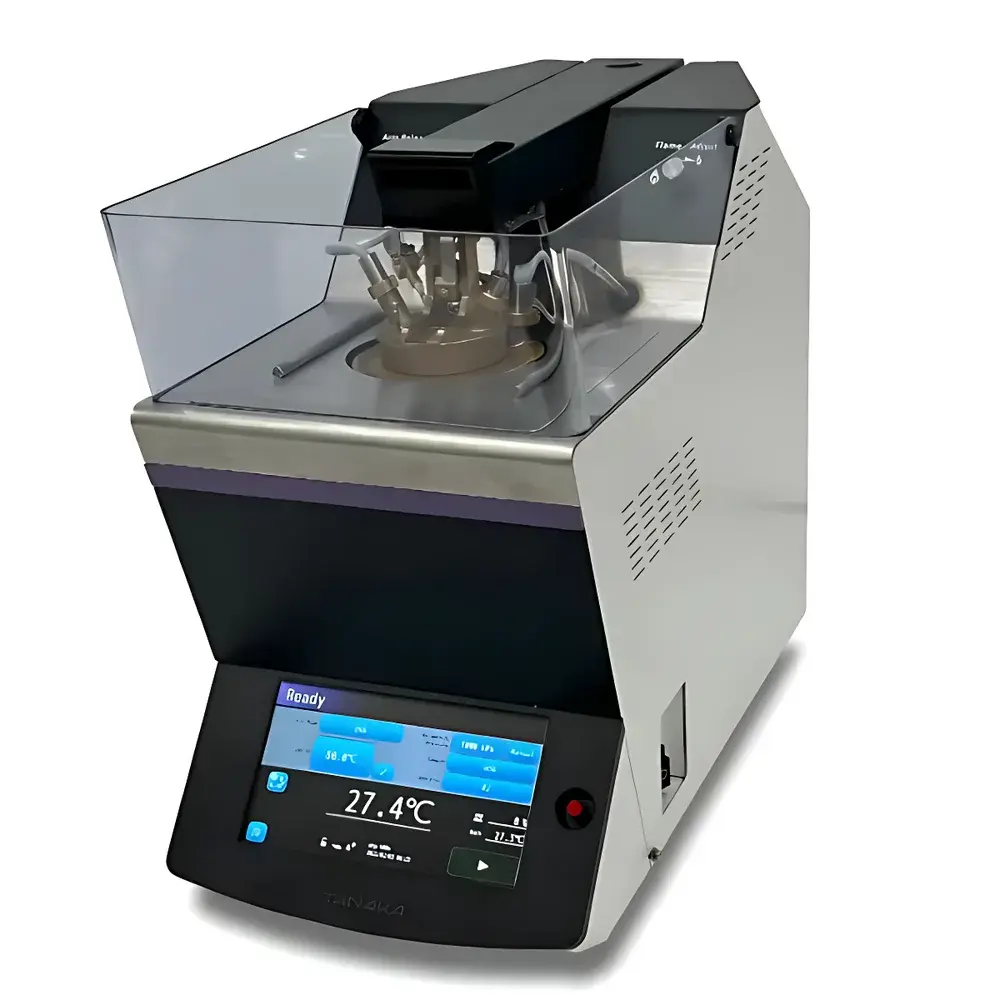
TANAKA APM-100 Pensky-Martens Closed-Cup Flash Point Tester
| Brand | TANAKA |
|---|---|
| Origin | Japan |
| Model | APM-100 |
| Test Method | Closed-Cup (Pensky-Martens) |
| Operation Mode | Fully Automatic |
| Applicable Standards | ASTM D93, GB/T 261, ISO 2719 |
| Ignition Source | Dual-mode (Gas Flame & Electric Spark) |
| Temperature Range | Ambient to 370 °C |
| Data Storage Capacity | 200 test records |
| Interface | USB (for keyboard, flash drive, and LIMS export) |
| Security | Password-protected test program |
| Safety Features | Integrated thermal cutoff, flame detection interlock, and automatic lid closure |
Overview
The TANAKA APM-100 Pensky-Martens Closed-Cup Flash Point Tester is a compact, fully automated analytical instrument engineered for precise determination of the flash point of petroleum products, solvents, lubricants, and other flammable liquids according to internationally recognized closed-cup methodologies. It operates on the fundamental principle of controlled heating in a sealed test cup while periodically introducing an ignition source—either a calibrated gas flame or electric spark—at defined temperature intervals. When vapors above the sample ignite momentarily upon exposure to the ignition source, the lowest temperature at which this occurs is recorded as the flash point. This thermodynamic endpoint serves as a critical safety parameter in refining, transportation, storage, and regulatory compliance workflows. Designed to meet the strict procedural requirements of ASTM D93 (Standard Test Method for Flash Point by Pensky-Martens Closed Cup Tester), ISO 2719, and GB/T 261, the APM-100 delivers high reproducibility across its full operating range from ambient temperature up to 370 °C.
Key Features
- Compact monolithic architecture—the smallest commercially available Pensky-Martens closed-cup flash point tester globally—optimized for benchtop deployment in QC laboratories with spatial constraints.
- Integrated test arm assembly housing both the flash point detection loop and platinum resistance thermometer (PRT), enabling synchronized thermal profiling and ignition timing without manual alignment.
- One-touch operation: users select test mode (e.g., Method A or B per ASTM D93), enter estimated flash point, and initiate fully compliant automated sequence—including cup filling, heating ramp, stirring control, ignition timing, and endpoint validation.
- Dual ignition capability: seamless switching between propane-based flame ignition and high-energy electric spark ignition via front-panel selection; each mode adheres to respective energy calibration requirements specified in ASTM D93 Annex A1 and A2.
- Embedded safety logic includes real-time flame presence monitoring, overtemperature cutoff (>375 °C), automatic lid closure upon ignition cycle completion, and fail-safe cooling initiation post-test.
- Password-protected method configuration prevents unauthorized modification of test parameters, supporting audit readiness under GLP and GMP frameworks.
Sample Compatibility & Compliance
The APM-100 accommodates standard 70–75 mL test samples in accordance with ASTM D93 specifications. It supports viscous liquids (including used engine oils and bituminous materials) when preheated to reduce viscosity prior to loading. All operational sequences—including heating rate (5–6 °C/min during final approach), stir speed (90±5 rpm), and ignition frequency (every 1–2 °C)—are programmatically enforced to ensure strict conformance with ASTM D93, ISO 2719, and GB/T 261. The system’s firmware is validated against NIST-traceable reference standards and includes built-in verification routines for temperature sensor linearity and ignition source energy output. Instrument qualification documentation supports 21 CFR Part 11-compliant environments when paired with optional electronic signature modules and audit trail logging.
Software & Data Management
Test data—including sample ID, operator ID, start/end time, observed flash point, atmospheric pressure correction factor, and pass/fail status—are timestamped and stored locally in non-volatile memory (capacity: 200 records). USB connectivity enables direct export of CSV-formatted reports to external drives or laboratory information management systems (LIMS). Optional USB keyboard integration allows alphanumeric sample naming without reliance on external PCs. Firmware updates and method templates can be loaded via USB flash media. Audit trail functionality—when enabled—logs all user actions, parameter changes, and system events with immutable timestamps, satisfying traceability requirements under ISO/IEC 17025 and FDA-regulated quality systems.
Applications
- Quality control of crude oil fractions, gasoline, diesel, kerosene, and jet fuels in refinery laboratories.
- Flash point verification of industrial solvents (e.g., toluene, xylene, acetone) for SDS preparation and OSHA hazard communication compliance.
- Stability assessment of transformer oils and hydraulic fluids per IEC 60814 and ASTM D92 (open cup) cross-reference protocols.
- Regulatory submission testing for EPA, DOT, and IMDG Code classifications of hazardous materials transport.
- R&D screening of biofuel blends and synthetic lubricants where thermal volatility profiling informs formulation optimization.
FAQ
Does the APM-100 comply with ASTM D93 Method A and Method B?
Yes—the instrument automatically adjusts heating rate, stir speed, and ignition timing based on selected method, ensuring full procedural equivalence to both ASTM D93-22 Annex A1 (Method A) and Annex A2 (Method B).
Can test results be exported directly to a LIMS without intermediate software?
Yes—via USB mass storage mode, the APM-100 writes standardized CSV files compatible with most LIMS ingestion protocols; no proprietary drivers or middleware are required.
Is external atmospheric pressure input required for correction?
No—the unit includes a built-in barometric sensor; pressure compensation is applied automatically during result calculation per ASTM D93 Section 10.3.
What maintenance is required for the ignition system?
Gas nozzle cleaning and spark electrode gap verification (0.5 ± 0.05 mm) are recommended after every 50 tests; full calibration checks are advised annually using certified reference materials.
How is user access controlled in multi-operator environments?
Three-tier password protection is implemented: operator-level (test execution only), supervisor-level (method editing), and administrator-level (system configuration and audit log review).





