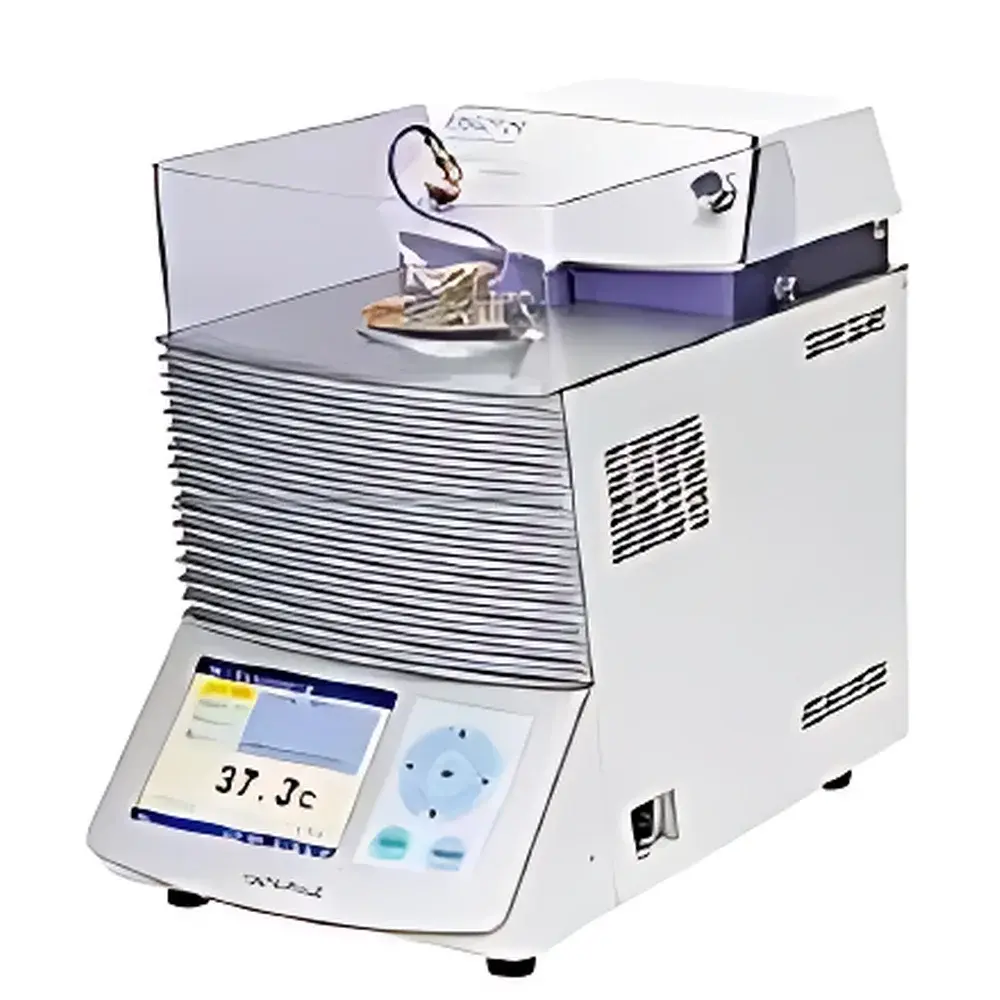
TANAKA ASC-8C Automatic Equilibrium Closed-Cup Flash Point Tester
| Brand | TANAKA |
|---|---|
| Origin | Japan |
| Model | ASC-8C |
| Test Method | Closed-Cup Equilibrium Method |
| Operating Mode | Fully Automatic |
| Applicable Standards | ISO 3679, ISO 3680, ASTM D3278, ASTM D7236, IP 534 |
| Temperature Range | −30 °C to +100 °C |
| Ignition Source | Dual-mode (electric spark or gas flame) |
| Repeatability | High |
| Atmospheric Pressure Compensation | Integrated barometric sensor |
| Data Storage Capacity | 200 test records |
| Output Options | Thermal printer, USB export, LIMS integration |
| Security | Password-protected user interface |
| Compliance | Designed for GLP-compliant laboratories and routine QC environments |
Overview
The TANAKA ASC-8C Automatic Equilibrium Closed-Cup Flash Point Tester is an engineered solution for precise, repeatable flash point determination of volatile petroleum-based liquids, coatings, adhesives, solvents, and related industrial fluids. It operates on the equilibrium closed-cup principle—where the sample is heated in a sealed cup until vapor–air equilibrium is established, followed by controlled ignition source application at defined temperature intervals. This methodology ensures strict adherence to internationally recognized flash point test protocols, particularly those requiring thermodynamic equilibrium conditions prior to ignition assessment. The ASC-8C is optimized for routine quality control laboratories, refinery process labs, and regulatory testing facilities where compliance with ISO, ASTM, and IP standards is mandatory. Its compact footprint, integrated environmental compensation, and automated decision logic eliminate operator-dependent variability while maintaining full traceability under Good Laboratory Practice (GLP) frameworks.
Key Features
- Fully automated equilibrium-based flash point measurement with real-time temperature ramping and dynamic ignition timing per standard-defined intervals.
- Dual ignition capability—seamless switching between electric spark and gas flame ignition without mechanical reconfiguration or hardware replacement.
- Integrated high-accuracy barometric pressure sensor enabling automatic correction of flash point values to standard atmospheric pressure (101.3 kPa), critical for inter-laboratory comparability.
- Color-coded 7-inch TFT LCD display that dynamically changes background hue (e.g., blue → amber → red) corresponding to test phase progression—equilibration, ignition sequence, and result confirmation.
- Self-diagnostic system with fault logging: detects anomalies in heater response, sensor drift, ignition failure, or pressure transducer deviation and halts operation with on-screen error code and description.
- Configurable test modes—including standard-compliant preset methods (ISO 3679, ASTM D3278, etc.) and customizable user-defined protocols with adjustable ramp rate, hold time, and ignition frequency.
- In-test parameter adjustment: operators may modify the estimated flash point during active testing to optimize heating profile and conserve sample volume—particularly valuable when screening unknown or variable-batch materials.
- Password-protected access levels (operator, supervisor, administrator) ensuring procedural integrity and audit readiness in regulated environments.
Sample Compatibility & Compliance
The ASC-8C is validated for use with transparent or opaque liquid samples exhibiting flash points between −30 °C and +100 °C, including but not limited to: hydrocarbon solvents, alkyd resins, nitrocellulose lacquers, epoxy diluents, cleaning formulations, and distillate fractions. It meets the mechanical, thermal, and procedural requirements of ISO 3679 (determination of flash point — Small scale closed cup method), ISO 3680 (repeatability and reproducibility criteria), ASTM D3278 (flash point by Setaflash closed tester), ASTM D7236 (Mini-Setaflash method), and IP 534 (closed cup equilibrium method). All internal calibration routines align with manufacturer-recommended traceable reference standards, supporting 21 CFR Part 11–compliant electronic recordkeeping when interfaced with validated LIMS platforms.
Software & Data Management
Test data—including date/time stamp, ambient pressure, sample ID, method used, raw temperature readings, ignition events, final flash point, and pass/fail status—are stored locally in non-volatile memory (200-test capacity). Export options include direct thermal printing (with header/footer customization), USB mass-storage mode for CSV file transfer, and bidirectional RS-232 or USB-to-serial communication for LIMS integration. Audit trails capture all user actions, parameter modifications, and system alerts. Firmware supports periodic updates via secure USB load, with version-controlled release notes and change logs retained in device memory.
Applications
- Quality assurance of incoming raw materials (e.g., solvent blends, monomers, thinners) in paint, ink, and adhesive manufacturing.
- Batch release testing of finished petroleum distillates (naphtha, kerosene, diesel fractions) per refinery specifications.
- Regulatory submission support for SDS (Safety Data Sheet) Section 9 classification under GHS and CLP frameworks.
- Research and development of low-flash reformulations, including bio-based solvents and halogen-free alternatives.
- Third-party certification labs performing accredited flash point testing under ISO/IEC 17025 scope.
FAQ
Does the ASC-8C comply with ASTM D93?
No—the ASC-8C implements the equilibrium closed-cup method per ASTM D3278 and D7236, not the Pensky-Martens method covered by ASTM D93.
Can the instrument be calibrated using certified reference materials?
Yes—calibration verification is performed using NIST-traceable or equivalent flash point standards (e.g., n-decane, n-dodecane) in “Standard Mode,” with results logged and printable.
Is remote monitoring or network connectivity supported?
The ASC-8C does not feature Ethernet or Wi-Fi; however, it supports serial command protocol (SCPI-like) over RS-232 for integration into centralized lab automation systems.
What maintenance is required for long-term accuracy?
Routine cleaning of the test cup, lid, and ignition electrode is recommended after every 20 tests; annual verification of temperature sensor linearity and pressure sensor offset is advised per ISO/IEC 17025 maintenance schedules.
How is atmospheric pressure compensation applied mathematically?
The instrument applies the ASTM E1–10 correction algorithm, adjusting observed flash point based on measured local pressure relative to 101.325 kPa, with interpolation across the full −30 °C to +100 °C range.