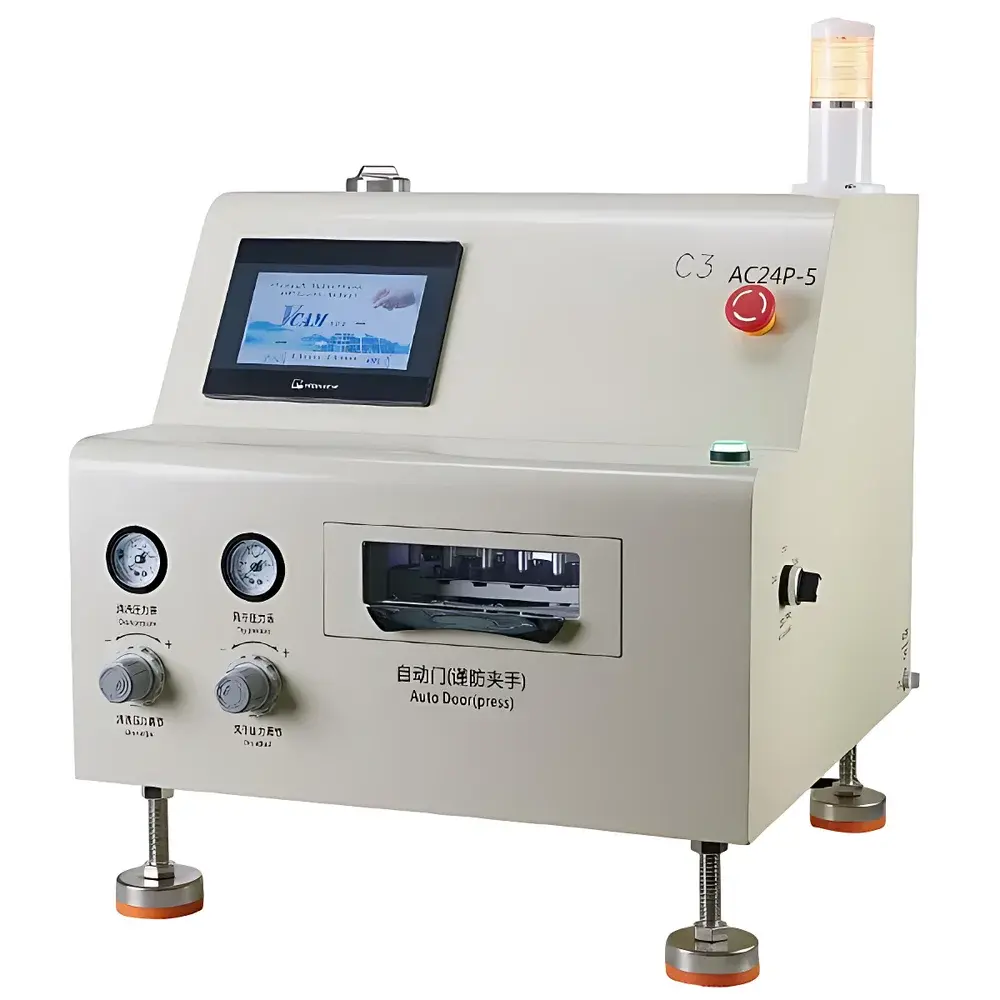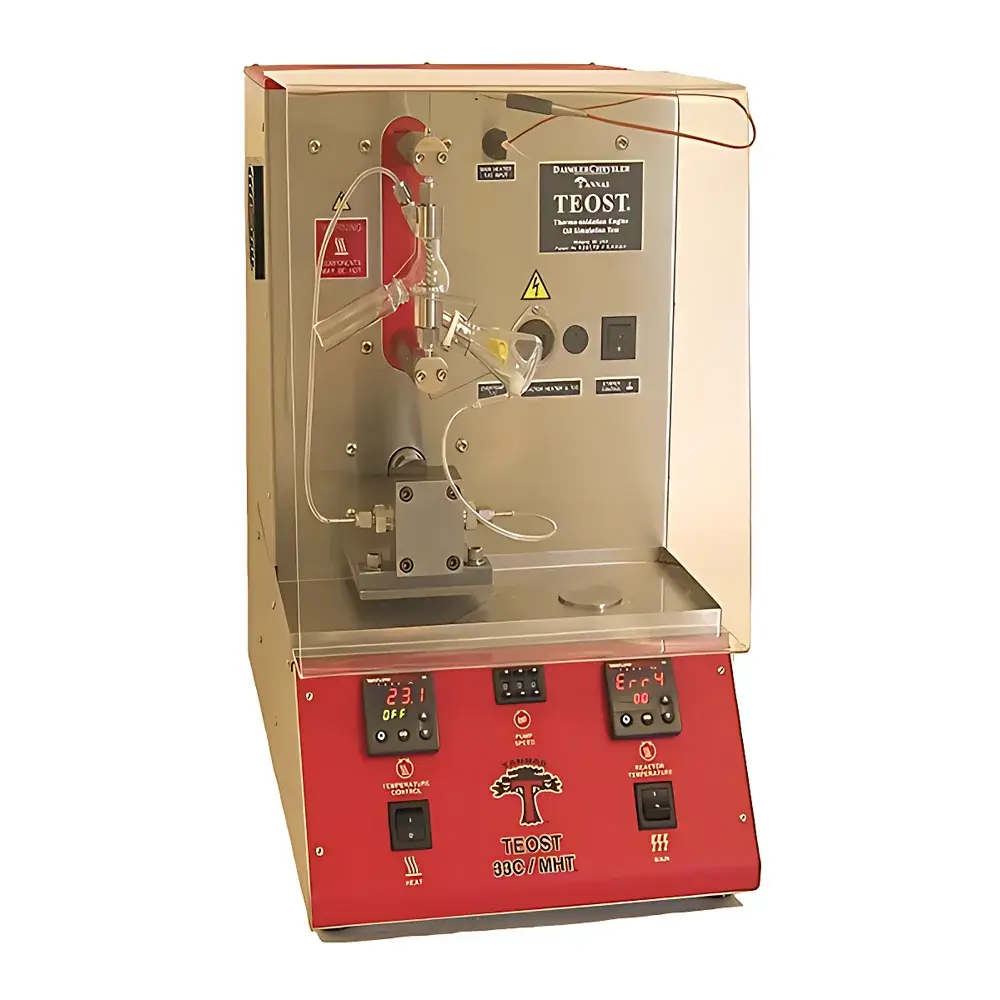
Tannas TEOST High-Temperature Oxidation and Deposit Formation Tester
| Brand | Tannas & King |
|---|---|
| Origin | USA |
| Manufacturer Status | Authorized Distributor |
| Origin Category | Imported |
| Model | TEOST |
| Pricing | Upon Request |
Overview
The Tannas TEOST High-Temperature Oxidation and Deposit Formation Tester is an engineered platform for standardized evaluation of engine oil thermal-oxidative stability and deposit-forming tendency under rigorously controlled, accelerated conditions. Based on the foundational two-stage oxidation/deposition methodology developed by Savant Laboratories in the mid-1980s—and subsequently codified in ASTM D6335 (TEOST 33C) and ASTM D7097 (TEOST MHT)—this instrument replicates critical high-temperature operational stresses experienced by modern engine lubricants. The TEOST 33C protocol simulates turbocharger turbine-side conditions through dynamic, cyclic heating of a precision steel deposition probe immersed in oil, while TEOST MHT subjects a fixed-temperature probe—wrapped with a catalytic metal coil—to extended exposure, modeling piston ring zone deposits. Both methods integrate precise mass flow control of reactive gas streams (wet air, N₂O), calibrated catalyst dosing (e.g., 100 ppm naphthenic iron), and gravimetric quantification of deposit mass gain. The system operates within a robust thermal enclosure featuring dual independent heating zones, CE-marked safety interlocks, redundant thermal fusing, and integrated thermal shielding—ensuring repeatability, operator safety, and compliance readiness for GLP/GMP environments.
Key Features
- Dual-test capability: Fully configurable for both ASTM D6335 (TEOST 33C) and ASTM D7097 (TEOST MHT) protocols on a single platform
- Thermally isolated dual-zone furnace: Independent control of reaction bath (±1 °C stability) and deposition probe (200–480 °C cycling for 33C; fixed 285 °C for MHT)
- Precision fluid delivery system: Peristaltic pumps with ±0.001 g accuracy for oil dosing (116 mL active volume in 33C; 8.5 g ±0.001 g in MHT) and calibrated mass-flow controllers for reactive gases (wet air, N₂O, dry air)
- Catalyst integration module: Dedicated reservoir and metering path for standardized iron naphthenate (100 ppm) addition in 33C testing
- Comprehensive safety architecture: CE-marked construction, current-limiting fuses, over-temperature cut-off sensors, and removable thermal protection shroud
- Modular transport configuration: Optimized for lab relocation—single-pallet shipping for standalone MHT or 33C units (~60 kg); dual-pallet arrangement for combined systems (~82 kg)
Sample Compatibility & Compliance
The TEOST platform accommodates standard engine oil formulations—including conventional, synthetic, and low-SAPS grades—as well as candidate additives and base stock blends. All test procedures align with internationally recognized specifications: ASTM D6335 (TEOST 33C) is referenced in API SP, ILSAC GF-6, and ACEA C6/C7 sequences for turbocharged gasoline engine oils; ASTM D7097 (TEOST MHT) is specified in API CK-4, FA-4, and ACEA E9/E10 for heavy-duty diesel applications. The instrument’s design supports audit-ready operation per FDA 21 CFR Part 11 requirements when paired with compliant LIMS or electronic lab notebook (ELN) integration—enabling full traceability of method parameters, operator identity, timestamped run logs, and raw deposit mass data. Thermal calibration certificates and gas flow verification reports are provided to support ISO/IEC 17025 laboratory accreditation.
Software & Data Management
While the TEOST operates via embedded microcontroller-based logic for thermal ramping, pump sequencing, and gas flow regulation, it outputs time-stamped analog and digital signals (temperature, pressure, flow rate, elapsed time) via RS-232 and 0–10 V analog interfaces. These outputs are compatible with third-party SCADA systems, LabVIEW-based acquisition platforms, or validated chromatography/data management software suites. Full test sequence parameters—including cycle count, dwell times, setpoint profiles, and mass gain thresholds—are stored in non-volatile memory with battery-backed retention. Audit trails generated during operation include operator ID entry (via optional keypad or network authentication), method version stamping, and real-time deviation alerts—facilitating retrospective review during regulatory inspections or internal quality audits.
Applications
- Evaluation of high-temperature deposit control performance in API SP, CK-4, and FA-4 engine oil formulations
- Screening of antioxidant, detergent, and dispersant package efficacy under simulated turbocharger and piston ring zone conditions
- Development and validation of low-viscosity, fuel-efficient lubricants subject to severe thermal shear
- Root-cause analysis of field-reported sludge or varnish formation in gasoline direct injection (GDI) and turbo-diesel engines
- Supporting OEM-specific engine oil qualification programs requiring TEOST pass/fail criteria
- Reference testing for lubricant additive suppliers seeking OEM approval or industry consortium certification
FAQ
What standards does the TEOST instrument directly support?
ASTM D6335 (TEOST 33C) and ASTM D7097 (TEOST MHT) are fully implemented; the system meets all hardware, timing, temperature, and flow requirements specified in both methods.
Is the instrument suitable for regulated GLP or GMP laboratories?
Yes—when operated with documented SOPs and paired with validated data capture tools, the TEOST supports full traceability, electronic signatures, and audit trail generation required under GLP and GMP frameworks.
Can both TEOST 33C and MHT tests be run on the same unit without hardware modification?
Yes—the platform is factory-configured for dual-mode operation; switching between protocols requires only software selection and minor fixture reconfiguration (e.g., probe type, gas manifold routing).
What maintenance is required to ensure long-term measurement integrity?
Recommended quarterly verification includes thermocouple calibration against NIST-traceable references, peristaltic pump tubing replacement, gas flowmeter recalibration, and deposition probe surface inspection per ASTM guidelines.
Does the system include automated deposit weighing functionality?
No—the TEOST delivers the conditioned probe post-test; final deposit mass must be determined using an external analytical balance meeting ASTM D6335/D7097 sensitivity requirements (0.01 mg resolution).