
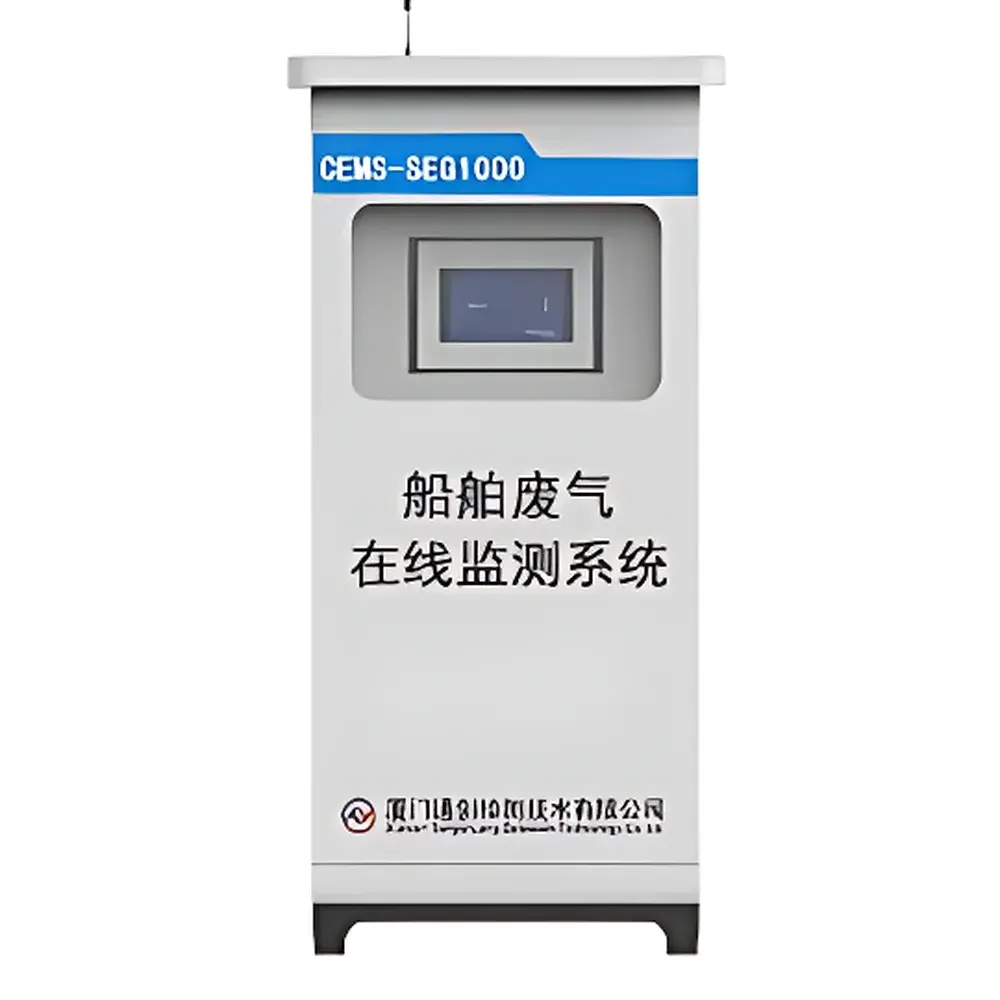
TCT CEMS-SEG1000 Marine Exhaust Gas Continuous Emission Monitoring System
| Brand | TCT (Xiamen Tongchuang) |
|---|---|
| Origin | Fujian, China |
| Manufacturer Type | Authorized Distributor |
| Country of Origin | China |
| Model | CEMS-SEG1000 |
| Price Range | USD 1,400 – 28,000 |
| Instrument Type | Online CEMS |
| Detection Principle | NDIR (CO, CO₂, CH₄, CnHm), NDUV (NO, NO₂, SO₂), Electrochemical (O₂), Diffusion Charging (PN), Gravimetric/β-absorption (PM) |
| Max. Permissible Error | ±1.5% rel |
| Zero Drift | ±1% FS |
| Span Drift | ±1% FS |
| Repeatability | ±1% FS |
Overview
The TCT CEMS-SEG1000 is a fully integrated, marine-grade Continuous Emission Monitoring System (CEMS) engineered for real-time, regulatory-compliant measurement of exhaust gas constituents from marine diesel engines and exhaust after-treatment systems. Designed in accordance with MARPOL Annex VI, IMO NOx Technical Code, and Chinese national standards including GB 15097–2016 and GD01–2011, the system delivers high-fidelity, traceable data under demanding operational conditions—namely high ambient temperature, high humidity, mechanical vibration, and transient load profiles typical of shipboard environments. Its multi-technology architecture combines non-dispersive ultraviolet (NDUV) spectroscopy for NO, NO₂, and SO₂; non-dispersive infrared (NDIR) absorption for CO, CO₂, CH₄, and hydrocarbons (CnHm); long-life electrochemical sensing for O₂; diffusion charging for particle number (PN); and gravimetric or β-absorption methods for particulate mass (PM). Volumetric concentration measurements are referenced to standardized dry flue gas conditions, with simultaneous in-situ monitoring of stack temperature, relative humidity, static pressure, and differential pressure via Pitot tube-based flow calculation.
Key Features
- High-temperature sampling probe (≥180 °C) with automated reverse-pulse back-blowing to prevent fouling and maintain sampling integrity in soot-laden exhaust streams.
- Fully heated sample transport line (≥180 °C throughout) to eliminate condensation, suppress water vapor interference, and preserve reactive species such as NO₂ and HNO₃ during transit.
- Robust pre-processing unit featuring a 5.5 L/min German vacuum pump, dual-stage filtration (5 µm sintered metal + 0.1 µm membrane), and an electronic condenser with integrated peristaltic pump (dew point ≤5 °C).
- Modular gas analysis subunits—each certified to IEC 61000-6-2/6-4 for EMC resilience and IP65-rated enclosures—support field-reconfigurable sensor combinations without hardware replacement.
- Integrated industrial cabinet with optional thermostatically controlled air conditioning (operating range: −20 °C to +55 °C ambient), enabling deployment in engine rooms, exhaust uptakes, and open-deck installations.
- Automated calibration sequence (zero and span) executed under closed-loop bypass mode, ensuring zero interruption to continuous data acquisition and full auditability per ISO 14064-3 and EPA Method 205 requirements.
Sample Compatibility & Compliance
The CEMS-SEG1000 is validated for use with marine diesel exhaust across all engine load points (10–100% MCR), including low-load and transient cycles where condensable organics and ammonium bisulfate formation pose analytical challenges. It meets the metrological performance criteria defined in EN 15267–3 (QAL1 certification readiness), ISO 14064–3 (GHG verification), and US EPA Performance Specification 2 (PS-2) for SO₂/NOx. All gas analyzers comply with IEC 61207–7 for NDIR/NDUV instruments and IEC 62109 for electrochemical sensors. The system supports full traceability under GLP/GMP-aligned data governance frameworks, including 21 CFR Part 11-compliant electronic signatures, immutable audit trails, and secure user role management.
Software & Data Management
The embedded CEMS-DataCore™ software platform provides ISO/IEC 17025-aligned data handling: automatic correction for moisture content (per ISO 14792), stoichiometric O₂ compensation, dilution factor application (for SCR/EGCS applications), and real-time emission rate calculation (g/kWh). Raw and processed data are stored locally (≥12 months at 1-second resolution) and transmitted via Modbus TCP, OPC UA, or MQTT to shore-side central monitoring systems (CMS). Reporting modules generate ISO-compliant compliance reports—including daily summary logs, exceedance alerts, calibration records, and maintenance history—in PDF/CSV formats. All firmware updates undergo cryptographic signature validation prior to installation.
Applications
- Regulatory compliance monitoring for Tier II/III NOx, SOx, PM, and CO₂ reporting under IMO DCS and EU MRV schemes.
- Performance evaluation of exhaust gas cleaning systems (EGCS), selective catalytic reduction (SCR), and diesel particulate filters (DPF) on board container ships, tankers, and cruise vessels.
- On-vessel R&D support for alternative fuel trials (LNG, methanol, ammonia), including slip measurement of unburnt CH₄ and NH₃.
- Port State Control (PSC) inspection readiness and remote verification by classification societies (e.g., DNV, LR, ABS) via secure cloud interface.
- Integration into vessel energy management systems (EnMS) per ISO 50001 for real-time fuel efficiency optimization.
FAQ
Does the CEMS-SEG1000 meet IMO’s Tier III NOx verification requirements?
Yes—the system satisfies the continuous monitoring and data retention provisions of MEPC.259(68) and supports mandatory reporting to the IMO Ship Energy Efficiency Management Plan (SEEMP) Part II.
Can it operate reliably in high-salinity maritime environments?
All external components—including probe housings, heated lines, and cabinet ingress protection—are constructed from marine-grade 316 stainless steel and conform to IEC 60068-2-52 salt mist testing (severity level 5).
Is third-party type approval available?
TCT provides documentation packages for QAL1 certification per EN 15267–3 and supports customers through notified body audits (e.g., TÜV Rheinland, SGS).
How is zero drift compensated during extended unattended operation?
The system performs scheduled zero checks every 24 hours using certified zero air (N₂ ≥99.999%), with drift correction applied only if deviation exceeds ±0.5% FS—fully logged and reportable.
What cybersecurity protocols are implemented?
The system implements TLS 1.2 encryption for remote communication, role-based access control (RBAC), disabled default credentials, and periodic security patching aligned with IEC 62443-3-3 SL2 requirements.







