
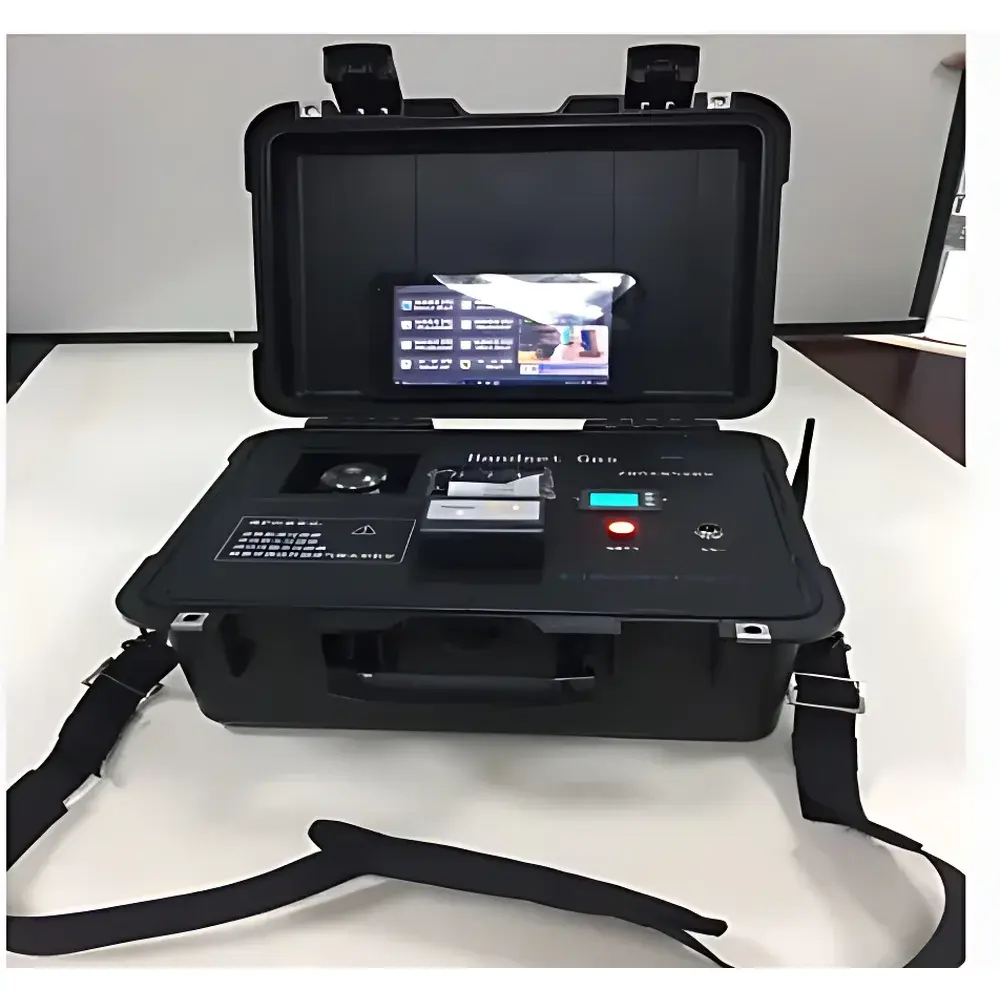
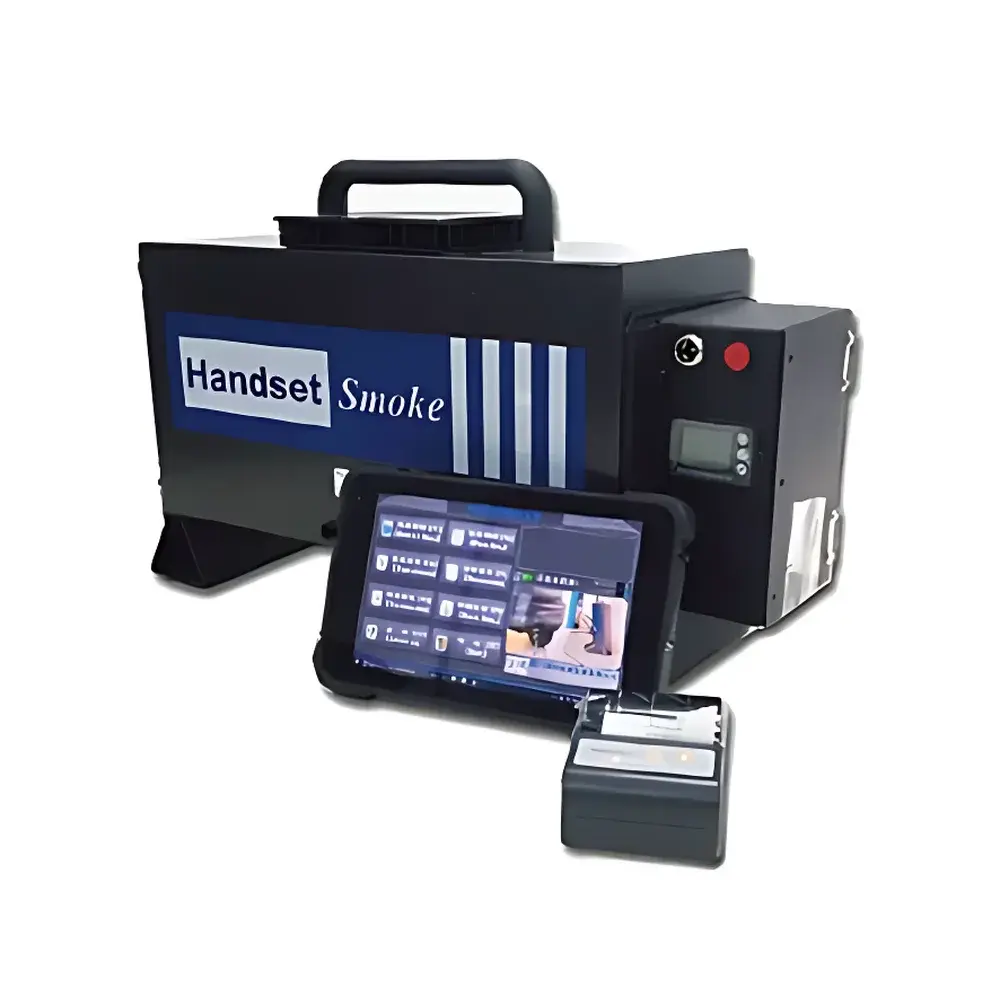
TCT Handset Gas 3000 Portable Diesel NOx and Opacity Analyzer
| Brand | TCT (Xiamen Tongchuang) |
|---|---|
| Origin | Fujian, China |
| Model | Handset Gas 3000 |
| Instrument Type | Portable |
| Detection Principle | NDUV (Non-Dispersive Ultraviolet) for NO/NO₂, NDIR (Non-Dispersive Infrared) for CO/CO₂/HC, Electrochemical for O₂, Light Absorption Coefficient Method for Opacity |
| Max. Permissible Error | ±10% |
| Span Drift | ±3% |
| Repeatability | <2% |
| Compliance | GB 3847–2018, GB 36886–2018, ISO 11614, 2014/45/EU, OIML R99 Class 00 |
| Operating Temp. | 5–45 °C |
| Relative Humidity | 30–90% RH |
| Power Supply | AC 220 V ±20 V / 50 Hz ±10 Hz or DC |
| Battery | 240 Wh (≥6 h operation) |
| Weight | Gas Module: 10 kg (excl. battery), 15 kg (incl.) |
| Opacity Module | <5 kg (excl.), 7 kg (incl.) |
| Communication | Wi-Fi (120 m), Bluetooth (80 m), 4G (optional) |
| Optical Path Length | 215 mm ±0.05 cm |
Overview
The TCT Handset Gas 3000 is a fully integrated, field-deployable analyzer engineered for regulatory-grade measurement of gaseous pollutants and particulate opacity in diesel engine exhaust. It combines dual-path sampling architecture with orthogonal detection principles: NDUV (Non-Dispersive Ultraviolet) resonance spectroscopy for selective, interference-resistant quantification of NO and NO₂; NDIR (Non-Dispersive Infrared) absorption for CO, CO₂, and hydrocarbons (expressed as C₆H₁₄ equivalent); electrochemical sensing for O₂; and standardized light absorption coefficient methodology per ISO 11614 and GB 3847–2018 for opacity (N-value) and extinction coefficient (K-value). Unlike legacy analyzers requiring catalytic NO₂-to-NO conversion—introducing systematic uncertainty—the Handset Gas 3000 measures NO and NO₂ independently, enabling direct, traceable NOₓ (NO + NO₂) calculation without conversion efficiency assumptions. Its modular design separates gas analysis and opacity modules, each optimized for thermal stability, optical alignment integrity, and long-term drift control.
Key Features
- True dual-species NO/NO₂ detection via NDUV spectroscopy—no catalytic converter required, eliminating conversion-related bias and ensuring metrological traceability to primary standards.
- Simultaneous real-time measurement of CO, CO₂, HC (C₆H₁₄), O₂, NO, NO₂, calculated NOₓ, Lambda, opacity (N%), and extinction coefficient (K m⁻¹).
- Integrated multi-stage gas conditioning: heated flexible probe (7 m), coarse particulate filter, automatic water-gas separator, fine particulate filter, and flow-regulated sampling pump (>4 L/min) to protect optical cells and electrochemical sensors from fouling.
- Opacity module features a precision 215 mm optical path length, automatic fan and heater management, 50% electronic neutral density filter self-calibration, and auto-alignment compensation for thermal drift.
- Onboard 240 Wh lithium battery supports ≥6 hours of continuous operation under mixed-mode (gas + opacity) testing; dual power input (AC/DC) with real-time battery level display.
- Wireless connectivity stack: IEEE 802.11n Wi-Fi (120 m range), Bluetooth 5.0 (80 m), and optional 4G LTE for cloud-based data upload and remote diagnostics.
- Automated calibration suite: scheduled zero/span checks, temperature-compensated 10-point linearity verification for NO/NO₂ channels, and pre-measurement diagnostic self-test.
Sample Compatibility & Compliance
The Handset Gas 3000 is validated for use across diverse diesel-powered platforms—including light-duty vehicles, heavy-duty trucks, construction machinery, agricultural equipment, and marine auxiliary engines—under both free-acceleration and loaded-mode test cycles. Its gas module meets OIML R99 Class 00 accuracy requirements for exhaust gas analyzers, while the opacity module complies with ISO 11614 and EU Regulation 2014/45/EU for in-service vehicle inspection. All measurements satisfy the metrological criteria defined in China’s mandatory standards GB 3847–2018 (Diesel Vehicle Emission Limits and Test Procedures) and GB 36886–2018 (Emission Limits and Measurement Methods for Non-Road Mobile Diesel Machinery). The instrument’s architecture supports GLP-aligned audit trails when paired with certified data management software, including timestamped calibration logs, sensor health reports, and environmental condition metadata (ambient T, P, RH).
Software & Data Management
Embedded firmware provides ISO/IEC 17025-aligned data handling: all raw sensor outputs, computed parameters (e.g., Lambda, NOₓ), and environmental context are time-stamped with microsecond resolution and stored locally on removable SD card (≥32 GB). The device supports export in CSV and XML formats compliant with national environmental monitoring database schemas. Optional TCT FleetLink software enables centralized fleet reporting, trend analysis of emission deterioration over time, and automated generation of statutory test certificates (e.g., I/M program documentation). When configured with 4G telemetry, data packets include digital signatures and cryptographic hashes to ensure integrity during transmission—meeting baseline requirements for remote auditing under CNAS-accredited laboratories.
Applications
- Regulatory roadside inspections and periodic technical inspections (PTI) conducted by environmental protection bureaus and traffic enforcement agencies.
- In-plant quality assurance for diesel engine manufacturers and Tier-1 suppliers performing production-line exhaust certification per GB/T 17692 or ISO 8178.
- Aftermarket diagnostics at authorized service centers, integrating optional OBD-II interface for concurrent reading of engine speed, coolant temperature, rail pressure, and fault codes (SAE J1979/J2190).
- Field validation of retrofit technologies (e.g., SCR, DPF) by third-party emissions verification bodies.
- Research applications in mobile source emissions inventories, urban air quality modeling, and low-emission zone compliance monitoring.
FAQ
Does the Handset Gas 3000 require annual recalibration?
Yes—annual full-system calibration against certified reference gases and opacity standards is recommended to maintain OIML R99 Class 00 conformance. Internal diagnostics monitor sensor drift and trigger alerts when calibration intervals approach expiration.
Can the instrument measure NO₂ without interference from water vapor or CO₂?
Yes—the NDUV detection principle operates at specific UV absorption bands (200–250 nm) where NO and NO₂ exhibit strong, non-overlapping resonances. Neither H₂O nor CO₂ absorbs significantly in this spectral region, ensuring minimal cross-sensitivity.
What is the minimum detectable K-value and its associated uncertainty?
The opacity module resolves K-values down to 0.01 m⁻¹ with a stated expanded uncertainty (k=2) of ±0.05 m⁻¹ at K = 1.0 m⁻¹, verified per ISO 11614 Annex B using NIST-traceable neutral density filters.
Is the 215 mm optical path length adjustable for different exhaust pipe diameters?
No—the path length is fixed and factory-aligned to meet ISO 11614 geometric tolerance requirements. Sample dilution or flow conditioning is not applied; measurements assume undiluted, representative exhaust stream sampling per GB 3847–2018 Section 6.3.
How does the system handle condensation in cold ambient conditions?
The probe assembly includes an active thermoelectric heater and automatic water-gas separator. Condensate is continuously expelled from the gas stream prior to reaching the optical cell, preventing lens fogging and photodetector signal attenuation.
Related Products







