
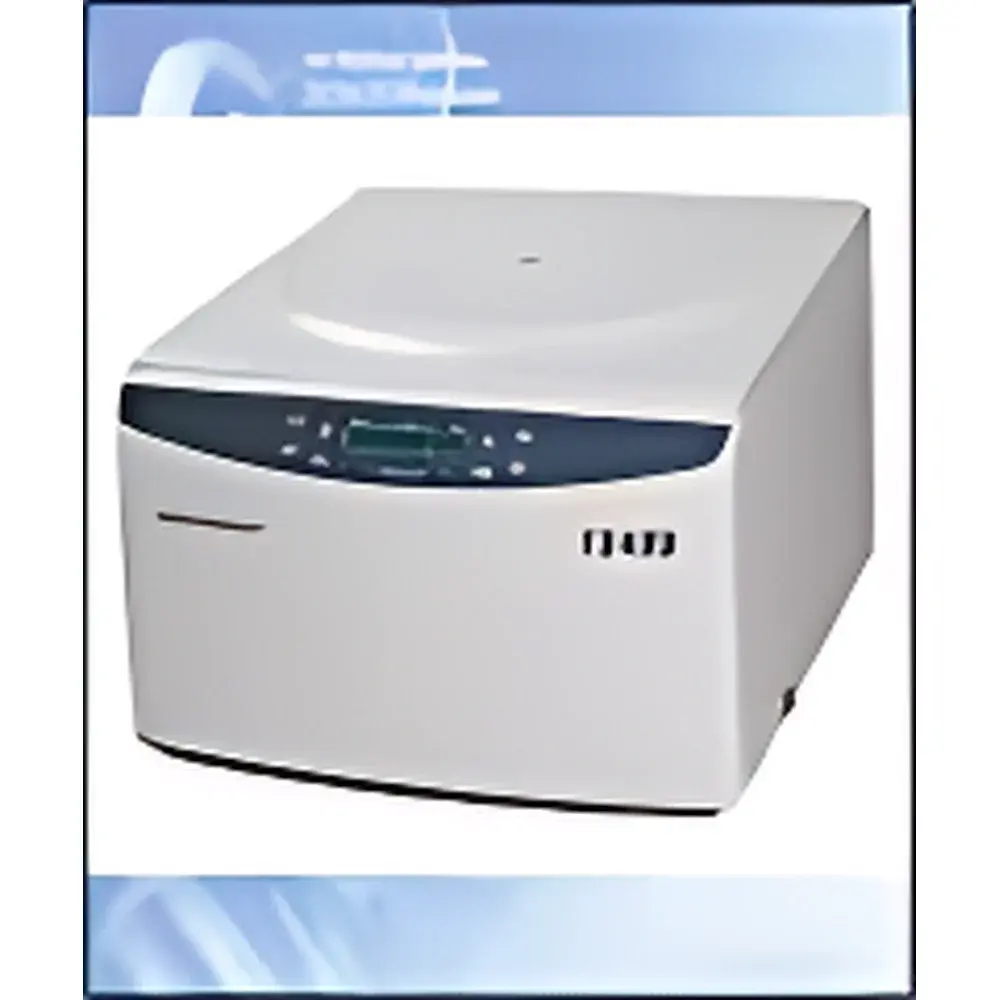
TDLab TDZ5-WS & TD5M-WS Multi-Rotor Automatic Balancing Centrifuges
| Origin | Shanghai, China |
|---|---|
| Manufacturer Type | Authorized Distributor |
| Origin Category | Domestic (China) |
| Models | TDZ5-WS, TD5M-WS |
| Max Speed | 5000 rpm |
| Max RCF | 4390 × g (TDZ5-WS), 5030 × g (TD5M-WS) |
| Timer Range | 0–99 min (TDZ5-WS), 0–99 h 59 min (TD5M-WS) |
| Power Supply | AC 220 V, 50 Hz, 10 A |
| Dimensions (L×W×H) | 440×550×340 mm (TDZ5-WS), 460×550×340 mm (TD5M-WS) |
| Weight | 45 kg (TDZ5-WS), 50 kg (TD5M-WS) |
| Rotor Compatibility | Swing rotors for 7–250 mL tubes, 96-well microplate carriers, and optional conical cup adapters |
Overview
The TDLab TDZ5-WS and TD5M-WS Multi-Rotor Automatic Balancing Centrifuges are microprocessor-controlled, brushless motor-driven instruments engineered for high-reproducibility separation in routine laboratory workflows. Designed around the principle of sedimentation centrifugation—where differential particle migration under controlled gravitational force enables phase separation—the system delivers precise, repeatable RCF (Relative Centrifugal Force) application across diverse sample formats. Both models feature automatic imbalance detection and dynamic rotor compensation, eliminating manual counterbalancing and reducing operator error during multi-tube processing. The integrated touch interface, digital speed/RCF readout, and programmable run profiles support GLP-compliant documentation when paired with audit-trail-enabled software (see Software & Data Management). These centrifuges meet fundamental mechanical safety requirements per IEC 61010-1 and are constructed to withstand continuous operation in QC, clinical, and academic laboratories handling biological fluids, cell suspensions, serum, plasma, and microplate-based assays.
Key Features
- Brushless DC motor with thermal overload protection and extended service life (>20,000 hr MTBF)
- Automatic rotor recognition and real-time imbalance compensation across all swing-bucket configurations
- Electronic safety door lock with interlock verification—operation prohibited unless lid is fully sealed and verified
- Programmable protocols with up to 10 user-defined methods stored locally; RCF auto-calculated from entered rpm and rotor radius
- Dual-layer safety architecture: hardware-based overspeed cutoff (±1% tolerance) + firmware-enforced rotor-specific speed limits
- Low-noise operation (<65 dB(A) at 5000 rpm) enabled by precision-balanced rotor assemblies and vibration-damping chassis
- Wide timer range: 0–99 minutes (TDZ5-WS); expanded 0–99 h 59 min (TD5M-WS) for unattended overnight protocols
Sample Compatibility & Compliance
These centrifuges accommodate a broad spectrum of primary labware without adapter modification: standard polypropylene or glass centrifuge tubes (7–250 mL), conical-bottom tubes, PCR strip carriers, and ANSI/SLAS-compliant 96-well microplates (including deep-well and shallow-well variants). All swing rotors comply with ISO 15195:2018 for clinical centrifuge performance validation. The TD5M-WS’s 250 mL and 500 mL rotor options support large-volume processing required for bioprocessing intermediates or environmental sample concentration. Rotors are certified to ASTM F2119-22 for mechanical integrity under cyclic loading. No hazardous materials or ozone-generating components are used; the system meets RoHS Directive 2011/65/EU and CE marking requirements for laboratory equipment.
Software & Data Management
While standalone operation requires no PC connection, optional TDLab CentriLink™ software (v3.2+) enables full method transfer, remote monitoring, and electronic record generation compliant with FDA 21 CFR Part 11. The software provides timestamped audit trails for parameter changes, start/stop events, and error logs—including imbalance event duration and corrective action taken. Export formats include CSV and PDF reports with embedded instrument ID, rotor serial number, and calibration status. Data integrity is enforced via role-based access control (admin/operator modes) and encrypted local storage on internal flash memory (non-volatile, 10-year retention).
Applications
- Clinical diagnostics: Serum/plasma separation from whole blood (e.g., CLSI H18-A3 pre-analytical guidelines)
- Cell culture labs: Harvesting adherent or suspension cells prior to lysis or cryopreservation
- Pharmaceutical QA/QC: Clarification of protein solutions, particulate testing per USP
- Environmental testing: Sedimentation of suspended solids in wastewater or soil extracts
- Academic research: Fractionation of subcellular organelles using differential centrifugation protocols
- High-throughput screening: Parallel processing of 96-well plates for ELISA, bead-based assays, or nucleic acid purification
FAQ
What safety certifications do these centrifuges hold?
They conform to IEC 61010-1 (Safety Requirements for Electrical Equipment for Measurement, Control, and Laboratory Use) and carry CE marking for the European Economic Area. Rotor assemblies are validated per ISO 15195:2018 Annex B for clinical accuracy and repeatability.
Can I use third-party rotors?
No. Only TDLab-certified rotors are supported. Non-OEM rotors void the warranty and disable automatic rotor recognition and RCF calculation functions.
Is calibration traceable to national standards?
Yes. Factory calibration uses NIST-traceable tachometers and torque sensors. Certificate of Conformance includes uncertainty values per ISO/IEC 17025:2017 requirements.
How does automatic balancing work without manual counterweights?
The system employs dual-axis accelerometers and real-time motor current analysis to detect mass asymmetry. It dynamically adjusts rotational phasing and applies compensatory torque pulses—no physical counterbalance adjustment is required.
What maintenance is required beyond routine cleaning?
Annual verification of rotor integrity (crack inspection via dye-penetrant testing) and speed/RCF calibration is recommended. Brushless motors require no scheduled commutator servicing.
Related Products



