
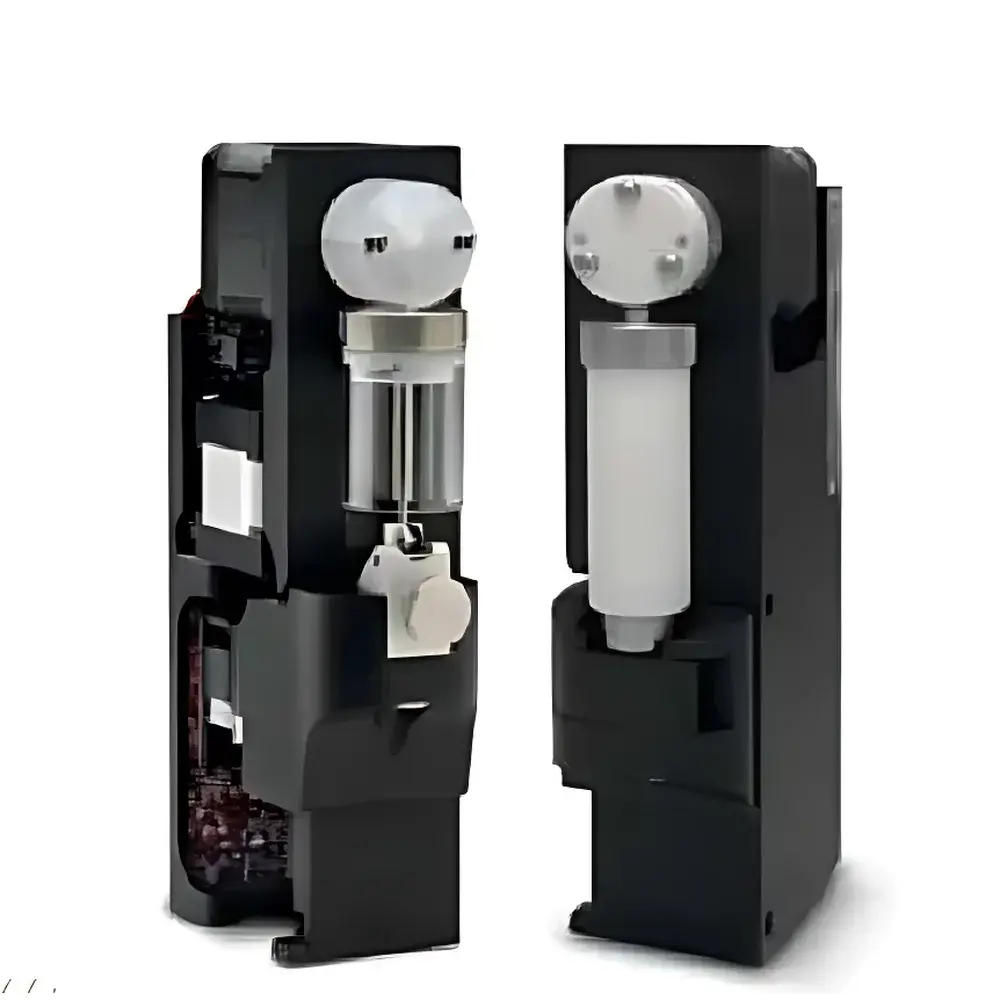
Tecan Cavro Centris Syringe Pump
| Brand | Tecan Cavro |
|---|---|
| Origin | Malaysia |
| Manufacturer Type | Authorized Distributor |
| Origin Category | Imported |
| Model | Cavro Centris Pump |
| Instrument Type | Microfluidic Syringe Pump |
| Flow Rate Range | 5 nL/s to 5 mL/s |
| Accuracy | <0.25% of full scale |
| Repeatability | <0.05% of full scale |
| Stepping Resolution | 181,490 microsteps |
| Plunger Travel | 30 mm |
| Communication Interfaces | RS-232, RS-485, CAN bus |
| Valve Options | Ceramic (non-distributing: 3-way, 4-way, dual-loop 4-way |
| distributing | 3-way, 6-way, beveled 6-way, 9-way, 12-way) and polymer (same configurations) |
| Syringe Compatibility | 50 µL, 100 µL, 250 µL, 500 µL, 1.0 mL, 2.5 mL, 5.0 mL, 12.5 mL glass syringes |
| Pulse Suppression | Engineered for ultra-low flow pulsation |
Overview
The Tecan Cavro Centris Syringe Pump is a high-precision, microstepping motor-driven fluid handling instrument engineered for demanding low-flow applications in life science and analytical instrumentation. Based on closed-loop stepper motor control and ceramic or polymer valve actuation, the Centris delivers exceptional volumetric accuracy and temporal reproducibility across an exceptionally wide dynamic flow range—from 5 nanoliters per second (5 nL/s) up to 5 milliliters per second (5 mL/s). Its core architecture integrates a 30 mm plunger travel with 181,490 microsteps per revolution, enabling sub-nanoliter dispensing resolution and minimizing mechanical hysteresis. Designed specifically for integration into OEM systems and automated laboratory platforms—including flow cytometers, digital PCR instruments, capillary electrophoresis modules, and microfluidic assay workstations—the Centris operates with ultra-low acoustic noise and minimal pressure pulsation, ensuring stable laminar flow critical for optical detection and kinetic assays.
Key Features
- High-resolution microstepping drive (181,490 steps/rev) ensures precise plunger positioning and repeatable volume delivery
- Ultra-wide flow range spanning nine orders of magnitude: 5 nL/s to 5 mL/s—configurable via syringe size and step rate
- Ceramic valve options provide long-term chemical resistance and wear durability for aggressive solvents and biological buffers
- Polymer valve variants offer cost-effective, high-cycle-life alternatives for aqueous and mild reagent applications
- Modular valve manifold support: non-distributing (3-way, 4-way, dual-loop 4-way) and distributing configurations (3-way, 6-way, beveled 6-way, 9-way, 12-way)
- Standard communication protocols include RS-232, RS-485, and CAN bus—enabling seamless integration into industrial control networks and multi-instrument orchestration frameworks
- Low-vibration, brushless motor design minimizes mechanical interference in vibration-sensitive optical setups
Sample Compatibility & Compliance
The Cavro Centris supports standard glass syringes from 50 µL to 12.5 mL, allowing users to optimize resolution, pressure capability, and dead volume according to application requirements. All wetted materials—including ceramic valve seats, PTFE seals, and borosilicate glass barrels—are compatible with common laboratory solvents, aqueous buffers, and low-concentration acids/bases. The pump meets CE marking requirements for electromagnetic compatibility (EMC Directive 2014/30/EU) and low-voltage safety (LVD Directive 2014/35/EU). While not certified as medical device hardware, its performance characteristics align with ISO 8573-1 (compressed air purity) and ISO 13485-aligned manufacturing controls when deployed in GMP-compliant instrument assembly environments. Traceability of calibration parameters and firmware revision history supports GLP audit readiness.
Software & Data Management
The Centris operates via ASCII-based command protocol over serial or CAN interfaces, enabling direct integration with LabVIEW, Python (pySerial, can-utils), MATLAB, or custom C/C++ host applications. Tecan provides comprehensive command reference documentation and sample scripts for common workflows—including ramped flow profiles, multi-step dispensing sequences, and synchronized valve switching. Firmware supports non-volatile storage of up to 16 user-defined methods, each with independent acceleration/deceleration profiles and error-handling thresholds. Audit-trail-capable systems may log all executed commands, timestamps, and real-time status registers (e.g., current position, valve state, motor stall flag) to external databases compliant with FDA 21 CFR Part 11 when paired with validated host software.
Applications
- Digital PCR reaction setup requiring picoliter-level reagent partitioning and low-pulsation injection into nanowell arrays
- Flow cytometry sheath fluid and sample stream regulation for stable hydrodynamic focusing and reduced CV in fluorescence intensity measurements
- Automated capillary electrophoresis sample loading with programmable plug-volume injection and buffer exchange
- OEM integration into high-throughput screening platforms for sequential reagent addition across 384- and 1536-well plates
- Microfluidic chip priming, washing, and assay execution where backpressure stability and bubble-free delivery are essential
- Calibration fluid delivery in metrology-grade liquid handling validation protocols per ISO/IEC 17025
FAQ
What syringe sizes are supported by the Cavro Centris Pump?
The pump accommodates standard glass syringes of 50 µL, 100 µL, 250 µL, 500 µL, 1.0 mL, 2.5 mL, 5.0 mL, and 12.5 mL—each selected based on required flow resolution, maximum pressure, and dead volume constraints.
Does the Centris support bidirectional flow or only unidirectional dispensing?
The Centris is designed for unidirectional fluid displacement (push-only mode); reverse motion is limited to syringe refill under controlled vacuum or external pressure assistance—not integrated into native firmware control.
Can multiple Centris pumps be synchronized over CAN bus?
Yes—CAN bus implementation supports deterministic timing synchronization across up to 32 nodes using standardized message identifiers and time-triggered communication frames, suitable for coordinated multi-channel fluid delivery.
Is firmware update capability available in the field?
Firmware updates are performed via RS-232 using Tecan-provided utilities and require host authentication; version history and checksums are logged internally to support change control documentation.
How is accuracy verified during installation qualification (IQ)?
Accuracy verification follows gravimetric measurement per ASTM E2758–19: mass loss of calibrated water dispensed over ≥10 cycles at 1%, 10%, and 100% of full-scale flow, with results reported against stated specifications (<0.25% FS).



