
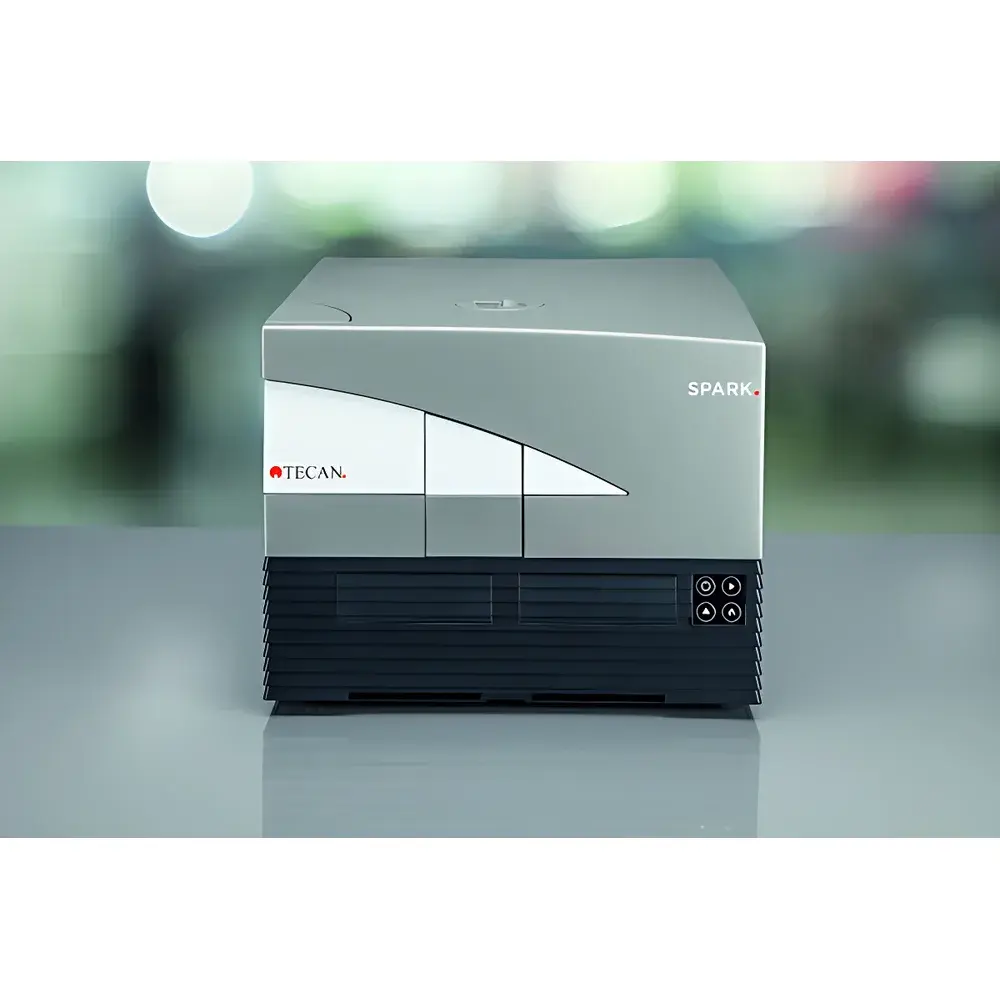
TECAN Spark Multimode Microplate Reader
| Brand | TECAN |
|---|---|
| Origin | Austria |
| Model | Spark |
| Function Type | Multimode |
| Automation Level | Fully Automated |
| Detection Modes | Absorbance (UV-Vis spectral scanning), Fluorescence Top/Bottom Read (including 3D fluorescence spectral scanning), Time-Resolved Fluorescence (TRF), TRF Spectral Scanning, Fluorescence Resonance Energy Transfer (FRET), Time-Resolved FRET (TR-FRET), Fluorescence Polarization (FP), Luminescence (Glow, Flash, Multicolor, High-Sensitivity Luminescence Spectral Scanning), AlphaScreen®/AlphaLISA®/AlphaPlex®, Real-Time Brightfield Cell Imaging (Cell Counting & Confluence Analysis) |
| Wavelength Range | 200–1000 nm |
| Additional Modules | Cuvette Port (Absorbance), NanoQuant Plate, Temperature Control (RT +3 °C to 42 °C), Integrated Liquid Handling with Heating & Stirring, CO₂ & O₂ Gas Control Module, Humidity Chamber (Volatile Compound Protection), Te-Cool™ Active Cooling (18–42 °C), Automatic Lid Lifting, Built-in QC Tools (IQ/OQ Support), Integrated Spark-Stack™ Microplate Stacker |
Overview
The TECAN Spark Multimode Microplate Reader is an engineered platform for quantitative, high-throughput detection in life science laboratories requiring rigorous assay flexibility and long-term adaptability. Based on modular architecture and precision optical design, the Spark implements core detection principles including UV-Vis absorbance spectroscopy, intensity- and lifetime-resolved fluorescence photometry, luminescence photon counting, and brightfield digital imaging—all within a single, compact footprint. Its optical path integrates monochromator-based excitation and emission scanning (200–1000 nm), enabling spectral characterization of complex biological interactions without filter dependency. Designed for use in regulated environments, the system supports method validation workflows aligned with GLP and GMP expectations, including audit-trail-enabled software operation and documented IQ/OQ protocols.
Key Features
- Fully automated multimode detection: simultaneous configuration of absorbance, fluorescence (top/bottom), TRF, TR-FRET, FP, luminescence (glow/flash/multicolor), and Alpha technologies in one assay run
- Monochromator-based wavelength selection across 200–1000 nm with ≤1 nm resolution, eliminating need for physical filter sets and enabling de novo spectral profiling
- Integrated liquid handling module with on-deck heating (up to 42 °C) and orbital stirring—enabling kinetic assays with precise reagent timing and temperature control
- Active thermal management via Te-Cool™ technology: maintains stable plate temperature from 18 °C to 42 °C with ±0.2 °C uniformity across 96- and 384-well formats
- Real-time brightfield cell imaging engine with motorized Z-focus and LED-based illumination, supporting label-free confluence estimation, viability assessment, and migration tracking over time
- Gas-controlled incubation capability (CO₂ and O₂ modulation) with integrated humidity chamber—critical for extended live-cell assays under physiologically relevant conditions
- Spark-Stack™ microplate stacking system enables unattended processing of up to 50 plates with robotic arm integration and barcode reading
Sample Compatibility & Compliance
The Spark accommodates standard microplate formats (6–1536-well), cuvettes (via dedicated port), and specialized consumables including NanoQuant plates for low-volume nucleic acid quantification. All detection modes comply with industry-standard assay formats such as ELISA, HTRF®, Transcreener®, DLR®, and BRET/NanoBRET®. Instrument qualification documentation—including Installation Qualification (IQ) and Operational Qualification (OQ) templates—is provided by TECAN and supports compliance with FDA 21 CFR Part 11 requirements when used with i-control™ or SparkControl™ software configured for electronic signature and audit trail functionality. The system meets ISO/IEC 17025 calibration traceability standards through factory-certified photometric and thermal validation.
Software & Data Management
Control and analysis are performed using SparkControl™ software (v3.x or later), which provides protocol-driven assay setup, real-time data visualization, and export-ready reporting. The software includes built-in curve-fitting algorithms (four-parameter logistic, linear regression, exponential decay), statistical outlier detection, and plate mapping tools for spatial artifact identification. Raw data files (.spf) are structured in HDF5 format for long-term archival integrity and third-party interoperability. Integration with laboratory information management systems (LIMS) is supported via RESTful API and ASTM E1384-compliant data exchange protocols. Audit trails record all user actions, parameter changes, and instrument events with timestamped, non-erasable entries.
Applications
- Quantitative nucleic acid analysis (DNA/RNA concentration, purity ratios A260/A280, labeling efficiency)
- Protein quantification (Bradford, BCA, Lowry) and enzymatic activity profiling (kinetic and endpoint)
- Cell-based functional assays: receptor-ligand binding (FP), protein-protein interaction (FRET/TR-FRET), second messenger signaling (cAMP, Ca²⁺), and reporter gene expression (luciferase, GFP)
- High-content cytotoxicity and proliferation screening using confluence and morphology metrics derived from time-lapse imaging
- Immunoassay development and validation (ELISA, AlphaLISA®, HTRF®) with dual-read capability for heterogeneous assay formats
- Drug discovery workflows including target engagement, ADME-Tox profiling, and phenotypic screening under controlled gas and humidity conditions
FAQ
Does the Spark support FDA 21 CFR Part 11 compliance?
Yes—when deployed with SparkControl™ software configured for electronic signatures, role-based access control, and full audit trail logging, the system meets key technical requirements for Part 11 compliance.
Can the Spark perform kinetic measurements with automatic reagent addition?
Yes—the integrated liquid handler supports programmable dispensing with sub-microliter precision, synchronized with optical read cycles for true real-time kinetics.
What is the minimum sample volume supported in absorbance mode?
Using the NanoQuant Microplate, the Spark achieves reliable quantification from 2 µL samples with pathlength correction applied automatically.
Is remote monitoring or troubleshooting possible?
TECAN’s Remote Service Portal enables secure, encrypted diagnostic access by certified engineers, minimizing instrument downtime without compromising network security.
How is temperature uniformity validated across the microplate?
Each Spark undergoes factory calibration using NIST-traceable thermal probes; users may verify performance using the included temperature mapping protocol in SparkControl™ software.





