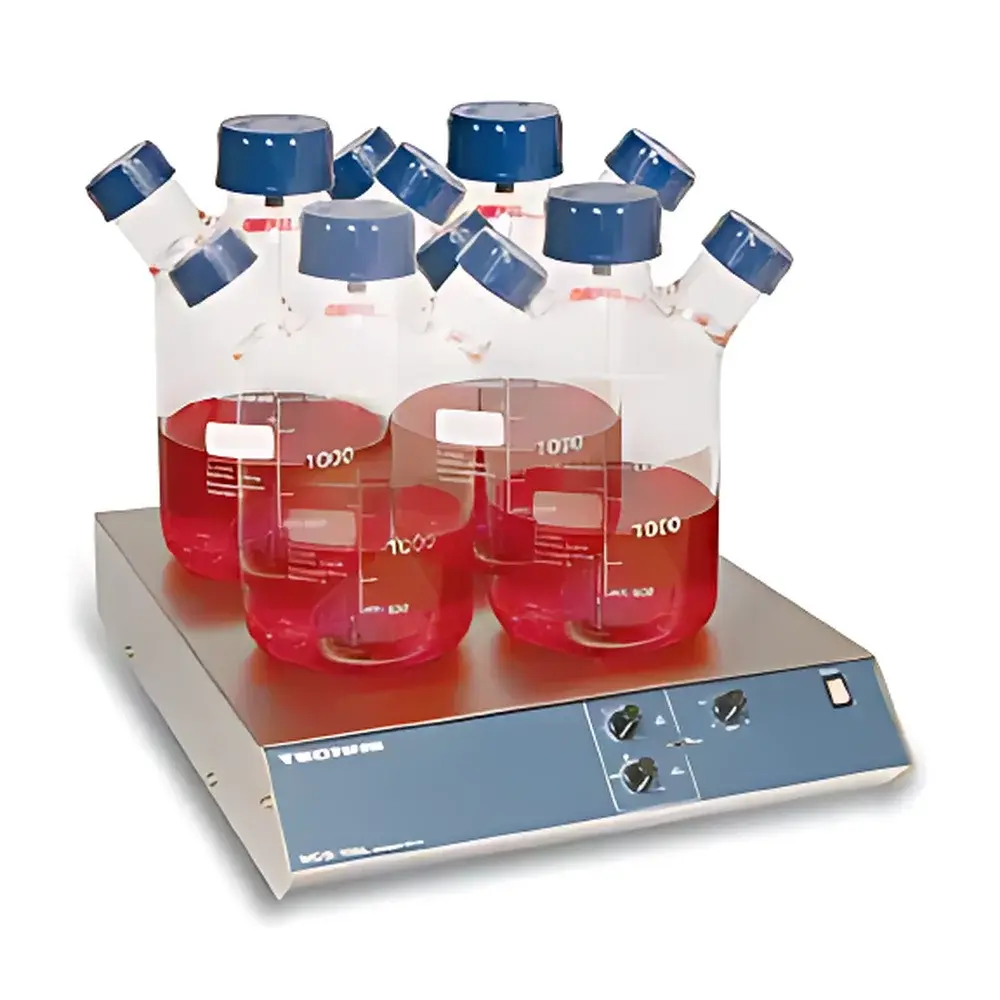
Techne MSC Series Suspension Cell Culture Agitator
| Brand | Techne |
|---|---|
| Origin | United Kingdom |
| Model | MSC |
| Speed Range | 0–80 rpm |
| Speed Accuracy | < ±3 rpm |
| Soft-Start/Stop Ramp Time | 20 sec acceleration/deceleration |
| Intermittent Mode | On-time 6 sec–5 min, Off-time 2 min–2 hr |
| Operating Environment | ≤40°C, ≤95% RH (non-condensing) |
| Power Supply | Dual-voltage 110/230 V, 50/60 Hz |
| Power Consumption | 2 W |
| Fuse Rating | 100 mA |
| Compatible Vessels | Pyrex® borosilicate glass flasks (125 mL–5 L), with 2 or 5 side necks |
| Stirrer Platforms | MCS-101L (1×3–5 L), MCS-102L (2×1 L), MCS-104S (4×500 mL), MCS-104L (4×1 L), MCS-104XL (4×5 L) |
| Material | Stainless steel base, siliconized stir rods, borosilicate glass vessels |
Overview
The Techne MSC Series Suspension Cell Culture Agitator is an engineered solution for gentle, reproducible suspension and microcarrier-based cell culture under controlled environmental conditions. Designed explicitly for use inside CO2 incubators, refrigerated chambers, and cleanroom environments, the system operates on the principle of low-shear, laminar orbital agitation—grounded in classical fluid dynamics principles derived from Einstein’s analysis of particle suspension stability and J.J. Thomson’s early work on viscous flow patterns in rotating systems. Unlike magnetic stirrers or overhead impellers that generate turbulent eddies and localized shear stress, the MSC agitator induces a defined helical flow path: cells or microcarriers ascend centrally due to buoyancy and gentle upward velocity, then descend along the vessel wall under gravity and boundary-layer drag—minimizing collision frequency, surface adhesion artifacts, and mechanical damage. This hydrodynamic profile supports high-viability expansion of sensitive mammalian lines (e.g., CHO, HEK293, hybridomas), primary neurons, and stem cell aggregates—particularly during attachment-dependent phases on dextran-based or Cytodex-type microcarriers.
Key Features
- Gentle helical flow generation via patented flask geometry and spherical-tip stir rod—optimized for minimal shear stress (<0.1 Pa) and maximal suspension homogeneity
- Soft-Start/Soft-Stop control: programmable 20-second linear ramp-up and ramp-down profiles to eliminate transient turbulence during power transition
- Intermittent agitation mode with independently adjustable ON and OFF durations (ON: 6 seconds–5 minutes; OFF: 2 minutes–2 hours) to support synchronized adhesion, nutrient diffusion, and gas exchange cycles
- Ultra-low thermal load: stir rod and platform generate negligible heat (<0.05°C rise at 80 rpm), enabling stable operation within ±0.3°C incubator setpoints
- Siliconized stainless-steel stir rods reduce non-specific cell adhesion and biofilm formation—critical for long-term passaging and bioprocess scalability
- Dual-voltage universal power supply (110/230 V, 50/60 Hz) with Class II insulation and 2 W nominal draw—compatible with standard lab-grade uninterruptible power supplies (UPS)
- Five modular stirrer platforms (MCS-101L through MCS-104XL) supporting scalable vessel configurations—from single 125 mL flasks to quadruple 5 L reactors—each with precision flask alignment fixtures and anti-slip silicone gasketing
Sample Compatibility & Compliance
The MSC agitator accommodates standardized Pyrex® borosilicate glass culture flasks (ISO 8536-1 compliant) in volumes ranging from 125 mL to 5 L, all fitted with either two or five side necks for gas exchange, sampling, pH probe insertion, or perfusion line integration. All contact surfaces—including stir rods, flask bases, and platform inserts—are autoclavable (121°C, 20 min) and compatible with ethanol, isopropanol, and hydrogen peroxide vapor (HPV) decontamination protocols. The system meets IEC 61000-6-2 (immunity) and IEC 61000-6-4 (emissions) standards for laboratory electromagnetic compatibility. While not certified as medical device hardware, its design aligns with GLP and GMP-aligned workflows—particularly when integrated into validated cell banking or upstream process development protocols requiring audit-ready agitation parameters (e.g., traceable speed logs, runtime counters, and duty-cycle records).
Software & Data Management
The MSC Series operates as a standalone electromechanical unit without embedded firmware or digital interfaces. Speed, intermittent timing, and ramp profiles are configured via front-panel rotary encoder and LED display—ensuring deterministic, drift-free analog control without software dependencies or cybersecurity vulnerabilities. For laboratories requiring electronic recordkeeping, optional external data loggers (e.g., Omega OM-DAQPRO-5300) may be connected via 0–5 V analog output (available on MCS-104XL variant) to capture real-time RPM, cumulative runtime, and cycle count. All operational parameters comply with FDA 21 CFR Part 11 requirements when paired with validated third-party logging systems featuring user access controls, electronic signatures, and immutable audit trails.
Applications
- Microcarrier-based expansion of anchorage-dependent cell lines in serum-free or chemically defined media
- Long-term maintenance of suspension-adapted clones under hypoxic or normoxic incubation
- Preparation of high-density inocula for bioreactor seeding (e.g., 5–10 × 106 cells/mL for 5 L stirred-tank reactors)
- Small-scale differentiation protocols requiring precise temporal modulation of mechanical stimulation (e.g., mesenchymal stromal cell chondrogenesis)
- Quality control testing of microcarrier integrity, coating uniformity, and batch-to-batch consistency
- Academic research on shear-sensitive organoid suspension cultures and spheroid co-culture systems
FAQ
Can the MSC agitator be used inside a humidified CO2 incubator without condensation-related failure?
Yes—the electronics housing is sealed to IP54 rating, and the operating envelope (≤40°C, ≤95% RH, non-condensing) is validated for continuous use in standard 5% CO2/95% air incubators.
Is the stir rod compatible with sterile filtration of media before loading?
Stir rods are pre-sterilized via gamma irradiation (25 kGy) and supplied individually wrapped; they may be re-sterilized by autoclaving or ethylene oxide without performance degradation.
What is the maximum viscosity range supported at 80 rpm?
The system maintains laminar flow up to 15 cP (e.g., 2% methylcellulose in DMEM); higher viscosities require empirical validation using the specific vessel geometry and cell density.
Does Techne provide IQ/OQ documentation packages for GMP environments?
Yes—qualified installation and operational qualification templates, including calibration certificates for speed verification (traceable to NPL UK), are available upon request for regulated users.
How is speed accuracy verified during routine maintenance?
Speed is confirmed using a calibrated optical tachometer (±0.5 rpm resolution) against the front-panel display; deviation exceeding ±3 rpm triggers recalibration of the internal potentiometer circuit.