
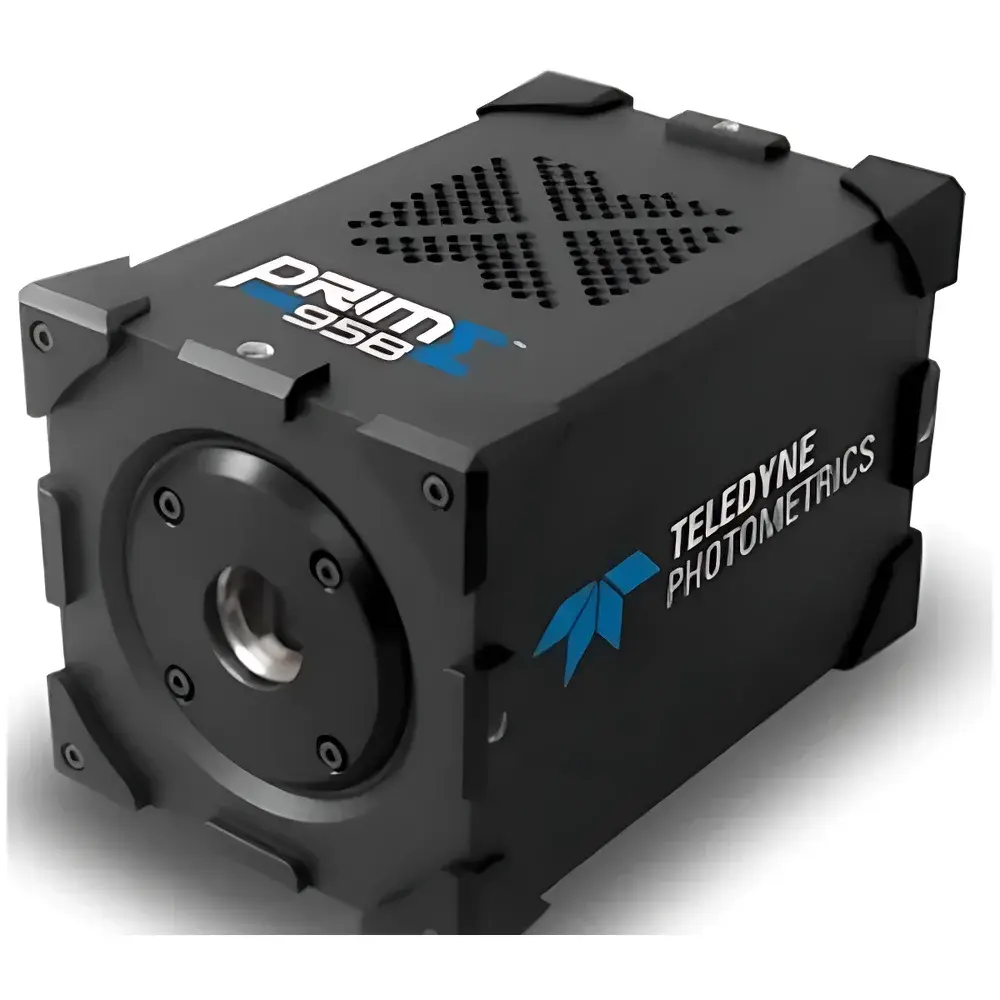
Teledyne Photometrics PRIME 95B Scientific CMOS Camera
| Brand | Teledyne Photometrics |
|---|---|
| Origin | USA |
| Model | PRIME 95B |
| Sensor Type | Back-Illuminated (BI) sCMOS |
| Quantum Efficiency (QE) | Up to 95% at 600 nm |
| Pixel Size | 11 µm |
| Dynamic Range | True 16-bit |
| Read Noise | <1.0 e⁻ (at high speed) |
| Frame Rate | Up to 43 fps at full 2048 × 2048 resolution |
| Interface | Camera Link HS or USB 3.2 Gen 2 |
| Mount | C-mount (PRIME 95B & PRIME 95B 22 mm), F-mount (PRIME 95B 25 mm) |
| UV Option | PRIME 95B UV (enhanced sensitivity 250–310 nm) |
Overview
The Teledyne Photometrics PRIME 95B is a high-performance scientific complementary metal-oxide-semiconductor (sCMOS) camera engineered for quantitative low-light imaging in life science and physical research applications. Its core architecture centers on a back-illuminated (BI) monochrome sensor with peak quantum efficiency (QE) of 95% at 600 nm — among the highest available in commercial sCMOS technology. Unlike front-illuminated sensors, where microlenses and wiring layers attenuate incident photons—especially at oblique angles induced by high-magnification microscope objectives—the BI design directs light directly onto the photodiode’s active region from the substrate side, eliminating absorption and reflection losses. This optical path optimization, combined with a large 11 µm pixel pitch, delivers exceptional photon collection efficiency across wide-field and high-magnification configurations. At 100× objective magnification, the PRIME 95B captures over 300% more signal than conventional sCMOS cameras with smaller pixels or front-illuminated architectures. Critically, it achieves true 16-bit dynamic range with photon-shot-noise-limited performance—enabling simultaneous quantification of dim and bright features within a single frame without saturation or loss of low-signal fidelity.
Key Features
- Back-illuminated sCMOS sensor with >95% peak QE, optimized for visible and near-UV spectral response
- True 16-bit digitization with sub-electron read noise (<1.0 e⁻ at full-frame high-speed mode)
- High-speed acquisition: up to 43 fps at full 2048 × 2048 resolution; scalable ROI-based frame rates exceeding 500 fps
- On-camera real-time processing engine supporting PrimeLocate, Multi-ROIs, and Real-Time Particle Tracking
- Three optical formats: C-mount (PRIME 95B, PRIME 95B 22 mm) and F-mount (PRIME 95B 25 mm) for compatibility with standard and large-format microscopes
- UV-enhanced variant (PRIME 95B UV) with anti-reflective coating optimized for 250–310 nm, enabling faster acquisition and reduced phototoxicity in DAPI, Hoechst, and UV-excited fluorophores
- Camera Link HS and USB 3.2 Gen 2 interfaces for deterministic low-latency data transfer and host system flexibility
Sample Compatibility & Compliance
The PRIME 95B is designed for integration into regulated and non-regulated laboratory environments, including those operating under GLP and GMP frameworks. Its hardware-level timestamping, frame-accurate trigger synchronization (TTL, LVDS), and metadata-rich image headers support traceability requirements for method validation. While not FDA-cleared as a medical device, its performance characteristics align with ISO 13660 (imaging system metrology) and ASTM E2877 (quantitative fluorescence microscopy standards). The camera’s deterministic exposure control, absence of EM gain drift or calibration dependencies, and stable dark current behavior (<0.001 e⁻/pix/s at 20°C) make it suitable for longitudinal studies requiring inter-session reproducibility. All firmware and SDK components comply with IEEE 1789-2015 flicker mitigation guidelines for continuous illumination protocols.
Software & Data Management
The PRIME 95B operates via Photometrics’ unified SDK (v5.x), supporting Windows and Linux platforms with native Python, MATLAB, and LabVIEW bindings. Its real-time processing suite includes three embedded algorithms: PrimeLocate performs on-sensor localization analysis—identifying and extracting only the top 500 candidate molecule positions per frame—reducing host bandwidth and storage load by >90% compared to full-frame transmission. Multi-ROIs allows definition of up to 15 non-contiguous regions-of-interest per frame, enabling selective data streaming without compromising spatial context. Real-Time Particle Tracking executes full-stack motion analysis onboard: background subtraction, pixel-wise noise normalization, sub-pixel centroid refinement, false-positive filtering (e.g., hot pixels, cosmic rays), and trajectory linking—all with metadata injection into each frame header (particle ID, position, intensity, bounding box). No proprietary analysis lock-in occurs: raw ROI or localized data exports are fully compatible with third-party tools including ThunderSTORM, QuickPALM, and TrackMate.
Applications
The PRIME 95B is widely deployed in quantitative fluorescence microscopy where photon budget, temporal resolution, and spatial fidelity are limiting factors. It serves as the imaging backbone for super-resolution modalities including PALM, STORM, and DNA-PAINT, particularly in sparse-emission regimes where PrimeLocate significantly accelerates reconstruction throughput. In confocal and light-sheet microscopy, its large field-of-view and high QE enable rapid volumetric acquisition with minimal laser power—critical for live-cell calcium imaging, organelle dynamics, and developmental biology. Single-molecule tracking applications benefit from its real-time particle engine, allowing immediate feedback during experiment setup and reducing post-acquisition computational overhead. UV-enhanced variants extend utility to nucleic acid labeling, UV crosslinking assays, and photoactivation kinetics where conventional sCMOS sensitivity drops sharply below 350 nm.
FAQ
What distinguishes the PRIME 95B from EMCCD cameras?
The PRIME 95B eliminates excess noise factor (ENF) and gain calibration drift inherent to EMCCDs while delivering comparable or superior single-photon detection efficiency—without the operational constraints of EM gain stability, accelerated sensor aging, or high power consumption.
Can the PRIME 95B be used for quantitative intensity measurements?
Yes. Its linear response across the full 16-bit range, calibrated gain/offset tables, and certified uniformity correction (flat-field, pixel-response non-uniformity) support absolute intensity quantification per ASTM E2877 Annex A2.
Is the UV-enhanced model compatible with standard microscope filter sets?
The PRIME 95B UV incorporates fused silica window and AR coatings optimized for 250–310 nm transmission; users must verify compatibility with UV-grade excitation/emission filters and quartz optics in the optical path.
Does the camera support hardware triggering for synchronization with other instruments?
Yes. It provides dual-input TTL/LVDS trigger modes (start-of-exposure and exposure-gating), programmable delay, and output sync pulses for precise coordination with lasers, shutters, or stage controllers.
How is data integrity ensured during high-speed acquisition?
All frames include embedded timestamps, exposure metadata, sensor temperature, and CRC-32 checksums; optional SDK logging enables audit-trail generation compliant with 21 CFR Part 11 electronic record requirements.





