
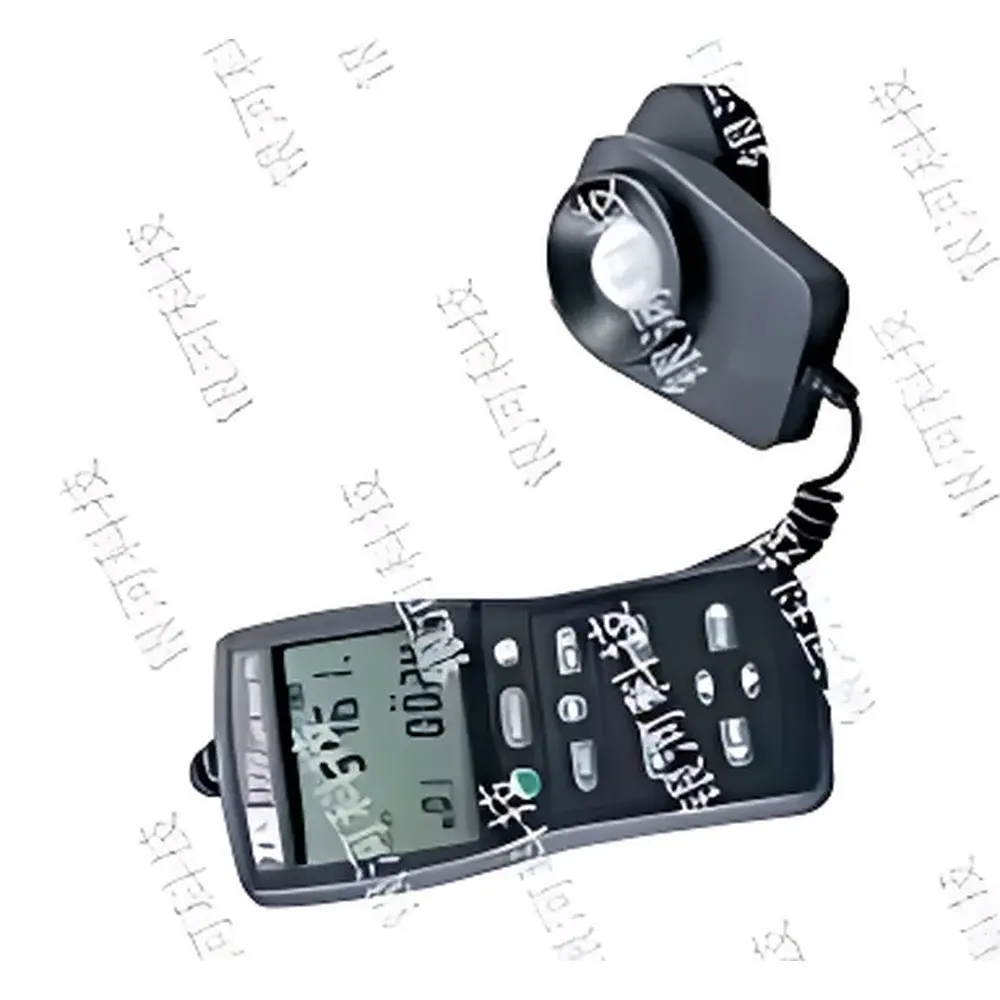
TES-1339 Professional Illuminance Meter
| Origin | Jiangsu, China |
|---|---|
| Manufacturer Type | Distributor |
| Origin Category | Domestic |
| Model | TES-1339 |
| Pricing | Upon Request |
Overview
The TES-1339 Professional Illuminance Meter is a precision optical measurement instrument engineered for reliable, repeatable photometric evaluation in industrial, laboratory, architectural lighting, and occupational health & safety environments. Based on silicon photodiode detection with spectral response calibrated to the CIE photopic luminosity function (V(λ)), the device delivers high-fidelity illuminance measurements across an exceptionally wide dynamic range—from 0.01 lux to 999,900 lux (equivalent to 0.001–99,990 fc). Its integral design incorporates cosine-corrected optics and rigorous adherence to CNS 5119 Class II requirements—ensuring compliance with national standards for accuracy, linearity, and angular response in general-purpose illuminance metrology.
Key Features
- High-resolution dual-display LCD (4-digit, dual-range) enabling simultaneous viewing of current reading and auxiliary parameters (e.g., average, max/min, or deviation)
- Five-range auto-ranging capability (0.01–999,900 lux / 0.001–99,990 fc) with seamless switching and overload indication (“OL”)
- Integrated illuminance integration mode for time-weighted total light exposure (lux·s), essential for photobiological safety assessments and lighting energy audits
- Dedicated stray-light compensation function (STRAY + LIGHT mode) to isolate target source contribution by subtracting ambient background irradiance
- Programmable timed measurement lock: user-defined interval acquisition with automatic hold upon completion
- Onboard data logging capacity for up to 50 measurement records—accessible directly via LCD without external software or interface
- Configurable comparative mode supporting absolute deviation (±Δlux) or relative percentage deviation (% of reference) for quality control pass/fail verification
- Point averaging function (user-selectable N-point moving average) to suppress transient fluctuations and enhance signal stability
- Auto-power-off after 15 minutes of inactivity; battery life extends to approximately 100 hours using six AAA alkaline cells
Sample Compatibility & Compliance
The TES-1339 is optimized for use with continuous or quasi-steady-state light sources including incandescent, halogen, fluorescent, LED, and OLED emitters. Its spectral mismatch error (f’₁ ≤ 6%) meets CNS 5119 Class II specifications—aligned with international best practices for general illuminance meters per IEC 60825-1 and ISO/CIE 19476. The cosine-corrected sensor head (100 × 60 × 27 mm) minimizes angular dependence errors up to ±75° incidence, satisfying EN 13201-3 requirements for roadway lighting verification. Operating temperature range (0–50°C, <80% RH) supports deployment in HVAC-controlled labs as well as field-based environmental monitoring applications. Calibration traceability is maintained to NIST-traceable standard lamps (2856 K blackbody reference), with stated accuracy of ±3% of reading ±5 digits.
Software & Data Management
While the TES-1339 operates as a fully standalone instrument, its internal memory architecture enables GLP-compliant documentation: each stored record includes timestamped value, measurement mode identifier, and unit flag. No proprietary software or drivers are required for basic data review; all 50 entries are navigable via front-panel controls. For integration into larger QA/QC workflows, manual transcription supports alignment with LIMS or Excel-based reporting systems. Though not equipped with USB/Bluetooth connectivity, the meter’s deterministic behavior, stable zero drift (<0.1%/°C), and repeatable response make it suitable for audit-ready environments governed by ISO/IEC 17025 or FDA 21 CFR Part 11 where electronic records are not mandated but procedural integrity is critical.
Applications
- Workplace lighting assessment per OSHA 1910.303 and EN 12464-1 for visual task performance and fatigue mitigation
- LED product development and binning verification under controlled photometric test conditions
- HVAC and daylight harvesting system commissioning and seasonal recalibration
- Photobiological safety screening (IEC 62471) for UV-A/blue-light hazard estimation in display and illumination devices
- Educational physics laboratories conducting inverse-square law validation and spectral sensitivity experiments
- Architectural daylight modeling validation using on-site spot measurements at workplane height
- Maintenance scheduling for aging lighting infrastructure based on longitudinal illuminance decay trends
FAQ
What calibration standard is used for factory verification?
The TES-1339 is calibrated against a NIST-traceable 2856 K tungsten filament standard lamp, conforming to ASTM E308 and CIE S 008/E:2001 protocols.
Can the instrument measure pulsed or modulated light sources?
It is designed for steady-state or slowly varying illumination; rapid PWM-driven LEDs (e.g., >200 Hz modulation) may yield attenuated readings due to 5-Hz sampling rate and analog integration bandwidth.
Is the sensor head detachable and replaceable?
Yes—the 150 cm coaxial cable connects a removable silicon photodiode sensor head, allowing repositioning or future replacement without instrument recalibration.
Does the device support data export to a PC?
No native digital interface is provided; however, logged values can be manually transcribed or captured via screen photography for traceable recordkeeping.
How is stray-light compensation implemented technically?
The STRAY + LIGHT mode performs two sequential measurements: first with the sensor shielded, then unshielded—computing net source illuminance as the difference, thereby rejecting ambient contributions.





