
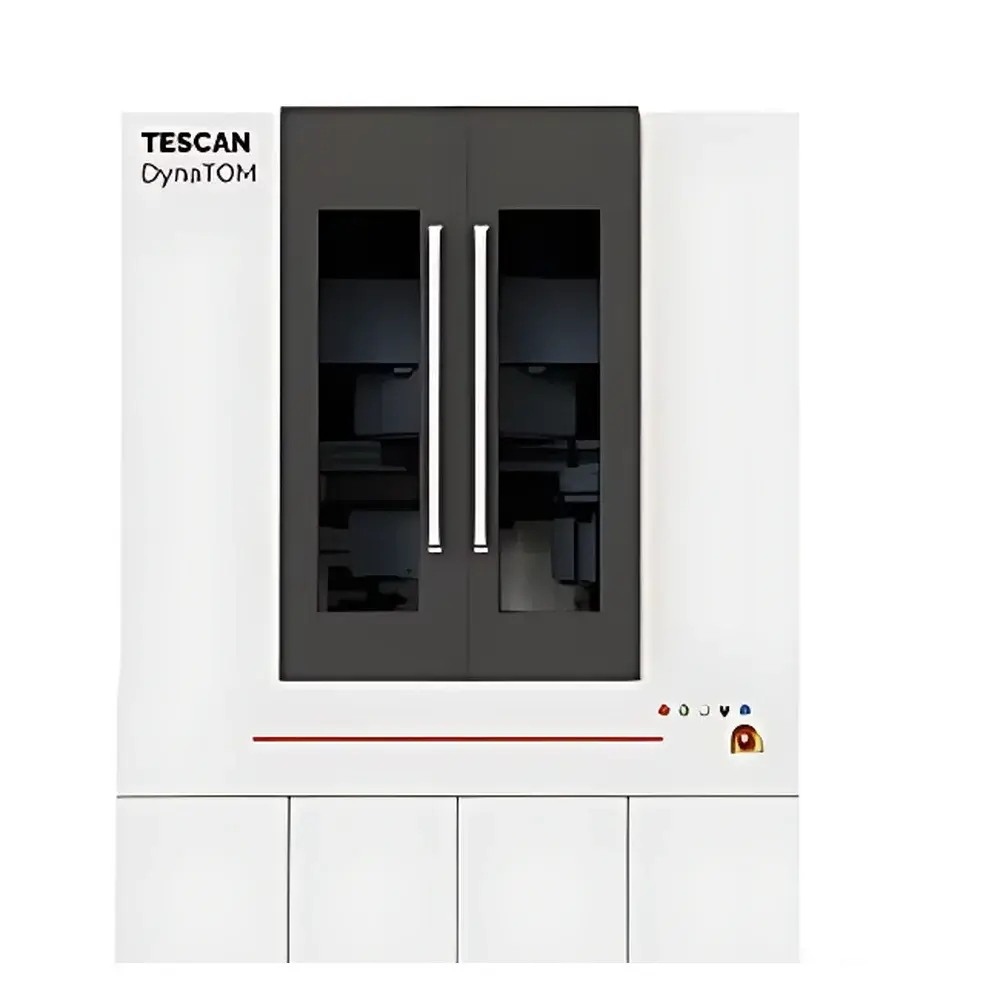
TESCAN DynaTOM 4D Dynamic X-ray Microscope
| Brand | TESCAN |
|---|---|
| Model | DynaTOM |
| Origin | Czech Republic |
| Manufacturer Type | Original Equipment Manufacturer (OEM) |
| Product Category | Imported Industrial Micro-CT System |
| Imaging Principle | Cone-Beam X-ray Computed Tomography with Continuous Rotational Acquisition |
| Temporal Resolution | <10 s per full 360° scan |
| Spatial Resolution | ≤2 µm |
| Geometry | Fixed-sample, rotating source–detector gantry |
| Software Suite | DynaTOM 4D Reconstruction & In Situ Workflow Package |
Overview
The TESCAN DynaTOM is the world’s first laboratory-scale, dedicated 4D dynamic X-ray microscope engineered for high-fidelity, non-destructive, time-resolved microtomography under real experimental conditions. Unlike conventional micro-CT systems that rely on step-and-shoot acquisition or limited angular sampling, the DynaTOM implements a continuous rotational geometry where the X-ray source and flat-panel detector rotate synchronously around a stationary sample—enabling true 4D (3D + time) volumetric imaging at sub-second temporal intervals. This architecture directly addresses long-standing limitations in in situ and operando studies: mechanical interference from moving stages, thermal drift during long acquisitions, and misalignment between external stimuli (e.g., mechanical loading, fluid flow, thermal cycling) and tomographic reconstruction. The system operates on cone-beam X-ray computed tomography principles, optimized for quantitative density contrast, phase-sensitive edge enhancement, and robust reconstruction stability across variable exposure conditions.
Key Features
- Fixed-Sample Rotating-Gantry Architecture: Eliminates stage motion during acquisition—preserving precise alignment with external in situ rigs (e.g., tensile stages, electrochemical cells, heating/cooling chambers, and high-pressure fluid cells).
- Continuous 360° Rotation: Achieves full-volume tomographic datasets in under 10 seconds per scan, enabling repeatable time-series acquisition with consistent geometric fidelity.
- Sub-2-µm Isotropic Spatial Resolution: Delivered via high-brightness microfocus X-ray source, low-noise CMOS-based flat-panel detector, and geometric magnification control—validated per ISO 15739:2013 for resolution and noise performance.
- Real-Time Synchronization Interface: TTL-triggered I/O ports support hardware-level synchronization with external sensors (strain gauges, pressure transducers, temperature probes) and actuation systems for event-locked acquisition.
- Modular Mechanical Design: Open-access龙门 (gantry) frame accommodates custom sample environments up to Ø200 mm × 300 mm (diameter × height), with integrated cable management for feedthroughs and signal routing.
Sample Compatibility & Compliance
The DynaTOM supports a broad range of solid, porous, composite, and multiphase materials—including metals, ceramics, polymers, geological cores, battery electrodes, and biological scaffolds—without requiring destructive sectioning or conductive coating. Its fixed-sample configuration ensures compatibility with ASTM E1441-21 (Standard Practice for Computed Tomography) and ISO/IEC 17025:2017-accredited workflows when paired with traceable calibration phantoms (e.g., NIST-traceable step wedges, sphere arrays). All firmware and reconstruction modules comply with FDA 21 CFR Part 11 requirements for electronic records and signatures, including audit trail logging, user access controls, and data integrity validation—making it suitable for GLP and GMP-regulated R&D environments.
Software & Data Management
The DynaTOM 4D software suite provides an integrated environment for acquisition orchestration, motion-corrected reconstruction, temporal registration, and dynamic visualization. Key components include: (1) In Situ Control Hub, enabling plug-in integration with third-party controllers (LabVIEW, Python API, Modbus TCP); (2) 4D Reconstruction Engine, implementing iterative SART and GPU-accelerated FDK algorithms with ring artifact suppression and beam-hardening correction; (3) Event Detection Module, applying voxel-wise temporal variance analysis to automatically flag onset points of structural change (e.g., crack nucleation, pore coalescence, phase transformation); and (4) VolumeFlow Visualizer, supporting synchronized playback of reconstructed volumes alongside time-series sensor data in a unified timeline. Raw projections are stored in DICOM-compliant format with embedded metadata (exposure time, rotation angle, source voltage, detector gain), ensuring FAIR (Findable, Accessible, Interoperable, Reusable) data principles.
Applications
The DynaTOM enables quantitative 4D characterization across multiple industrial and academic domains: monitoring lithium-ion electrode degradation during cycling; visualizing fluid front propagation in reservoir rock analogs under differential pressure; tracking microcrack initiation and coalescence in additively manufactured alloys under cyclic load; observing dendritic growth kinetics in solidifying metal alloys; and mapping hydration-driven swelling in cementitious materials. Its ability to serve as a pre-screening platform for synchrotron beamtime—validating in situ protocols and optimizing scan parameters prior to large-facility access—has been adopted by leading facilities including ESRF, DESY, and APS to improve proposal success rates and reduce experimental overhead.
FAQ
What distinguishes DynaTOM from conventional micro-CT systems in dynamic experiments?
Unlike step-and-shoot or limited-angle systems, DynaTOM acquires projection data continuously while rotating—eliminating motion artifacts and enabling true time-resolved volumetric reconstruction without interpolation gaps.
Can DynaTOM be integrated with third-party in situ stages?
Yes—its open I/O architecture and software SDK support native integration with commercial mechanical, thermal, electrical, and fluidic stages via Ethernet, USB, or analog/digital triggers.
Is the system suitable for regulatory submissions?
All software modules meet 21 CFR Part 11 requirements for audit trails, electronic signatures, and data integrity—validated for use in pharmaceutical, medical device, and aerospace QA/QC workflows.
What is the minimum detectable feature size under dynamic conditions?
At optimal magnification and exposure settings, the system resolves features down to 2 µm isotropic voxel size—verified using line-pair phantoms and confirmed through NIST-traceable metrology reports.
Does TESCAN provide application-specific reconstruction protocols?
Yes—application engineers deliver validated workflows for battery cycling, geomechanics, metallurgy, and biomaterials, including parameter presets, artifact mitigation strategies, and reporting templates aligned with ASTM/ISO standards.



