
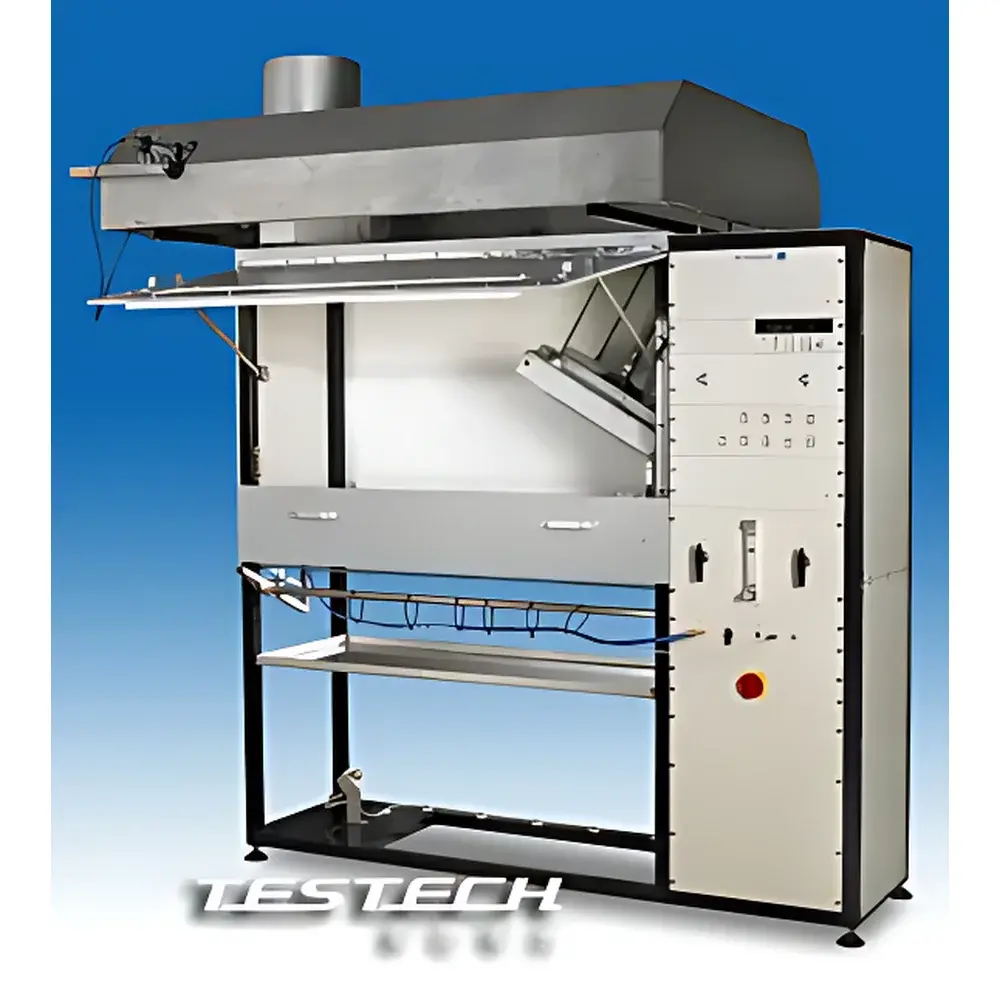
TTech-ASTM162 Radiant Panel Flame Spread Tester per ASTM E 162
| Brand | TTech (TESTech) |
|---|---|
| Origin | Jiangsu, China |
| Manufacturer Type | Direct Manufacturer |
| Model | TTech-ASTM162 |
| Power Supply | AC 220 V, 50/60 Hz, 15 A |
| Dimensions (Tester) | 1850(W) × 700(D) × 1260(H) mm |
| Control Console Dimensions | 600(W) × 750(D) × 1600(H) mm |
| Weight | 150 kg |
| Exhaust Flow Rate | ≥15 m³/min |
| Fuel | Propane |
| Data Acquisition | Integrated DAQ System with Laptop Interface |
| Calibration | Compliant with ASTM E 162 and ASTM D 3675 requirements for radiant panel alignment, thermocouple placement, and burner orifice geometry |
Overview
The TTech-ASTM162 Radiant Panel Flame Spread Tester is a precision-engineered apparatus designed to evaluate the surface flammability and lateral flame propagation behavior of solid materials under controlled radiant heat exposure. It implements the standardized test methodology defined in ASTM E 162 – “Standard Test Method for Surface Flammability of Materials Using a Radiant Heat Energy Source” – and additionally supports conformance testing per ASTM D 3675 for flexible, porous materials such as foams, textiles, and acoustic insulation. The instrument employs a calibrated radiant panel heater (typically operating at 35–40 kW/m² surface flux) combined with a pilot ignition source (propane-fueled burner) to initiate combustion. During testing, specimens are mounted vertically and exposed to both radiant heat and localized flame for up to 15 minutes. Flame front progression is tracked visually against calibrated reference marks spaced at 3-inch intervals along the specimen surface; time-to-reach each mark is recorded to calculate flame spread index (FSI). Concurrent measurements include smoke obscuration (via optical density sensors), mass loss rate, droplet formation (if applicable), and backside temperature rise using embedded thermocouples.
Key Features
- Stainless steel structural frame ensuring long-term corrosion resistance and dimensional stability in high-temperature, high-humidity exhaust environments
- Integrated air-cooled radiant panel with precision-machined reflector and forced-air filtration system for uniform thermal distribution
- Calibrated propane burner assembly featuring 16 precisely aligned 1.8 mm orifices arranged symmetrically about the central axis per ASTM E 162 Annex A2
- Dual-stage ignition system: electronic spark igniter with real-time flame supervision and automatic gas cutoff upon flameout detection
- Modular stainless steel specimen holder with adjustable clamping mechanism and standardized 3-inch interval observation markers
- Exhaust ducting system equipped with eight Class I, 0.5 mm diameter mineral-insulated thermocouples positioned per ASTM E 162 Figure 2 for radiant flux verification and temperature profiling
- Industrial-grade data acquisition system with synchronized timestamping, analog input channels for thermocouple signals, and digital I/O for valve control and safety interlocks
- Dedicated control cabinet with programmable logic controller (PLC), calibrated mass flow controllers for propane/air mixture, and emergency circuit-breaker integration
Sample Compatibility & Compliance
The TTech-ASTM162 accommodates flat, rigid, or semi-rigid specimens measuring 24 in × 9 in (610 mm × 229 mm), with thickness up to 1 in (25.4 mm), including but not limited to interior trim panels, ceiling tiles, wall coverings, seat upholstery substrates, and polymer composites used in rail transportation. It fully satisfies the physical configuration, instrumentation, and procedural requirements of ASTM E 162 and ASTM D 3675. The system is routinely employed to support compliance verification for NFPA 130 (Standard for Fixed Guideway Transit and Passenger Rail Systems), particularly for flame spread assessment of interior components in commuter trains, subways, and light rail vehicles. All critical measurement subsystems—including radiant panel output, thermocouple calibration, gas flow rates, and exhaust velocity—are traceable to NIST-certified references and documented per ISO/IEC 17025-aligned laboratory quality procedures.
Software & Data Management
The TTech-ASTM162 operates via a Windows-based control interface running on an included OEM laptop. The software provides real-time visualization of thermocouple readings, gas flow parameters, elapsed test time, and flame front position (manually entered or optionally integrated with machine vision modules). All raw sensor data are logged at user-configurable intervals (default: 1 Hz) in CSV format with embedded metadata (test ID, operator, date/time, standard version, calibration certificate ID). The system supports audit-trail functionality compliant with FDA 21 CFR Part 11 requirements when deployed in regulated GMP/GLP environments—enabling electronic signatures, role-based access control, and immutable record archiving. Exported datasets are directly compatible with statistical analysis platforms (e.g., JMP, Minitab) and reporting tools used for FSI derivation and regulatory submission packages.
Applications
This tester serves critical roles across fire safety engineering, product development, and regulatory certification workflows. Primary application domains include: evaluation of flame spread performance of polymeric composites in aerospace cabin interiors; qualification testing of acoustic insulation and HVAC duct linings in marine and rail applications; comparative assessment of halogen-free flame-retardant additives in thermoplastics; validation of fire-safe coatings for architectural façade systems; and technical support for UL 94 HB, FMVSS 302, and EN 45545-2 hazard level classification. Its reproducible radiant heat delivery and strict adherence to ASTM-defined geometry ensure inter-laboratory comparability essential for multi-site product harmonization and third-party certification.
FAQ
What standards does the TTech-ASTM162 explicitly support?
ASTM E 162, ASTM D 3675, and indirectly supports test protocols referenced in NFPA 130, UL 94, and EN 45545-2 through equivalent flame spread methodology.
Is propane the only approved fuel gas?
Yes—ASTM E 162 specifies propane as the sole fuel for the pilot burner; alternative fuels invalidate conformance.
How often must the radiant panel be recalibrated?
Per ASTM E 162 Section 8.2, radiant flux uniformity and peak output must be verified prior to each test series and after any maintenance affecting panel alignment or power supply.
Can the system operate without the supplied laptop?
No—the embedded PLC requires the proprietary software interface for test initiation, parameter setting, and data capture; standalone operation is not supported.
Does the unit include exhaust ductwork for connection to a lab fume hood?
The system includes a 300 mm diameter stainless steel exhaust manifold with quick-release couplings; external ducting to facility exhaust must be engineered separately per local fire code and static pressure specifications.



