
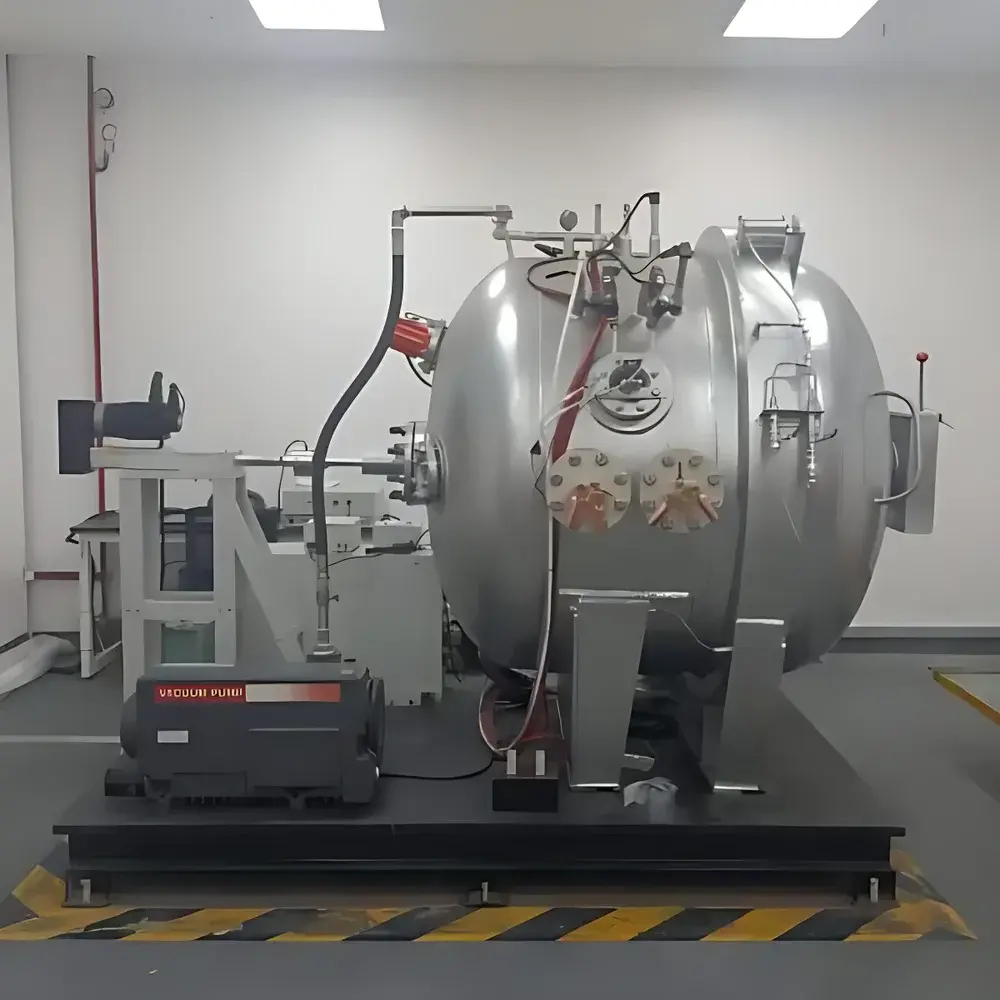
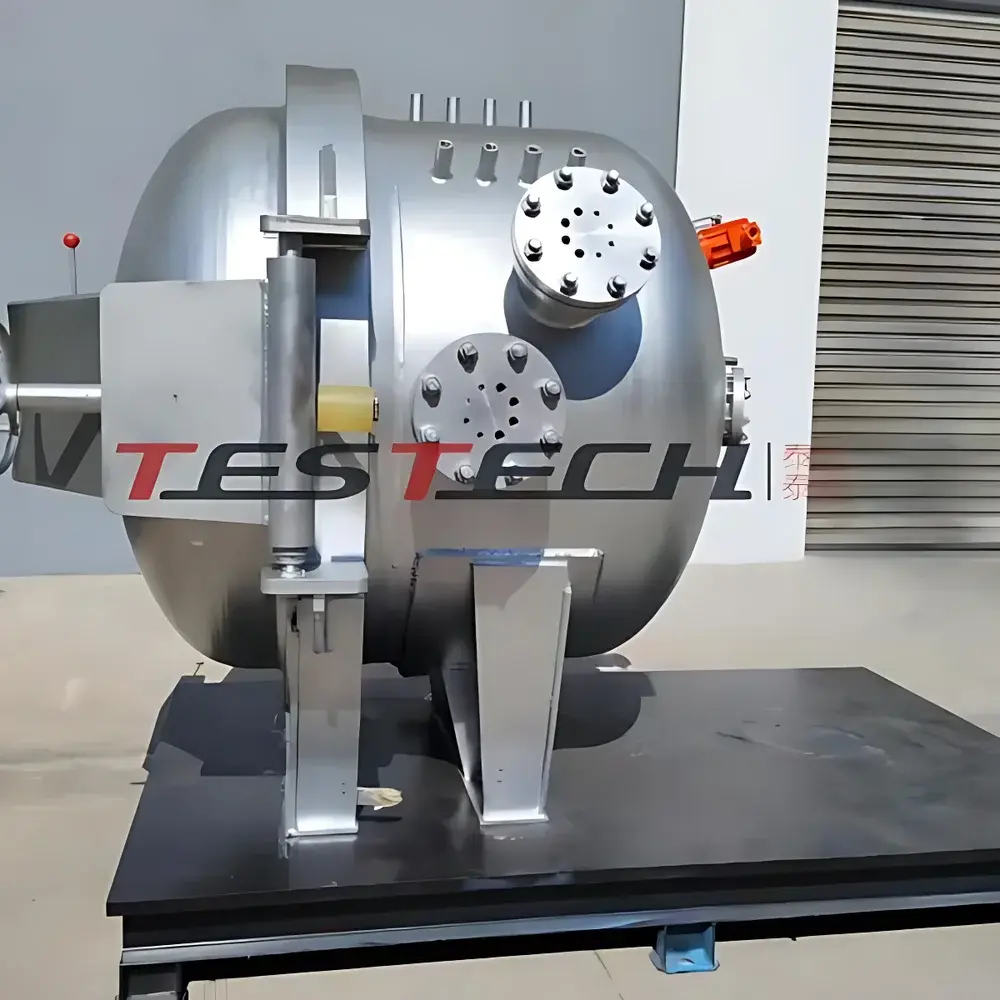
UL9540A Module Thermal Runaway Test Chamber
| Brand | TESTech |
|---|---|
| Model | TTech-UL9540A-2 |
| Internal Volume | 1500 L (customizable) |
| Inner Diameter | 1400 mm |
| Internal Length | 1200 mm |
| Construction Material | SUS#304 Stainless Steel Body + 16Mn Ring Flange |
| Pressure Rating | ≥2.0 MPa (sustained), ≥2.0 MPa (burst) |
| Leak Rate | ≤1 kPa/24 h at 2.0 MPa inert gas hold |
| Vacuum System | Pumping Speed ≥10 L/s, Ultimate Vacuum ≤1.0 kPa |
Overview
The UL9540A Module Thermal Runaway Test Chamber is a purpose-engineered high-pressure containment system designed specifically for quantitative off-gas analysis during lithium-ion battery module-level thermal runaway events. Based on the test methodology defined in UL 9540A Annex D and aligned with ASTM E2971 (Standard Test Method for Determining Off-Gas Composition from Lithium-Ion Batteries Under Thermal Abuse), this chamber provides a rigorously controlled, inert-atmosphere environment to capture, retain, and sample gaseous decomposition products generated during propagation-scale failure. Its horizontal cylindrical geometry—optimized for uniform stress distribution and volumetric scalability—enables reproducible testing of battery modules up to 1500 L equivalent volume, supporting both single-module and multi-module configurations. The vessel operates under fully programmable pressure control, integrating real-time monitoring of internal pressure, temperature, and gas composition via standardized sampling interfaces.
Key Features
- Structural integrity certified per GB/T 150.1–2011 (Chinese National Standard for Pressure Vessels), with dual-layer mechanical redundancy: elliptical head welding at one end and flanged hinged door with metallic C-ring sealing at the other.
- Pressure containment validated to ≥2.0 MPa sustained working pressure and ≥2.0 MPa burst rating; leak-tightness verified by 24-hour inert gas hold test at 2.0 MPa with ≤1 kPa pressure decay.
- Dual independent pressure relief pathways—mechanical rupture disc and spring-loaded safety valve—ensuring fail-safe depressurization under overpressure conditions.
- Hinged quick-access door enables rapid sample loading, sensor deployment, and post-test residue inspection without disassembly.
- Integrated automated gas handling manifold: precision-controlled nitrogen inlet for purging/inerting, vacuum exhaust port with ≤1.0 kPa ultimate vacuum capability (pumping speed ≥10 L/s), and dedicated sampling line with sub-micron particulate filtration (≤0.1 µm).
- Multiple standardized instrumentation ports: pressure transducer interface, thermocouple feedthroughs (Type K or T), optical viewport (borosilicate glass, 150 mm Ø), and ISO-KF 40 vacuum flanges for auxiliary diagnostics (e.g., FTIR, GC-MS, PID).
Sample Compatibility & Compliance
The chamber accommodates battery modules ranging from prismatic and pouch cells (up to 50 Ah nominal capacity) to assembled packs (e.g., 1P8S–4P20S configurations). Modular mounting fixtures allow secure positioning of thermal triggers—including calibrated needle penetration actuators, DC overcharge circuits, and external radiant heaters—without compromising vessel integrity. All materials in contact with test atmosphere comply with ASTM D4295 (outgassing compatibility) and are non-catalytic toward common electrolyte decomposition gases (CO, CO₂, H₂, CH₄, C₂H₄, HF, PF₅). The system meets mechanical and procedural requirements outlined in UL 9540A Section 7.3 (Module-Level Testing), supports traceable calibration per ISO/IEC 17025, and integrates seamlessly into GLP-compliant lab workflows requiring audit-ready pressure logs and event timestamps.
Software & Data Management
While hardware-centric, the chamber interfaces natively with third-party DAQ systems (e.g., National Instruments cDAQ, Keysight 34972A) via analog 4–20 mA and digital TTL I/O. Optional TESTech-supplied control software provides synchronized logging of pressure (±0.1% FS), temperature (±0.5 °C), valve actuation status, and vacuum cycle duration. All data files are exported in CSV and HDF5 formats, compliant with FDA 21 CFR Part 11 requirements when deployed with electronic signature and audit trail modules. Raw pressure traces and gas sampling timestamps are automatically tagged with unique test IDs and metadata (operator, ambient conditions, cell batch ID), enabling full traceability across qualification reports and regulatory submissions.
Applications
- Quantitative off-gas yield measurement for hazard classification per UN GHS criteria (e.g., flammability class, toxicity index).
- Validation of thermal barrier efficacy in module-level pack designs.
- Correlation of gas composition profiles with specific failure modes (e.g., SEI decomposition vs. cathode oxygen release).
- Supporting FMEA development for battery management system (BMS) thermal runaway detection algorithms.
- Generating input data for CFD-based fire propagation modeling in energy storage systems (ESS).
- Third-party certification testing per UL 9540, IEC 62619, and GB/T 36276–2018 standards.
FAQ
Is the chamber compatible with real-time gas analysis instruments such as FTIR or GC-MS?
Yes—the exhaust port features an ISO-KF 40 vacuum flange and integrated particulate filter, enabling direct coupling to analytical gas systems with minimal dead volume.
Can the internal volume be modified beyond 1500 L?
Yes—custom configurations up to 3000 L are available upon engineering review; structural recalculations and ASME/GB/T re-certification apply.
Does the system include validation documentation for regulatory audits?
Each unit ships with Factory Acceptance Test (FAT) report, pressure vessel nameplate, material traceability certificates (MTRs), and leak test records—all archived for 10 years per ISO 9001 requirements.
What safety interlocks are implemented?
Hardware-enforced interlocks prevent door opening above 50 kPa internal pressure; software monitors for abnormal pressure ramp rates (>0.5 MPa/min) and triggers automatic purge sequence.
Is remote operation supported?
All pneumatic valves and vacuum pump controls accept 24 VDC signals and Modbus RTU commands, enabling integration into centralized lab automation platforms.






