
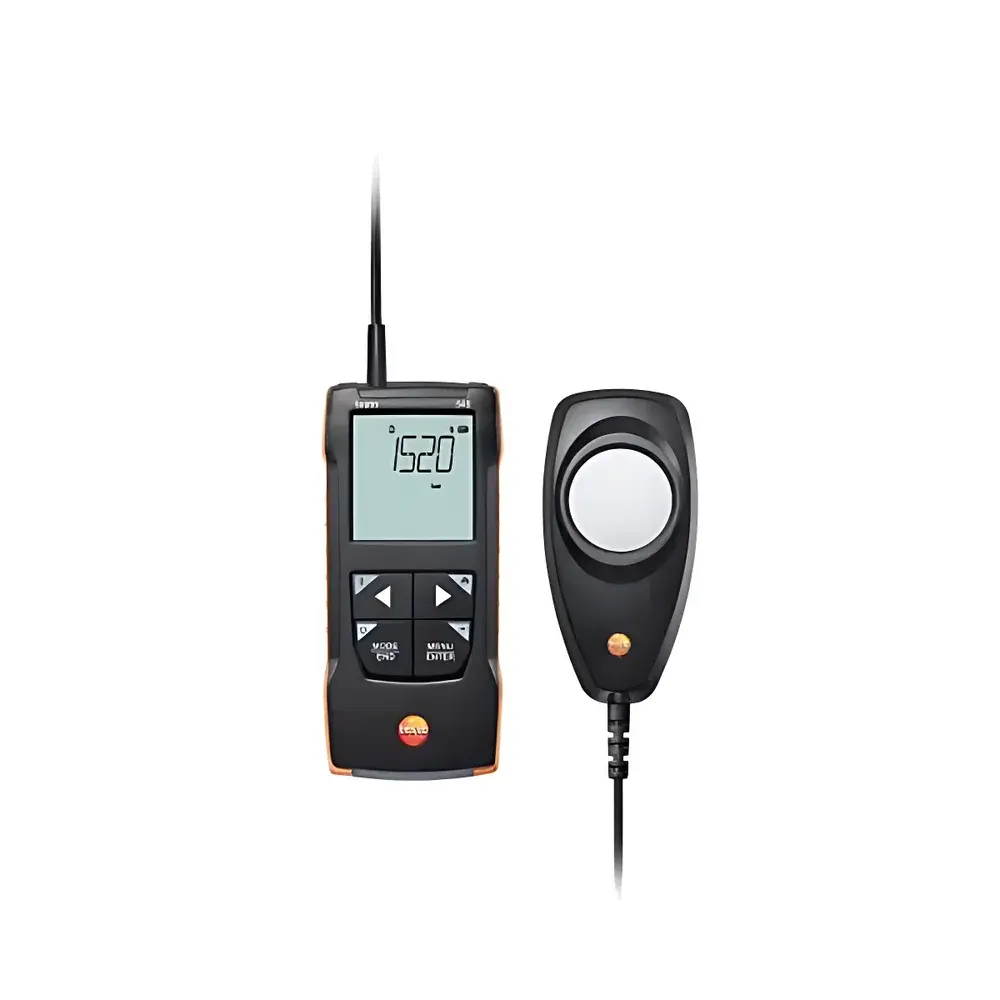
testo 545 Digital Illuminance Meter
| Brand | testo |
|---|---|
| Model | testo 545 |
| Sensor Type | Silicon Photodiode |
| Measurement Range | 0–100,000 lx |
| Accuracy | ±3% of reading ±1 digit (Class C per DIN 5032-7 / EN 13032-1 Annex B) |
| Resolution | 0.1 lx (<10,000 lx), 1 lx (≥10,000 lx) |
| Operating Temperature | −10 to +50 °C (probe: 0 to +50 °C) |
| IP Rating | IP40 (instrument), IP20 (probe) |
| Battery Life | ~70 h (3 × AA) |
| Weight | 288 g |
| Probe Dimensions | 134 × 54 × 23 mm |
| Main Unit Dimensions | 149 × 60 × 28 mm |
| Cable Length | 1.4 m |
| Compliance | V(λ)-corrected photopic response per CIE 1931 standard, optimized for white and warm-white LEDs (CCT < 5000 K), excluding monochromatic blue LEDs |
Overview
The testo 545 Digital Illuminance Meter is a precision optical measurement instrument engineered for reliable, photometrically accurate illuminance assessment in occupational, architectural, and quality assurance environments. It employs a silicon photodiode sensor with rigorous V(λ) spectral correction—aligned to the CIE 1931 photopic luminosity function—to deliver traceable lux measurements across common artificial light sources, including incandescent, fluorescent, and warm-white LED lighting (CCT ≤ 5000 K). Unlike basic meters using uncorrected photodiodes, the testo 545 applies real-time cosine-error compensation and spectral weighting to minimize deviation under non-perpendicular incidence or spectrally narrow emissions. Its Class C performance certification per DIN 5032-7 and EN 13032-1 Annex B ensures compliance with European standards for workplace lighting verification, supporting audits under ISO 45001, EN 12464-1 (lighting of work places), and national occupational health regulations.
Key Features
- V(λ)-corrected silicon photodiode sensor with integrated cosine diffuser for angular response optimization up to ±75° incidence
- Real-time audible alarm (adjustable threshold) with configurable limit values for immediate over/under-illumination detection
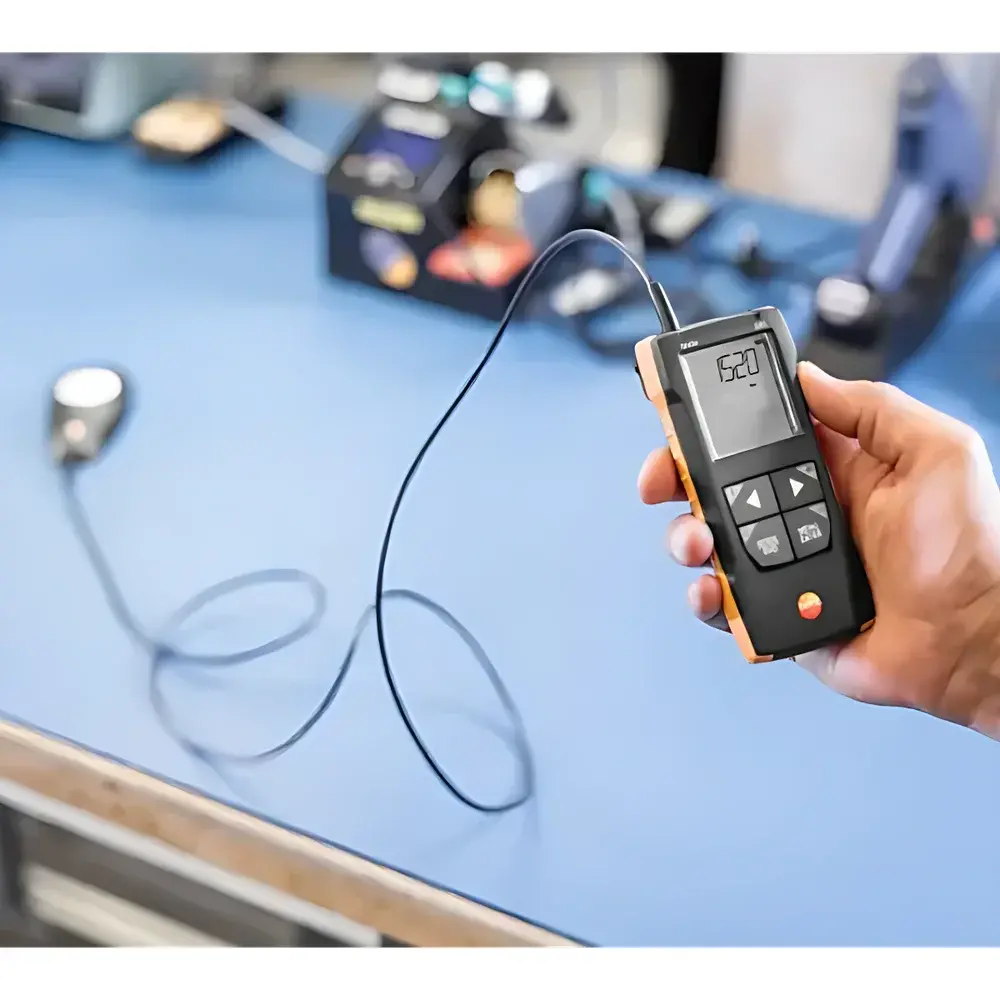
- On-device calculation of time-weighted averages (TWA) and multi-point spatial averages—enabling rapid compliance checks across workstations or room grids
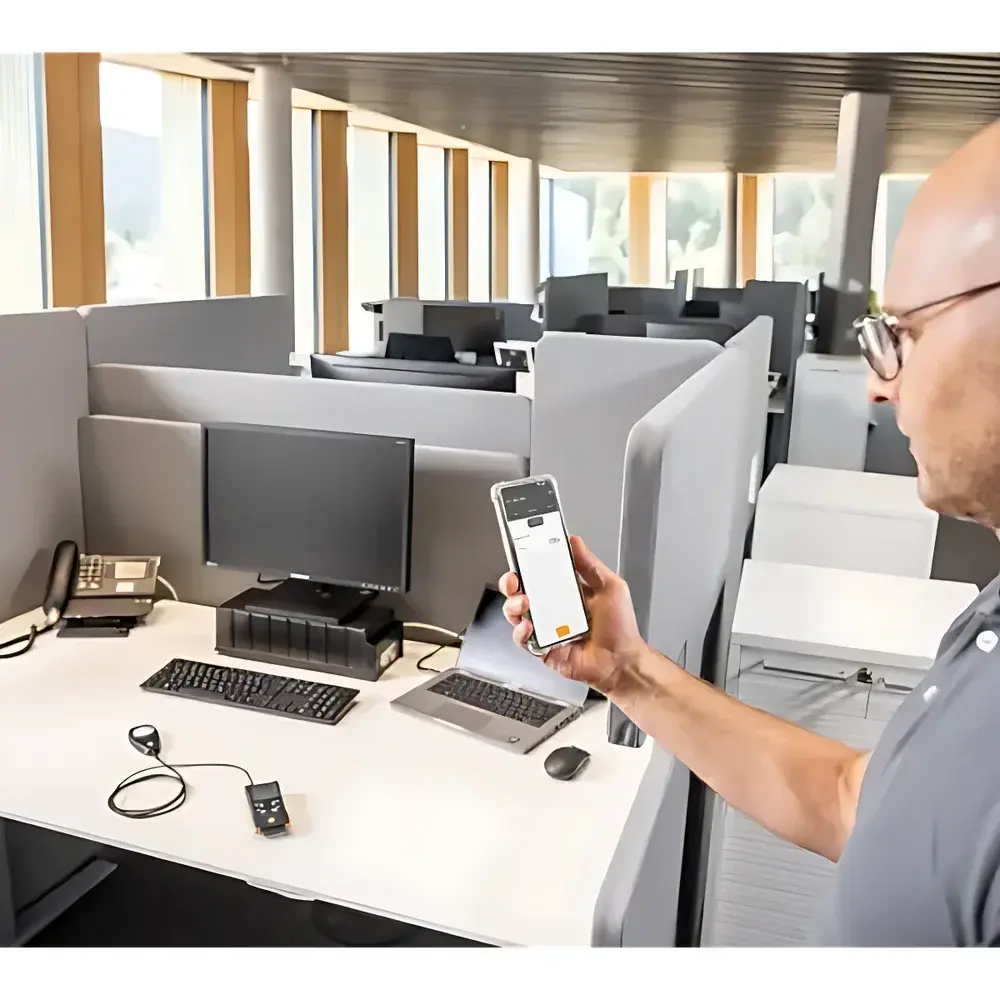
- Bluetooth 5.0 connectivity for seamless pairing with the free testo Smart App (iOS/Android), supporting remote configuration, live trend visualization, and dual-screen display
- Rugged, ergonomic housing (ABS + PC/TPE blend) with IP40-rated main unit and IP20-rated probe; designed for daily field use in industrial and office settings
- Extended battery runtime (~70 hours) via standard 3 × AA cells; low-power standby mode and auto-off functionality conserve energy without compromising readiness
Sample Compatibility & Compliance
The testo 545 is validated for photometric measurement of broadband and polychromatic light sources meeting CIE-defined photopic response criteria. It demonstrates high fidelity for white-light LEDs (CCT 2700–5000 K), compact fluorescents, halogen, and tungsten-filament lamps. Monochromatic blue LEDs (e.g., 450 nm peak) fall outside its calibrated spectral envelope and are explicitly excluded from specification—consistent with metrological best practices outlined in CIE TN 007:2021. The device conforms to EN 13032-1:2012 for luminance and illuminance meter classification, and its calibration traceability aligns with ISO/IEC 17025-accredited laboratories. Documentation includes a factory calibration certificate referencing NIST-traceable standards, facilitating integration into GLP-compliant lighting validation protocols.
Software & Data Management
The testo Smart App serves as a full-featured companion platform—not merely a data logger but an analytical interface. Users configure measurement intervals, define custom alarm thresholds, and assign location tags prior to deployment. Real-time graphs plot illuminance vs. time, while exported CSV files retain metadata (timestamp, GPS coordinates if enabled, instrument ID, and operator notes). Audit-ready reports can be generated directly within the app, embedding calibration status, environmental conditions (ambient temperature), and statistical summaries (min/max/mean/stdev). All stored measurements support 21 CFR Part 11-compliant electronic signatures when deployed on enterprise-managed devices with role-based access control.
Applications
- Workplace lighting audits per EN 12464-1: verifying minimum illuminance levels (e.g., 500 lx for office desk tasks, 300 lx for corridors)
- LED retrofit validation—quantifying uniformity, glare risk (via UGR estimation workflows), and compliance with WELL Building Standard L03 requirements
- HVAC-integrated daylight harvesting system commissioning, where sensor placement and response linearity directly impact energy savings
- Pharmaceutical cleanroom illumination mapping (ISO 14644-1), ensuring consistent photometric conditions across classified zones
- Ergonomic assessments linking illuminance distribution to visual fatigue metrics in shift-work environments
FAQ
Does the testo 545 support calibration verification against a reference lamp?
Yes—users may perform field verification using a stable, NIST-traceable reference illuminant (e.g., tungsten-halogen standard lamp) at known distance and geometry. Full recalibration is recommended annually or after mechanical shock.
Can it measure pulsed or modulated LED lighting (e.g., PWM-driven fixtures)?
The testo 545 samples at 10 Hz and provides RMS-equivalent lux values; it is not intended for high-frequency flicker analysis (e.g., >125 Hz modulation). For flicker metrics (flicker index, percent flicker), dedicated photometers such as the testo 549 are required.
Is the probe detachable and replaceable?
The probe is permanently integrated via a 1.4 m shielded cable and is not user-replaceable. Should sensor degradation occur, return-to-factory service includes probe replacement and full recalibration.
What environmental conditions affect measurement accuracy?
Ambient temperature extremes (>50 °C at probe or <−10 °C at main unit) may induce drift beyond specified tolerances. Humidity has no direct effect, but condensation on the diffuser surface must be avoided to prevent scattering artifacts.
How does the testo 545 handle reflected or indirect illumination during spot measurements?
Its cosine-corrected design inherently accounts for diffuse components incident at oblique angles. However, users must ensure the probe’s active area remains unobstructed and oriented perpendicular to the dominant light vector for task-area evaluation—per EN 12464-1 Section 5.2.




