
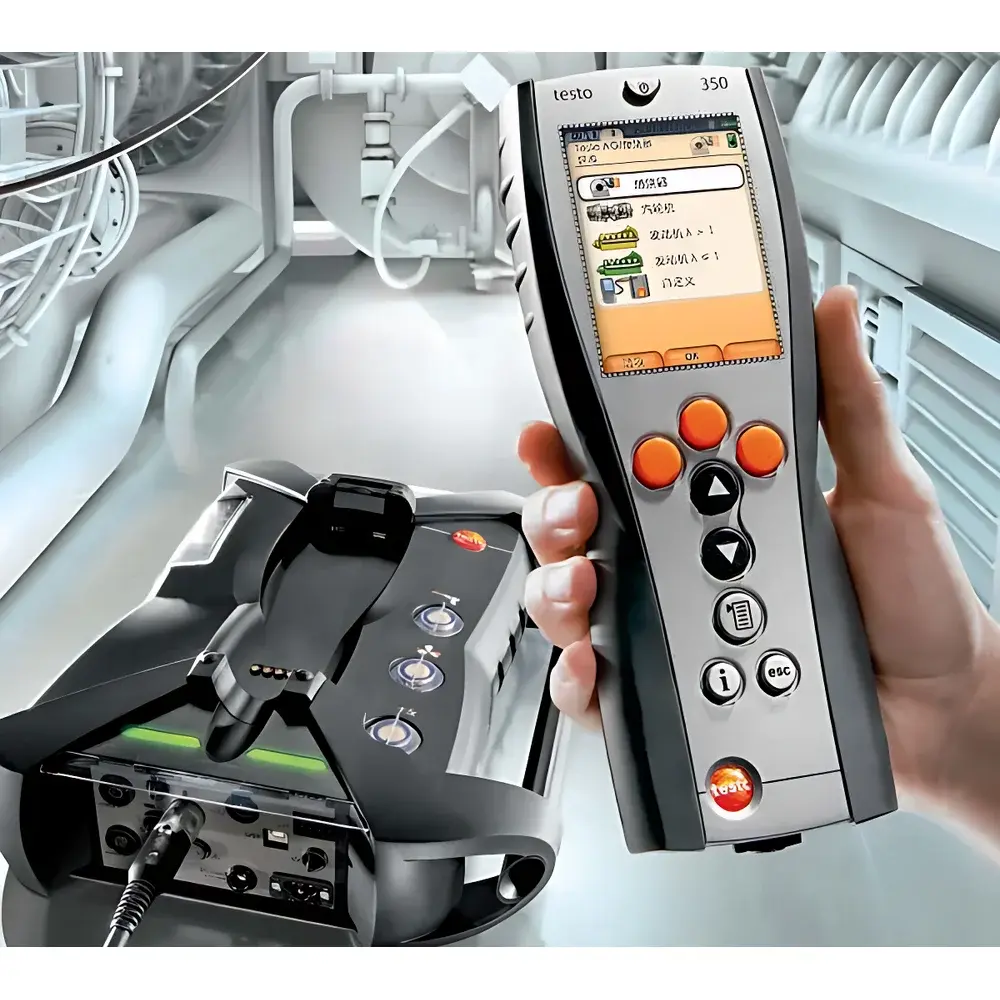
Testo Testo350 Flue Gas Analyzer
| Brand | Testo |
|---|---|
| Origin | Germany |
| Type | Portable Flue Gas Analyzer |
| Measurement Accuracy | <5% |
| Repeatability | <2% |
| Response Time | <90 s |
| Stability | <5% |
| Measured Gases | O₂, CO, NO, NO₂, SO₂ |
| Optional Sensors | CO₂ (IR), H₂S |
| Sampling Flow Rate | 1.0 L/min (regulated) |
| Data Storage Capacity | 250,000 values |
| Operating Temperature Range | –0 °C to +1000 °C (with high-temp probe) |
| Differential Pressure Range | –200 to +200 hPa |
| IP Rating | IP40 |
| Weight | 4.8 kg |
| Dimensions | 330 × 128 × 438 mm |
Overview
The Testo Testo350 is a professional-grade, portable flue gas analyzer engineered for precision emissions monitoring and combustion optimization in industrial, municipal, and commercial heating systems. Built on electrochemical sensor technology with optional infrared (IR) detection for CO₂, the instrument operates on the principle of selective gas absorption and redox reaction kinetics—enabling simultaneous, real-time quantification of O₂, CO, NO, NO₂, SO₂, and other regulated combustion byproducts. Its modular architecture supports up to six gas sensors in a single analyzer housing, with field-replaceable modules and hot-swappable calibration. Designed for compliance-driven environments—including those governed by EN 15267, EN 14181, EPA Method 6C, and ISO 12039—the Testo350 delivers traceable, audit-ready measurements under variable stack conditions: high humidity, elevated particulate load (up to 20 g/m³), transient pressure differentials (±300 mbar), and ambient temperatures from –10 °C to +50 °C. The integrated condensate separation system and non-heated high-humidity low-sulfur sampling module (0–200 ppm SO₂) eliminate reliance on external chillers or heated lines in low-temperature, high-moisture applications—reducing setup complexity while maintaining metrological integrity.
Key Features
- Modular sensor configuration supporting up to six simultaneous gas channels (O₂, CO, NO, NO₂, SO₂, CO₂IR, H₂S) with factory-calibrated, plug-and-play modules.
- Integrated gas conditioning system featuring automatic condensate removal, hydrophobic membrane filtration, and dual-stage water separation—ensuring stable sensor response even at relative humidity up to 90% RH.
- Dual-range SO₂ capability: standard 0–5000 ppm electrochemical sensor and optional low-range 0–200 ppm sensor with ±2 ppm accuracy below 40 ppm—optimized for low-emission biomass and natural gas boilers.
- Fresh air dilution valve enabling 5× range extension across all electrochemical sensors, validated per DIN EN 15267-3 for extended dynamic measurement without recalibration.
- Independent range extension kits (2×, 5×, 10×, 20×, 40×) for extreme-concentration applications such as cement kilns or waste incinerators—implemented via calibrated bypass flow control and sensor-specific compensation algorithms.
- Non-heated, high-humidity SO₂ sampling assembly: includes 1750 mm probe, 2.2 m sulfur-resistant hose, and 0–200 ppm SO₂ sensor—operational without external heating or pre-conditioning, reducing power demand and weight.
- Real-time unit conversion between ppm and mg/m³ (dry/wet basis, stoichiometric correction applied) per EN 14792 and VDI 3870 guidelines.
- Onboard fuel database with 12 preloaded standard fuels (e.g., natural gas, light oil, anthracite, wood chips) and user-definable fuel composition for accurate excess air, combustion efficiency (0–120%), and flue gas loss (–20 to +99.9%) calculations.
- Differential pressure measurement (–200 to +200 hPa, 0.1 hPa resolution, ±5% of reading) for draft and velocity calculation using integrated Pitot tube (stainless steel, 750 mm).
Sample Compatibility & Compliance
The Testo350 accommodates heterogeneous flue gas matrices encountered in coal-fired boilers, gas turbines, cogeneration units, and waste-to-energy plants. It tolerates particulate loading up to 20 g/m³, maximum positive pressure of +50 mbar, and negative pressure down to –300 mbar. Its ABS polymer housing meets IP40 ingress protection requirements for field use in non-submersible industrial settings. All sensor modules are CE-marked and comply with EMC Directive 2014/30/EU and RoHS 2011/65/EU. Measurement uncertainty statements align with ISO/IEC 17025:2017 requirements for accredited laboratories. Data integrity adheres to FDA 21 CFR Part 11 principles when used with Testo’s compliant software suite—supporting electronic signatures, audit trails, and role-based access control for GLP/GMP workflows.
Software & Data Management
Data acquisition and reporting are managed via Testo’s proprietary “testo EasyHeat” PC software (Windows-compatible) and the “testo Smart Probes” mobile app (iOS/Android). Raw time-series data—including timestamped gas concentrations, temperature, differential pressure, and calculated parameters—is stored internally (250,000 values) and exportable via USB or Bluetooth to CSV, PDF, or XML formats. The software implements automated calibration verification logs, drift compensation alerts, and configurable report templates aligned with EN 14181 QAL2/QAL3 protocols. Firmware updates preserve metrological traceability through digital signature validation. All stored records include metadata: operator ID, location tag, probe serial number, ambient conditions, and sensor zero/span timestamps—enabling full forensic reconstruction during regulatory audits.
Applications
- Periodic emission compliance testing per EU IED (Industrial Emissions Directive) and U.S. NSPS Subpart DDDD.
- Combustion optimization and boiler tuning for energy efficiency certification (e.g., ISO 50001, EN 16247).
- Commissioning and performance verification of SCR/SNCR denitrification systems.
- Stack testing for SO₂ abatement technologies including wet scrubbers and dry sorbent injection.
- Research and development of low-carbon fuels (hydrogen blends, bio-oils, pyrolysis gases) requiring multi-gas, high-dynamic-range analysis.
- Preventive maintenance diagnostics via trend analysis of O₂ excess, CO slip, and NOₓ formation patterns over operational cycles.
FAQ
Is the Testo350 certified for use in legally binding emissions reporting?
Yes—the instrument meets the performance criteria of EN 15267-3 for automated measuring systems (AMS) and is type-approved for QAL1 (Quality Assurance Level 1) when operated with certified sensor modules and documented calibration procedures.
Can the Testo350 measure CO₂ without cross-interference from water vapor or CO?
Yes—the optional NDIR CO₂ sensor (0–50 vol%) employs optical filtering and temperature-compensated signal processing to reject spectral overlap from H₂O and CO, delivering ±0.3 vol% resolution and long-term stability without frequent zeroing.
What is the recommended calibration frequency for field use?
Per EN 14181, daily zero and span checks are required before each measurement campaign; full multi-point calibration is recommended every 30 days or after sensor replacement, using certified calibration gases traceable to NIST or PTB standards.
Does the instrument support remote operation in hazardous zones?
The Testo350 itself is not ATEX-certified; however, its 5-meter (extendable to 20 m) handheld controller enables safe operation outside Zone 2 areas, and all sampling components are rated for use in non-explosive atmospheres per IEC 60079-0.
How does the built-in fuel table affect combustion efficiency calculation accuracy?
Fuel-specific stoichiometric coefficients (e.g., H/C and O/C ratios) are embedded in the firmware; selecting the correct fuel ensures proper air/fuel ratio derivation, minimizing error in efficiency and loss calculations—particularly critical for low-volatile fuels like anthracite or torrefied biomass.
Related Products







