
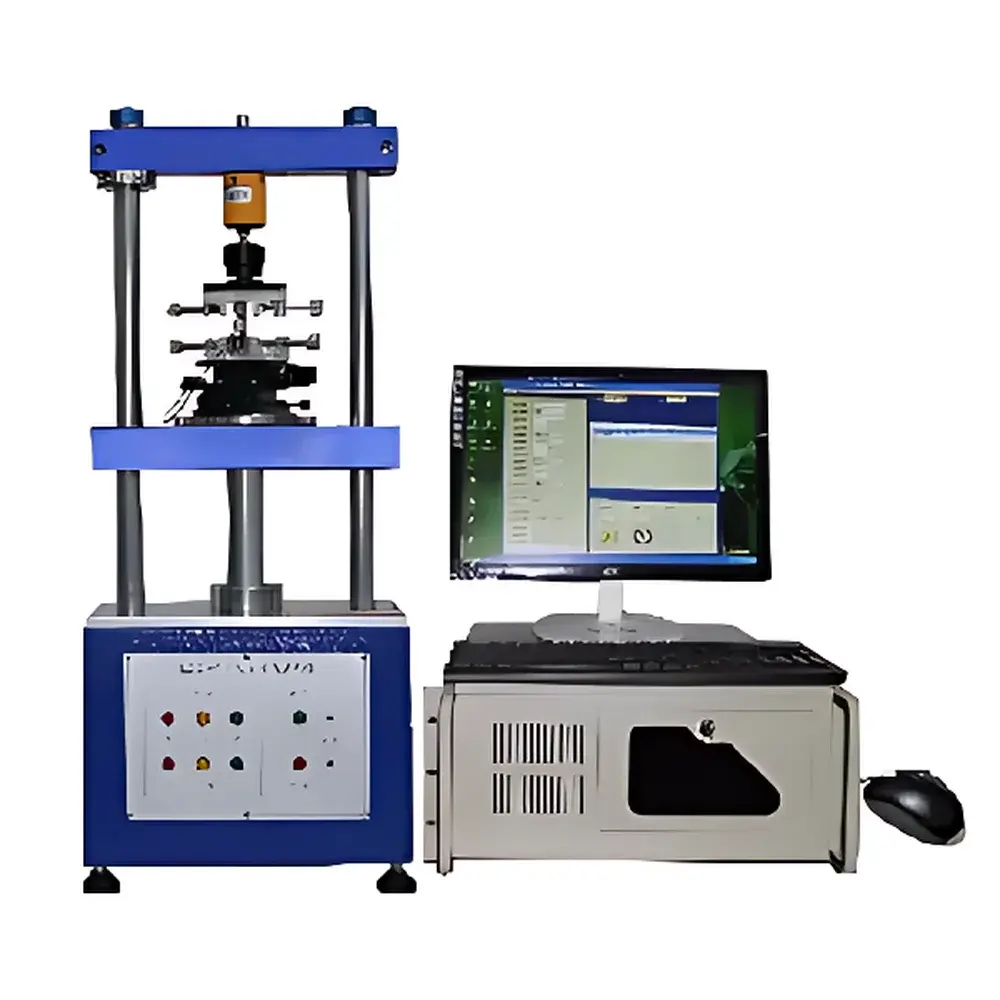
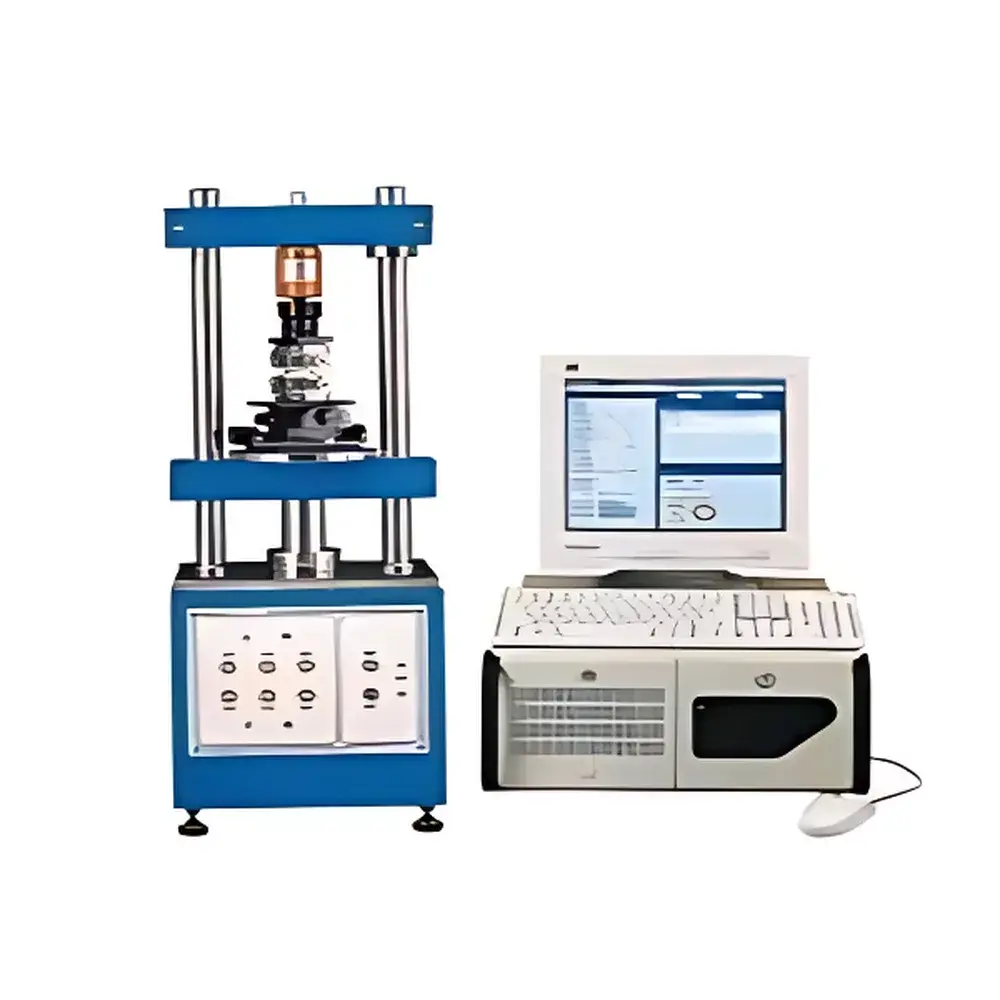
TF-220A Automatic Connector Insertion and Extraction Force Tester
| Brand | Tuofeng |
|---|---|
| Origin | Shanghai, China |
| Manufacturer Type | OEM/ODM Manufacturer |
| Regional Classification | Domestic (China) |
| Model | TF-220A |
| Pricing | Available Upon Request |
| Max Load Capacity | 2/5/10/20/50 kgf |
| Load Cell Accuracy | ±0.2% FS |
| Resolution | 0.01 or 0.001 kgf |
| Max Test Height | 150 mm |
| Fine Adjustment Increment | 0.01 mm |
| Test Speed Range | 1–200 mm/min |
| X-Y Axis Travel | 0–75 mm |
| Drive Mechanism | Precision Ball Screw |
| Motor Type | Servo Motor |
| Dimensions (W×D×H) | 400 × 300 × 980 mm |
| Weight | 75 kg |
| Power Supply | AC 220 V, 50/60 Hz |
| Test Modes | Single-pin insertion/extraction, full-row mating/unmating, retention force (pin-to-housing), normal force, compression/tensile failure, cycle life testing |
| Optional Integration | Real-time contact resistance monitoring (external instrument interface) |
| Data Output | Displacement-force curves, lifetime cycle plots, customizable inspection reports (exportable to Excel) |
| Software Features | PC-based test parameter configuration (stroke, speed, dwell time, pass/fail thresholds), audit-trail-capable report header editing (bilingual: EN/CN), unlimited local storage on internal HDD |
Overview
The TF-220A Automatic Connector Insertion and Extraction Force Tester is an electromechanical precision testing system engineered for the quantitative mechanical evaluation of electrical and electronic interconnects. It operates on a servo-controlled linear actuation principle, utilizing a high-rigidity ball-screw transmission system and calibrated load cells to measure dynamic insertion and extraction forces with traceable accuracy. Designed specifically for connector qualification in R&D, incoming inspection, and production line verification, the TF-220A complies with fundamental mechanical test requirements outlined in IEC 60512-2, IPC-TM-650 2.5.1, and USCAR-2, enabling standardized assessment of mating integrity, retention strength, and durability across discrete and array-type connectors.
Key Features
- Auto-centering alignment mechanism ensures coaxial engagement between male and female connector halves—eliminating edge-loading artifacts and improving measurement reproducibility.
- Modular load cell options (2 kgf to 50 kgf full scale) with ±0.2% full-scale accuracy and selectable resolution (0.01 or 0.001 kgf) support broad application coverage—from micro-coaxial RF connectors to heavy-duty automotive blade terminals.
- Programmable X-Y stage (0–75 mm travel) facilitates precise lateral positioning without manual re-fixturing, critical for multi-pin or offset connector geometries.
- Adjustable test speed (1–200 mm/min) and fine-height adjustment (0.01 mm increments) enable compliance with both low-speed qualification protocols and accelerated life-cycle simulations.
- Integrated PC-based control software supports fully configurable test sequences—including variable stroke, dwell time, directional reversal, and conditional looping—required for fatigue and wear-in testing per ISO 16750-3 and SAE J1752.
- Native support for synchronized external instrumentation via digital I/O and analog voltage interfaces allows concurrent acquisition of contact resistance (e.g., using a 4-wire milliohm meter), meeting combined mechanical-electrical validation needs.
Sample Compatibility & Compliance
The TF-220A accommodates standard PCB-mounted, wire-to-board, and board-to-board connectors—including USB-C, HDMI, FPC, IDC, D-sub, and automotive HSD variants—via interchangeable fixture plates and custom jaw inserts. Its mechanical architecture conforms to GLP-aligned laboratory practices: all test parameters are digitally defined and stored with timestamped metadata; raw force-displacement data and derived metrics (peak force, yield point, hysteresis area) are retained unaltered on internal non-volatile storage. The system supports audit-ready documentation workflows compliant with ISO/IEC 17025 clause 7.7 (reporting) and FDA 21 CFR Part 11 when deployed with validated software configurations and electronic signature controls.
Software & Data Management
Control and analysis are executed through a Windows-native application featuring intuitive graphical setup wizards and scriptable test templates. Each test generates three primary outputs: (1) real-time force vs. displacement curves with user-defined annotation markers; (2) cumulative cycle-life trend plots showing degradation in insertion/extraction force over repeated cycles; and (3) structured inspection reports with editable bilingual headers (English/Chinese), pass/fail status flags, statistical summaries (mean, SD, Cp/Cpk), and embedded calibration certificate references. All datasets—including raw ASCII time-series logs—are saved directly to the onboard SSD with no file-size or session limits. Export formats include CSV, PDF, and native Excel (.xlsx), ensuring seamless integration into enterprise quality management systems (QMS) such as MasterControl or TrackWise.
Applications
- Quantitative verification of pin retention force in plastic housing per IPC-2221B Annex A and JIS C 5401-2.
- Normal force characterization for shielded connector interfaces to ensure EMI gasket compression consistency.
- Accelerated mating cycle testing (up to 10,000+ cycles) to assess wear-induced changes in insertion profile and tactile feedback.
- Failure mode analysis during tensile pull-out tests on crimped or soldered terminations.
- Comparative benchmarking of alternative contact plating materials (e.g., Au vs. PdNi) under identical mechanical loading conditions.
- Production-line go/no-go screening with programmable upper/lower specification limits and automated pass/fail flagging.
FAQ
What standards does the TF-220A support for connector mechanical testing?
It aligns with IEC 60512-2 (insertion/extraction force), IPC-TM-650 2.5.1 (mechanical endurance), USCAR-2 (automotive connector requirements), and ISO 16750-3 (environmental stress screening). Custom test methods can be implemented via software scripting.
Can the system perform simultaneous force and contact resistance measurements?
Yes—through optional analog/digital I/O integration with third-party low-resistance meters (e.g., Keysight B2900 series), enabling synchronized acquisition of mechanical and electrical performance metrics.
Is the software compliant with FDA 21 CFR Part 11 for regulated environments?
When deployed with validated installation, operational qualification, and role-based electronic signature configuration, the software meets core Part 11 requirements for audit trails, data integrity, and authorized access control.
How is calibration traceability maintained?
Load cells are supplied with NIST-traceable calibration certificates; periodic verification follows ASTM E4 procedures using certified deadweight standards. System-level verification routines are embedded in the software.
What fixture options are available for non-standard connectors?
Tuofeng provides engineering consultation and custom fixture design services—including 3D-printed prototype jaws and CNC-machined aluminum fixtures—with mechanical drawings and mounting interface specifications provided upon request.



