
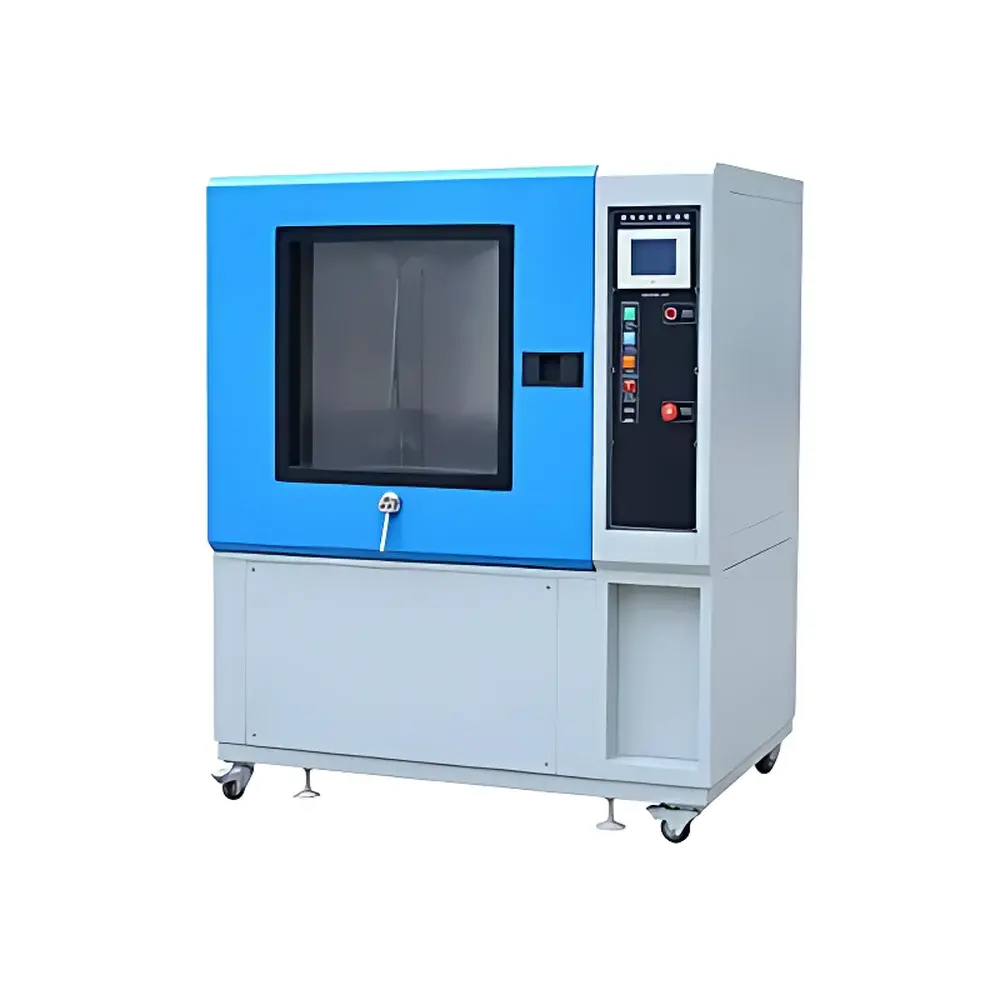
TF-340C Sand and Dust Test Chamber
| Brand | Tuofeng |
|---|---|
| Origin | Shanghai, China |
| Manufacturer Type | Direct Manufacturer |
| Model | TF-340C |
| Sand Composition | 97–99% SiO₂ (silicon dioxide) |
| Sand Blowing Concentration | 1 g/m³ ± 0.25 g/m³ |
| Sand Blowing Velocity | 0–29 m/s |
| Dust Blowing Concentration | 0.1–10.6 g/m³ |
| Dust Blowing Velocity | 8.9 m/s |
| Internal Dimensions (W×D×H) | 1000 × 1000 × 1000 mm |
| Mesh Filter | Stainless steel, wire diameter 50 µm, pitch 75 µm |
| Test Dust | ASTM D1898-compliant talcum powder or quartz sand (2–4 kg/m³ loading) |
| Vacuum Pump Flow Rate | 2 L/s |
| Vibration Timer Range | 0–99 h 59 min 59 s |
| Fan Timer Range | 0–99 h 59 min 59 s |
| Dust Collection System | Conical stainless-steel interior with centralized suction port |
| Control System | Weinview HMI touchscreen controller (industrial-grade, menu-free parameter access) |
| Heating/Cooling Ambient | +5 °C to +35 °C (for cooling operation: +5 °C to +28 °C) |
| Safety Protections | Overtemperature cutoff, short-circuit protection, fan overload detection, earth-leakage protection, phase-loss/sequence monitoring, reverse-fan rotation prevention, specimen safety interlock |
Overview
The TF-340C Sand and Dust Test Chamber is an industrial-grade environmental test system engineered for evaluating the ingress protection (IP) performance of enclosures against solid particulate contaminants—specifically airborne dust and abrasive sand—under controlled, repeatable conditions. Based on the principle of forced convective suspension, the chamber generates non-laminar, vertically recirculating airflows laden with standardized test particulates. These flows simulate real-world exposure scenarios where equipment operates in arid, desert, construction, or off-road environments. The system complies with key international and national standards governing enclosure integrity, including IEC 60529 (equivalent to GB/T 4208), ISO 20623, DIN 40050-9, and relevant clauses of UL 50E and SAE J575. Unlike static dust deposition chambers, the TF-340C dynamically replicates mechanical stress from particle impact, abrasion, and infiltration—critical for validating IP5X (dust-protected) and IP6X (dust-tight) ratings per IEC 60529.
Key Features
- Robust dual-mode particulate delivery: Independent control of sand-blowing (0–29 m/s, 1 g/m³ ±0.25 g/m³) and dust-blowing (8.9 m/s, 0.1–10.6 g/m³) cycles enables differentiated testing per application requirements—e.g., automotive under-hood components vs. outdoor lighting fixtures.
- High-fidelity filtration and recirculation architecture: A precision-woven 50 µm stainless-steel mesh (75 µm pitch) retains coarse particles while permitting continuous airflow; conical 304 stainless-steel interior geometry ensures gravitational dust recovery toward a centralized vacuum intake, minimizing cross-contamination and enabling long-duration tests without manual cleaning.
- Industrial-grade motion and timing control: Programmable vibration timer (0–99 h 59 min 59 s) and fan runtime scheduler support multi-phase test sequences—including intermittent blow-stop intervals, programmable cycle counts, and cumulative exposure time logging—with resolution down to 1 second.
- Compliance-ready control interface: Weinview 7-inch capacitive touchscreen HMI provides direct-access parameter editing (no nested menus), real-time display of setpoints, actual values, elapsed blow time, and cycle status. All operational events—including start/stop, alarm triggers, and parameter changes—are timestamped and stored locally for auditability.
- Integrated safety architecture: Dual redundant thermal cutoffs, Schneider contactors, Omron safety relays, and phase-sequence monitoring prevent unsafe operation. Mechanical interlocks disable fan activation if door is unlatched, and reverse-rotation detection prevents motor damage during startup.
Sample Compatibility & Compliance
The TF-340C accommodates specimens up to 1000 mm × 1000 mm × 1000 mm (W×D×H), making it suitable for full-assembly testing of automotive lighting modules, telecom base station housings, military-grade connectors, and outdoor-rated power distribution units. It supports both upright and tilted mounting configurations, with optional sample turntables (available as accessory) for uniform exposure. The chamber meets mandatory test conditions specified in GB/T 4208-2008 (IEC 60529), GB 10485, GB 4942.1, GB 7000.1 (luminaire dust resistance), and ISO 16750-3 for road vehicles. While not configured for GJB 150.12A’s high-velocity sandstorm profile (which requires external wind tunnel integration), it fully satisfies IPX5/IPX6 water-sand hybrid prequalification and MIL-STD-810H Method 510.7 dust exposure protocols when operated within defined velocity and concentration envelopes.
Software & Data Management
No proprietary software installation is required—the onboard Weinvew HMI stores all test logs internally (≥10,000 event records) with UTC timestamps, user ID fields (optional), and configurable export via USB flash drive in CSV format. Data includes chamber temperature, fan RPM, vacuum pressure, vibration actuation status, and cumulative exposure duration. For GLP/GMP-regulated laboratories, optional 21 CFR Part 11-compliant firmware upgrade adds electronic signature capability, audit trail encryption, and role-based access control (RBAC) for operator, supervisor, and QA reviewer tiers. Raw data files are compatible with LabVIEW, MATLAB, and LIMS platforms via standard serial or Ethernet Modbus TCP interface.
Applications
- Validation of IP5X/IP6X ratings for LED streetlights, traffic signal housings, and solar inverter enclosures exposed to desert or coastal airborne dust.
- Functional endurance testing of automotive HVAC actuators, brake control units, and ADAS sensor housings subjected to gravel road grit ingestion.
- Pre-certification screening for aerospace avionics cooling ducts and UAV battery compartments operating in unsealed ground environments.
- Material-level assessment of gasket compression set, seal extrusion resistance, and filter media clogging kinetics under sustained particulate load.
- Quality assurance of consumer electronics (e.g., rugged tablets, industrial handhelds) undergoing extended storage in warehouse or logistics staging areas with poor air filtration.
FAQ
Does the TF-340C meet IEC 60529 IP6X test requirements?
Yes—when operated with talcum powder at 2–4 kg/m³ loading, 8.9 m/s velocity, and ≥8-hour continuous exposure, it fulfills the “no ingress of dust” criterion for IP6X classification per Clause 14.2.7 of IEC 60529.
Can quartz sand be used instead of talcum powder?
Yes—quartz sand (97–99% SiO₂, median particle size ~150 µm) is supported for sand abrasion testing per GB/T 4208 Annex B and ISO 20623 Annex C; concentration and velocity must be adjusted per test plan.
Is remote monitoring supported?
Standard configuration includes RS-485 Modbus RTU; optional Ethernet/Wi-Fi module enables integration with building management systems (BMS) or centralized test lab dashboards.
What maintenance intervals are recommended?
Mesh filter inspection every 50 test hours; vacuum pump oil change every 500 operating hours; calibration verification of airflow sensors annually or per ISO/IEC 17025 internal procedure.
Is third-party calibration documentation provided?
Factory calibration certificate (traceable to NIM, China) is included; accredited calibration by CNAS-certified labs is available upon request with lead time.



