
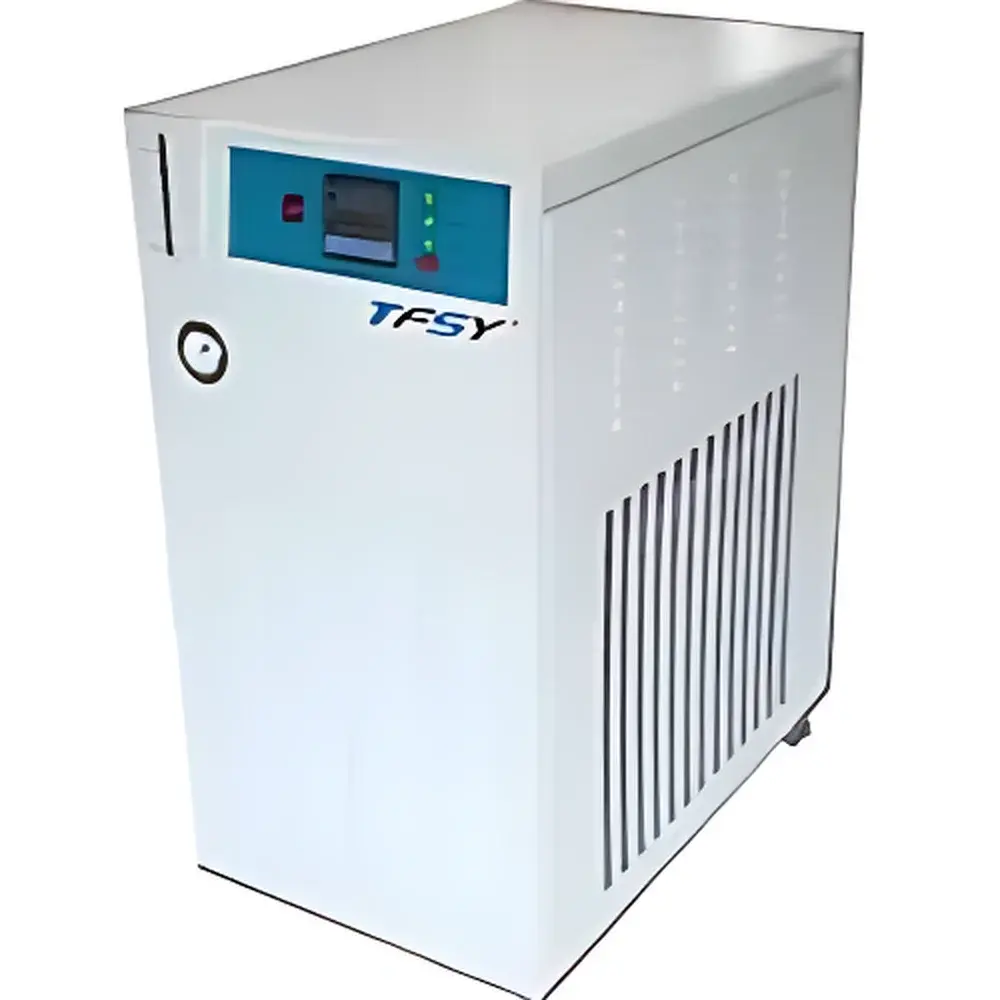
TF-LS-1500 Laser Cooling Circulating Chiller
| Origin | Shanghai, China |
|---|---|
| Manufacturer Type | Authorized Distributor |
| Origin Category | Domestic (China) |
| Model | TF-LS-1500 |
| Refrigeration Capacity | 1.5 kW/h |
| Cooling Capacity | 1290 kcal/h |
| Water Tank Volume | 15 L |
| Power Input | 1.0 kW |
| Voltage/Frequency | 3-phase ~380 V, 50 Hz (optional 220 V / 415 V, 50/60 Hz) |
| Refrigerant | R22 (R134a or R407C configurable) |
| Compressor Type | Hermetic Scroll Compressor |
| Compressor Power | 0.43 kW |
| Pump Power | 0.37 kW |
| Max. Head | 20 m |
| Inlet/Outlet Port | 1/2" BSP |
| Evaporator | 316 Stainless Steel Plate Heat Exchanger |
| Condenser | High-Efficiency Copper Tube with Aluminum Fin + Low-Noise External Rotor Fan |
| Temperature Control Accuracy | ±1.0 °C (±0.1 °C optional with PID upgrade) |
| Safety Protections | High/Low Pressure Switch, Compressor Overheat & Overcurrent Protection, Flow Monitoring, Phase Sequence & Phase Loss Detection, Anti-Freeze Protection, Exhaust Temperature Limit |
Overview
The TF-LS-1500 Laser Cooling Circulating Chiller is a precision-engineered closed-loop refrigeration system designed for stable, continuous thermal management of high-sensitivity scientific and industrial equipment. Utilizing vapor-compression refrigeration with a hermetic scroll compressor and R22 (or optionally R134a/R407C) refrigerant cycle, the unit delivers consistent cooling performance across variable ambient conditions. Its core function is to maintain coolant temperature within tight tolerances—critical for preserving optical alignment in laser systems, ensuring detector stability in analytical instruments (e.g., ICP-OES, XRD, SEM), and preventing thermal drift in vacuum and plasma-based platforms. Unlike open-loop tap-water cooling, this chiller eliminates dependency on municipal water quality, pressure fluctuations, and seasonal temperature variance—making it indispensable for GLP-compliant laboratories and ISO 17025-accredited testing facilities where reproducibility and auditability are mandatory.
Key Features
- PLC-based microprocessor controller with real-time monitoring of temperature, flow rate, pressure differentials, and compressor status—enabling automated fault detection and self-diagnostic logging.
- 316 stainless steel plate heat exchanger and titanium-tube evaporator assembly, engineered to resist corrosion from deionized or ultrapure water (UPW), minimizing metallic ion leaching that could compromise analytical integrity in AAS, ICP-MS, or XRF applications.
- High-efficiency condenser with copper-aluminum finned coil and low-noise external rotor fan, optimized for sustained operation in confined lab environments (<65 dB(A) at 1 m).
- Dual-stage safety architecture: primary protection via electronic flow switch (mechanical bypass optional) and secondary redundancy through thermistor-based temperature feedback loops—ensuring immediate shutdown upon flow interruption or thermal excursion beyond user-defined thresholds.
- Electrical components sourced exclusively from globally certified suppliers (Schneider Electric contactors, Omron relays, TE Connectivity sensors), supporting long-term reliability under 24/7 duty cycles.
- Modular enclosure with electrostatic powder-coated steel chassis and tool-free access panels—designed for rapid maintenance, filter replacement, and refrigerant service without disassembly.
Sample Compatibility & Compliance
The TF-LS-1500 is compatible with a broad spectrum of laboratory and industrial instrumentation requiring precise coolant temperature regulation between 5–35 °C. It supports integration with graphite furnace atomic absorption spectrometers (GFAAS), inductively coupled plasma optical emission spectrometers (ICP-OES), plasma mass spectrometers (ICP-MS), X-ray fluorescence (XRF) analyzers, X-ray diffractometers (XRD), scanning electron microscopes (SEM), transmission electron microscopes (TEM), laser marking/cutting systems, RF plasma sources, and high-speed spindles. The unit conforms to IEC 61000-6-2 (EMC immunity) and IEC 61000-6-4 (EMC emissions) standards. Its control firmware supports configurable alarm logging and timestamped event records—facilitating compliance with FDA 21 CFR Part 11 requirements when paired with validated data acquisition software. Optional analog (4–20 mA) and digital (RS485 Modbus RTU) interfaces enable seamless integration into centralized building management systems (BMS) or LIMS environments.
Software & Data Management
While the base configuration features an embedded LCD interface with tactile keypad navigation, the TF-LS-1500 supports optional Ethernet or RS485 connectivity for remote supervision via industry-standard protocols. Logged parameters—including inlet/outlet temperatures, pump current draw, compressor run time, and fault history—are exportable as CSV files for trend analysis and preventive maintenance scheduling. Audit trails retain timestamps, operator IDs (via optional RFID login), and parameter change logs—aligning with GLP and GMP documentation requirements. Firmware updates are performed via secure USB drive import, eliminating network exposure risks. No cloud dependency or proprietary vendor lock-in is required; all communication protocols remain open and documented per IEC 62443-3-3 guidelines.
Applications
- Laser systems: CO₂, fiber, and Nd:YAG lasers demanding sub-degree thermal stability to prevent beam divergence and focal shift.
- Analytical instrumentation: Maintaining detector cryo-cooling stages in XRD and SEM, stabilizing nebulizer gas temperature in ICP-OES, and regulating graphite furnace ramp profiles in GFAAS.
- Plasma and vacuum systems: Sustaining optimal electrode and chamber wall temperatures in RF sputtering, PECVD, and electron beam evaporation tools.
- Materials testing: Supporting high-precision thermal cycling during mechanical fatigue or creep testing of composites and alloys.
- Pharmaceutical QC: Enabling controlled solvent cooling in HPLC column ovens and preparative chromatography systems compliant with USP analytical instrument qualification (AIQ) protocols.
FAQ
What is the maximum allowable coolant temperature differential (ΔT) between inlet and outlet?
The unit is rated for a maximum ΔT of 8 °C under full load at 25 °C ambient—consistent with ASHRAE Guideline 33-2022 for laboratory chiller sizing.
Can the TF-LS-1500 operate with deionized water containing <0.1 µS/cm conductivity?
Yes—the 316 stainless steel and titanium wetted materials ensure compatibility with UPW; however, a minimum conductivity of 10 µS/cm is recommended to avoid static charge accumulation in closed-loop circuits.
Is the refrigerant charge compliant with EU F-Gas Regulation (EU) No 517/2014?
R134a and R407C configurations meet current GWP thresholds for laboratory-scale chillers; R22 is supplied only for legacy retrofit applications under national exemptions.
Does the unit support external temperature setpoint modulation via analog signal?
Yes—0–10 VDC or 4–20 mA input is available as an optional interface for dynamic setpoint adjustment synchronized with process controllers.
What is the expected service interval for compressor oil and refrigerant filtration?
Under continuous operation at ≤80% load, the hermetic compressor requires no oil servicing; the desiccant filter cartridge should be replaced every 24 months or after 8,000 operating hours—whichever occurs first.
Related Products



