
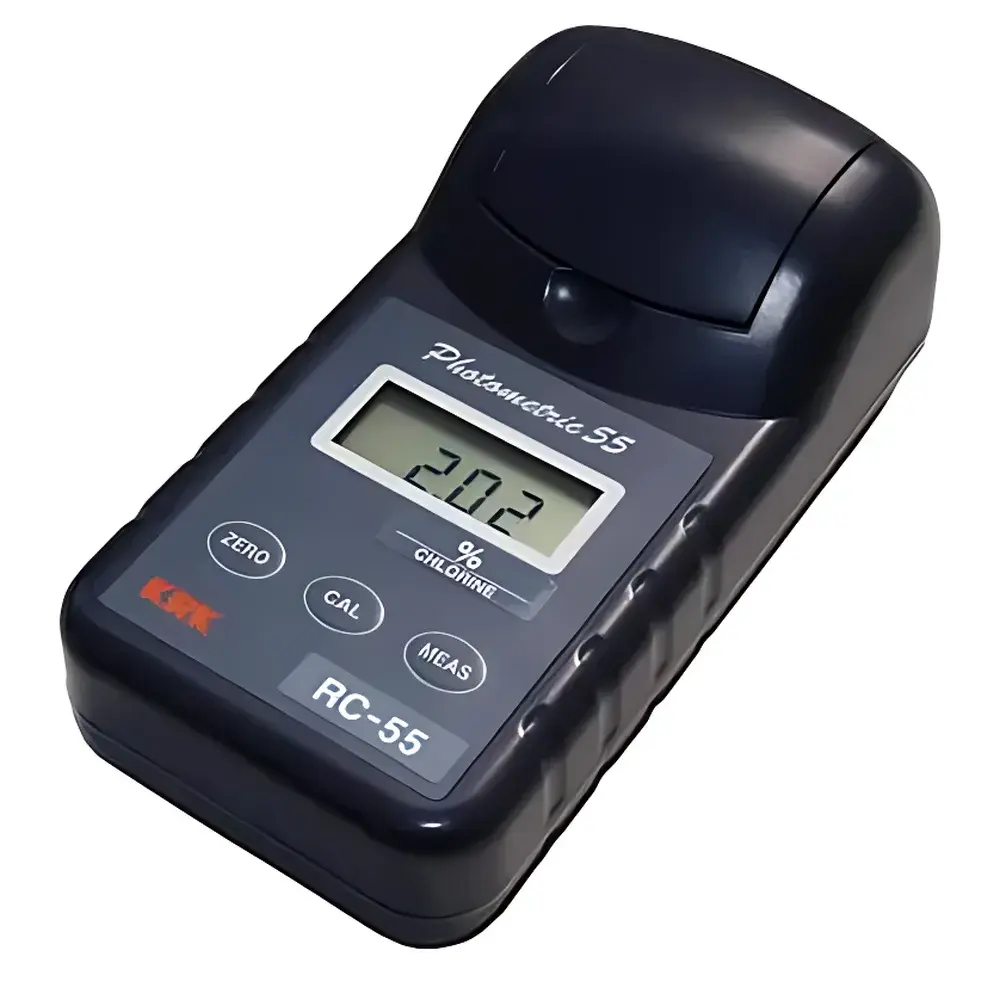
THAM IR-V1 Single-Parameter Infrared Concentration Analyzer for Semiconductor Wet Process Chemicals
| Brand | Rikorika |
|---|---|
| Origin | Japan |
| Manufacturer Type | Authorized Distributor |
| Origin Category | Imported |
| Model | IR-V1 |
| Pricing | Upon Request |
| Measurement Principle | Infrared Absorption Photometry |
| Measurable Analytes | TMAH, H₂SO₄, HCl, NaOH, H₂O₂ |
| Concentration Ranges | H₂SO₄: 0–500 g/L |
| HCl | 0–200 g/L |
| NaOH | 0–300 g/L |
| TMAH | 0–250 g/L |
| H₂O₂ | 0–350 g/L |
| Sample Temp. Range | 0.0–35.0 °C |
| Calibration | Zero calibration standard |
| Memory Capacity | Up to 19 measurement records |
| Power Supply | 4× LR03 alkaline batteries |
| Auto-Power-Off | After 10 min inactivity |
| Sample Volume | ~1 mL |
| Dimensions (W×H×D) | 88×174×65 mm |
| Weight | ~310 g |
| Standard Accessories | Instrument body, measurement cell, batteries, instruction manual, warranty card |
Overview
The THAM IR-V1 Single-Parameter Infrared Concentration Analyzer is a handheld, non-destructive process monitoring instrument engineered specifically for real-time quantification of key wet-etch and cleaning chemicals in semiconductor front-end manufacturing environments. It operates on the principle of mid-infrared absorption photometry—measuring analyte-specific absorbance bands in aqueous solutions without chemical reagents, dilution, or sample preparation. Unlike conventional titration or conductivity-based methods, the IR-V1 leverages fixed-wavelength optical detection optimized for industrial-grade concentrations of tetramethylammonium hydroxide (TMAH), sulfuric acid (H₂SO₄), hydrochloric acid (HCl), sodium hydroxide (NaOH), and hydrogen peroxide (H₂O₂). Its optical path design minimizes scattering effects from particulates commonly present in recirculated bath solutions, ensuring high reproducibility across repeated measurements in cleanroom-compatible settings. The analyzer is calibrated against traceable NIST-traceable reference standards and validated per ISO/IEC 17025-compliant procedures for routine use in controlled fabrication environments.
Key Features
- Reagent-free, non-contact infrared photometric measurement—eliminates consumables, cross-contamination risk, and operator-induced variability
- Dedicated pre-configured models for five critical semiconductor process chemistries: IR-V1-TMAH, IR-V1-H₂SO₄, IR-V1-HCl, IR-V1-NaOH, and IR-V1-H₂O₂
- Wide dynamic concentration range coverage: up to 500 g/L for H₂SO₄ and 350 g/L for H₂O₂—designed for undiluted bath monitoring
- Integrated temperature-compensated optics with built-in Pt1000 sensor (0.0–35.0 °C) to correct for thermal drift in refractive index and absorption coefficient
- Zero-calibration default protocol with optional two-point span calibration support for long-term stability verification
- Compact, ergonomic handheld form factor (88 × 174 × 65 mm; ~310 g) suitable for glovebox and tool-side deployment
- Low-power operation via four LR03 alkaline cells with intelligent auto-shutdown after 10 minutes of inactivity
Sample Compatibility & Compliance
The IR-V1 is validated for direct immersion or flow-cell measurement of clarified aqueous process solutions used in wafer cleaning, etching, and photoresist stripping. It accommodates solutions containing low levels of dissolved organics, metal ions, and residual photoresist byproducts—provided turbidity remains below 5 NTU. The instrument meets IEC 61326-1:2013 for electromagnetic compatibility in industrial laboratories and complies with JIS Z 8401 for numerical rounding in analytical reporting. While not certified as a medical device or safety-critical system, its measurement uncertainty profile aligns with ASTM D7217–19 guidelines for on-site chemical concentration verification in microelectronics manufacturing. Data integrity supports GLP-aligned documentation practices; however, full 21 CFR Part 11 compliance requires external audit-trail logging via optional USB data export.
Software & Data Management
The IR-V1 operates as a standalone field instrument with embedded firmware and no onboard display-driven GUI. All configuration, calibration history, and measurement metadata are stored in non-volatile memory. Up to 19 timestamped readings—including concentration value, temperature, model ID, and calibration status—are accessible via sequential recall using the front-panel keypad. Raw absorbance data is not user-accessible; only final concentration outputs are retained. For integration into centralized MES or SPC platforms, optional IR-V1-USB interface modules enable ASCII-formatted output (CSV-compatible) at 9600 bps RS-232/USB-C, supporting automated log ingestion into LabVantage, Siemens Opcenter, or custom Python-based analytics pipelines.
Applications
- Real-time monitoring of TMAH developer baths in lithography lines (2.38% w/w and higher)
- In-situ verification of sulfuric acid–hydrogen peroxide mixture (SPM) bath composition prior to wafer immersion
- Concentration trending of HCl-based SC-1 and SC-2 cleaning solutions to prevent under-etch or residue formation
- NaOH bath control during post-etch residue removal and surface activation steps
- H₂O₂ replenishment management in ozone-enhanced cleaning tools and DI water purification loops
- Supporting preventive maintenance schedules by correlating concentration drift with filter saturation or pump degradation
FAQ
Is the IR-V1 suitable for measuring mixed-acid solutions (e.g., HNO₃/HF blends)?
No—the IR-V1 is factory-configured for single-analyte quantification only. Cross-sensitivity between overlapping IR absorption bands prohibits reliable multi-component analysis.
Does the instrument require periodic recalibration with certified standards?
Zero calibration is performed daily using deionized water; span calibration is recommended every 30 days or after exposure to extreme temperature gradients or mechanical shock.
Can the IR-V1 be used with highly viscous or particle-laden slurries?
It is not designed for slurries or suspensions exceeding 5 NTU turbidity; particulate interference degrades photometric accuracy and risks optical window fouling.
What is the typical measurement repeatability under controlled conditions?
At 25 °C and within mid-range concentrations, repeatability is ±0.8% RSD (n=6) for H₂SO₄ and ±1.2% RSD for TMAH, based on internal validation per ISO 5725-2.
Is firmware upgrade capability available?
Yes—firmware updates are delivered via encrypted .bin files through authorized Rikorika service partners; end users cannot perform self-updates.
Related Products







