
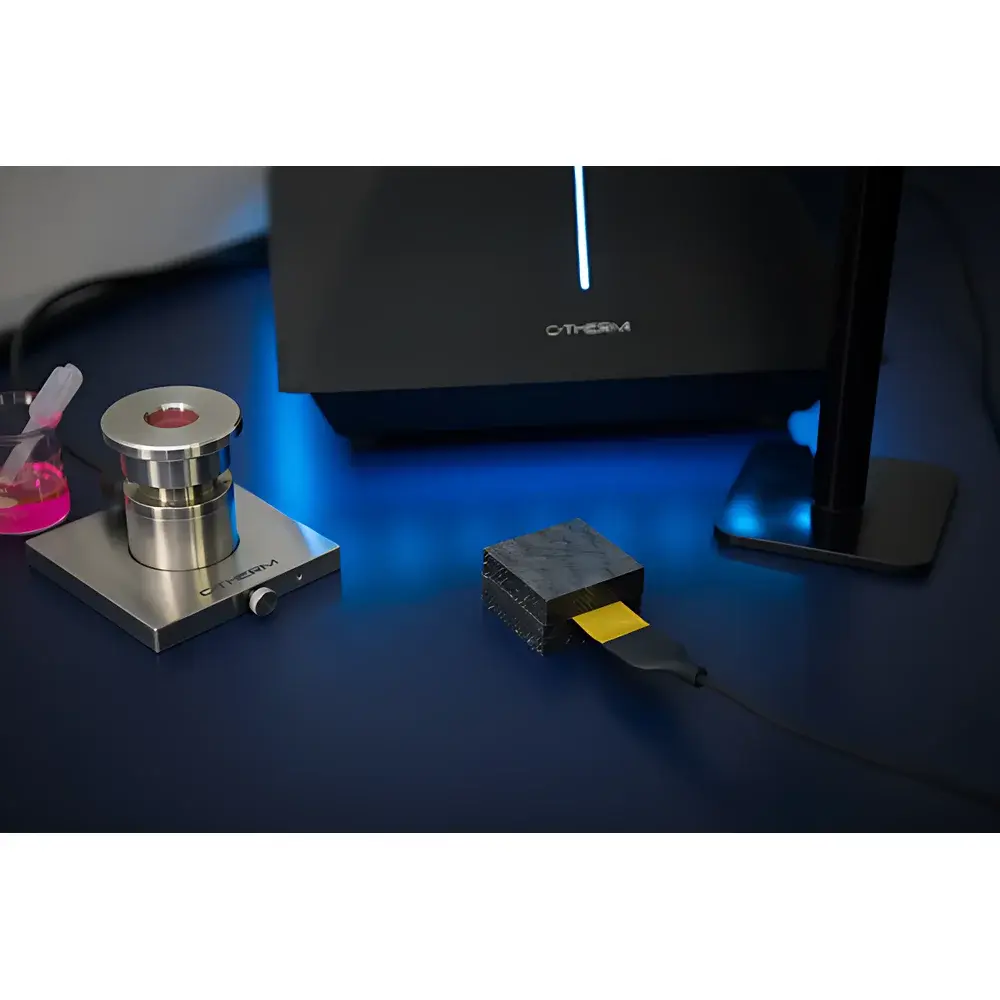
C-Therm Trident Thermal Conductivity Analyzer
| Brand | C-Therm |
|---|---|
| Model | Trident |
| Measurement Principle | Integrated Modified Transient Plane Source (MTPS), Flexible Transient Plane Source (Flex TPS), and Transient Line Source (TLS Needle) |
| Thermal Conductivity Range | 0–2000 W/m·K |
| Accuracy | <5% |
| Repeatability | <1% |
| Operating Temperature Range | –50°C to +500°C |
| Dimensions (L×W×H) | 40 × 40 × 40 cm |
| Compliance | ASTM D7984, ISO 22007-2.2, ASTM D5334, ASTM D5930, IEEE 442, GB/T 32064 |
Overview
The C-Therm Trident Thermal Conductivity Analyzer is an engineered platform for rapid, non-destructive, and calibration-free measurement of thermal conductivity, thermal diffusivity, and volumetric heat capacity across a broad spectrum of materials. Unlike conventional steady-state or single-method transient instruments, the Trident integrates three complementary transient techniques—Modified Transient Plane Source (MTPS), Flexible Transient Plane Source (Flex TPS), and Transient Line Source (TLS Needle)—within a single, unified hardware architecture. This tri-modal design enables method selection based on material class, geometry, thermal properties, and application context—not instrument availability. The MTPS sensor operates via controlled Joule heating of a thin, insulated nickel foil embedded in a polymer matrix, with simultaneous measurement of temperature rise and decay under constant power input. Heat flow is modeled using one-dimensional semi-infinite medium theory, eliminating dependence on prior knowledge of specific heat or density. The Flex TPS module accommodates irregular, soft, or low-conductivity samples through conformal contact and dynamic pressure compensation, while the TLS needle probe enables high-resolution profiling of layered solids, gels, and viscous liquids without surface preparation.
Key Features
- Tri-modal measurement capability: seamless switching between MTPS, Flex TPS, and TLS Needle methods via software-selectable modules
- Wide operational temperature range: –50°C to +500°C, supported by integrated Peltier and resistive heating stages with PID-controlled thermal management
- No sample preparation required: accommodates as-received solids, powders, pastes, films, anisotropic composites, and bulk liquids without cutting, polishing, or coating
- True non-destructive analysis: all methods apply sub-milliwatt-level thermal pulses; no mechanical deformation, phase change, or chemical alteration occurs
- Self-validating operation: built-in reference standards and real-time signal-to-noise monitoring ensure traceable accuracy without external calibration
- Modular probe design: interchangeable sensors enable rapid reconfiguration for lab R&D, QC floor deployment, or inline process monitoring
Sample Compatibility & Compliance
The Trident supports heterogeneous material classes without geometric or compositional constraints. Solid samples—including ceramics, metals, polymers, aerogels, and fiber-reinforced composites—are measured in native form, regardless of surface roughness, porosity, or anisotropy. Powders and granular media are tested in loose or lightly compacted states; liquids and suspensions require only minimal volume (≥2 mL) and no containment beyond standard vials. Thin films down to 10 µm thickness are characterized using the MTPS sensor with optional vacuum-contact enhancement. All measurement protocols adhere to internationally recognized standards: ASTM D7984 (MTPS), ISO 22007-2.2 (TPS), ASTM D5334/D5930 (TLS), and IEEE 442 (electrical insulation materials). Data acquisition and reporting comply with GLP and GMP documentation requirements, including full audit trails, electronic signatures, and 21 CFR Part 11–compliant user access control.
Software & Data Management
TridentControl™ v4.2 provides intuitive, role-based interface navigation with method-specific wizards, automated parameter optimization, and real-time curve fitting visualization. Raw thermogram data is stored in HDF5 format with embedded metadata (timestamp, ambient conditions, sensor ID, operator credentials). Batch processing supports statistical comparison across sample sets, outlier detection, and trend analysis over time. Export options include CSV, XML, and PDF reports compliant with ISO/IEC 17025 laboratory accreditation templates. The software architecture supports networked deployment across multi-instrument labs and integrates with LIMS via RESTful API. All firmware updates and method libraries are digitally signed and version-controlled to maintain regulatory integrity.
Applications
- Thermal interface material (TIM) qualification for EV battery packs and high-power semiconductor packaging
- Quality assurance of refractory linings, insulation foams, and fire-retardant composites in construction and aerospace
- Rapid screening of phase-change materials (PCMs) during formulation development
- In-process monitoring of polymer extrusion melt viscosity and thermal stability
- Characterization of geological cores and soil simulants for geothermal energy modeling
- Validation of thermal transport models in anisotropic 2D materials and metamaterials
FAQ
Does the Trident require periodic recalibration?
No. The system employs factory-traceable reference materials and self-diagnostic thermal transients to maintain metrological continuity between measurements.
Can the same probe be used for both solid and liquid samples?
Yes—the MTPS and Flex TPS sensors operate across phase boundaries; the TLS needle is optimized for semi-solids and high-viscosity fluids.
Is compliance with FDA 21 CFR Part 11 achievable?
Yes. TridentControl™ includes configurable electronic signature workflows, immutable audit logs, and user privilege tiers aligned with regulated pharmaceutical and medical device manufacturing environments.
What is the minimum sample thickness for film testing?
For supported films (e.g., laminated on substrates), measurements are valid down to 10 µm; unsupported free-standing films require ≥50 µm for reliable MTPS contact.
How does the system handle anisotropic thermal conductivity?
By rotating the sample relative to the sensor plane and performing sequential directional scans, the Trident quantifies principal thermal conductivities (kx, ky, kz) without requiring tensor inversion algorithms.



