
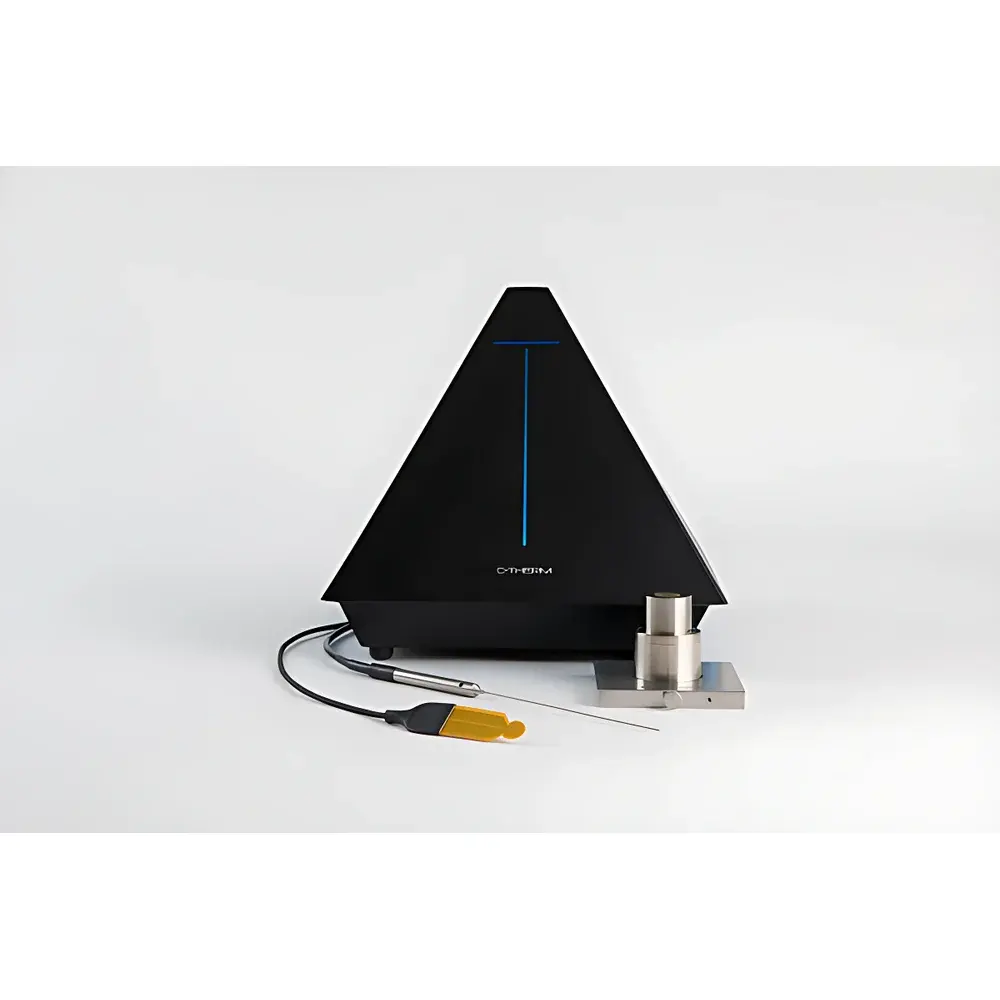
C-Therm Trident Thermal Constants Analyzer
| Brand | C-Therm |
|---|---|
| Origin | Canada |
| Model | Flex TPS |
| Measurement Principle | Transient Plane Source (TPS) |
| Dimensions (L×W×H) | 40 × 40 × 40 cm |
| Accuracy | < 5% |
| Thermal Conductivity Range | 0 – 2000 W/m·K |
| Repeatability | < 1% |
| Standards Compliance | ASTM D7984, ISO 22007-2.2, GB/T 32064, ASTM D5334, ASTM D5930, IEEE 442 |
Overview
The C-Therm Trident Thermal Constants Analyzer is a modular, benchtop thermal property measurement platform engineered for precision characterization of thermal conductivity (λ), thermal diffusivity (α), volumetric heat capacity (Cv), and thermal effusivity (e) across diverse material classes. It implements three physically distinct, standards-aligned measurement methodologies within a single instrument architecture: the standard Transient Plane Source (TPS) method (ISO 22007-2.2, GB/T 32064), the Modified Transient Plane Source (MTPS) technique (ASTM D7984), and the needle-based Transient Line Source (TLS) method (ASTM D5334, ASTM D5930, IEEE 442). This tri-sensor capability enables rigorous cross-validation and eliminates method-dependent bias—particularly critical for anisotropic, heterogeneous, or low-conductivity materials where conventional single-method instruments yield inconsistent results. The system operates on the principle of transient heat conduction: a thin, embedded sensor acts as both heater and temperature sensor; upon application of a constant current pulse, the resulting temperature rise over time is recorded and modeled using Fourier-based heat diffusion equations to extract fundamental thermal constants without requiring prior knowledge of sample geometry or boundary conditions.
Key Features
- Triple-sensor modularity: Interchangeable MTPS, Flex TPS, and TLS probe modules mounted on a common electronics and control platform
- Non-destructive, contact-based measurement with minimal sample preparation—no vacuum chamber, no clamping pressure calibration required
- Wide dynamic range: Thermal conductivity from 0.1 W/m·K (aerogels, foams) up to 2000 W/m·K (copper, graphite, diamond composites)
- High repeatability (< 1%) and accuracy (< 5%) validated against NIST-traceable reference materials
- Temperature-independent operation: No active environmental chamber needed; ambient-stable measurements from −10 °C to +60 °C (optional extended-range thermal stage available)
- Robust mechanical architecture: Aluminum alloy chassis with EMI-shielded electronics, designed for continuous use in QC labs and R&D environments
Sample Compatibility & Compliance
The Trident accommodates solid, semi-solid, and fluid samples without size or phase restrictions typical of guarded-hot-plate or laser-flash systems. Compatible geometries include bulk solids (≥ 5 mm thick), thin films (≥ 25 µm), powders (loose or compressed), pastes, gels, phase-change materials (PCMs), thermal interface materials (TIMs), building insulation, geological cores, and anisotropic composites (e.g., carbon-fiber laminates). Each sensor module complies with internationally recognized test standards: Flex TPS adheres to ISO 22007-2.2 and GB/T 32064 for isotropic solids; MTPS satisfies ASTM D7984 for thin films and low-conductivity polymers; TLS conforms to ASTM D5334 and IEEE 442 for soils, cables, and soft elastomers. All measurement protocols support GLP/GMP documentation requirements, including full audit trails, user access controls, and electronic signature capability per FDA 21 CFR Part 11 when configured with optional software licensing.
Software & Data Management
C-Therm’s proprietary Trident Software v5.x provides unified control, real-time visualization, and automated analysis for all three sensor types. The interface features a wizard-driven workflow—from sample selection and sensor calibration to parameter extraction and uncertainty reporting. Raw voltage vs. time data is acquired at 100 kHz sampling rate and processed using iterative curve-fitting algorithms based on analytical solutions to the heat equation. Export options include CSV, Excel, and PDF reports with embedded metadata (operator ID, timestamp, calibration certificate ID, environmental conditions). The software supports batch processing, statistical comparison across sample sets, and custom report templates compliant with internal SOPs or external regulatory submissions. Data integrity safeguards include automatic checksum validation, write-protected archives, and configurable backup to network drives or cloud storage via SFTP.
Applications
The Trident serves as a primary thermal characterization tool in advanced materials development, quality assurance, and failure analysis workflows. Typical applications include: thermal management validation of TIMs in power electronics packaging; effusivity mapping of multilayer battery electrode coatings; anisotropic conductivity profiling of carbon nanotube-reinforced composites; thermal stability assessment of PCMs for building energy storage; effusivity-based classification of mineral wool and aerogel insulation; thermal property certification of aerospace-grade polymer matrix composites; and rapid screening of thermal conductivity in additive-manufactured metal lattices. Its speed (measurements complete in < 10 s), reproducibility, and lack of destructive sample conditioning make it ideal for high-throughput lab environments and production floor deployment.
FAQ
What is the difference between MTPS and Flex TPS measurement modes?
MTPS uses a miniaturized, one-sided sensor optimized for thin films and low-conductivity materials (0–500 W/m·K); Flex TPS employs a symmetric dual-sided sensor configuration enabling higher upper-range measurements (up to 2000 W/m·K) and improved signal-to-noise ratio for dense conductors.
Can the Trident measure anisotropic materials?
Yes—the anisotropic module includes orientation-specific calibration routines and directional sensor alignment fixtures to resolve in-plane vs. through-plane conductivity in layered structures such as printed circuit boards or fiber-reinforced plastics.
Is sample thickness critical for accurate results?
For bulk mode (Flex TPS), minimum thickness is 5 mm; for thin-film mode (MTPS), samples as thin as 25 µm are supported. The software automatically applies appropriate heat-loss correction models based on input thickness and estimated thermal properties.
Does the system require regular recalibration?
Sensor modules are factory-calibrated against NIST-traceable standards; annual verification using certified reference materials (e.g., SRM 1470a) is recommended per ISO/IEC 17025 guidelines.
How is data security handled in regulated environments?
With the Compliance Edition license, the software enforces role-based access control, immutable audit logs, electronic signatures, and encrypted local database storage—all aligned with FDA 21 CFR Part 11 and EU Annex 11 requirements.



