
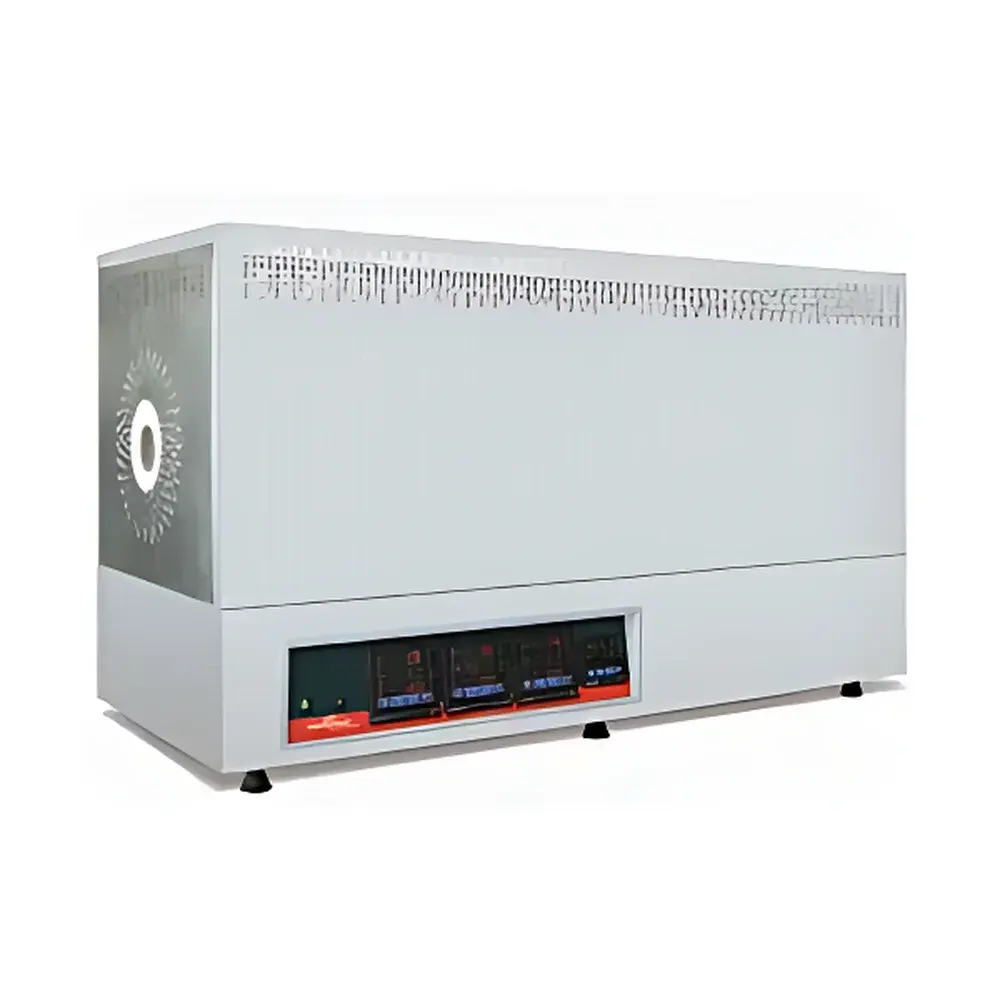
Thermconcept Compact Tube Furnace (Single-Zone and Triple-Zone Temperature Control Models)
| Brand | Thermconcept |
|---|---|
| Origin | Germany |
| Model | Compact Tube Furnace |
| Max Operating Temperature | 1100 °C (single-zone) / 1300 °C (triple-zone) |
| Tube Diameter | 200 mm |
| Heating Zone Length | 500 mm (extendable) |
| Heating Element Control | Solid-state relays (1100 °C) or semiconductor controllers (1300 °C) |
| Temperature Uniformity | Optimized via vacuum-formed ceramic fiber insulation |
| Safety Compliance | Overtemperature protection per EN 60519-2 |
| Controller Location | Bottom-mounted for ergonomic access |
| Optional Configurations | Vertical orientation, custom tube materials (quartz, alumina, stainless steel), extended heating zones |
Overview
The Thermconcept Compact Tube Furnace is a precision-engineered laboratory heating system designed for controlled thermal processing of samples under inert, reducing, or oxidizing atmospheres. Based on resistive heating principles with high-purity Kanthal or silicon carbide elements embedded in vacuum-formed ceramic fiber insulation, the furnace delivers exceptional radial and axial temperature uniformity across its defined heating zone. Two primary configurations are available: a single-zone model rated to 1100 °C and a triple-zone variant capable of sustained operation up to 1300 °C—each engineered for reproducible thermal profiles essential in materials synthesis, catalyst activation, annealing, and sintering applications. Its compact footprint (W × D × H ≈ 600 × 550 × 750 mm) enables integration into space-constrained laboratories without compromising thermal performance or safety integrity.
Key Features
- Modular thermal architecture: Single-zone and triple-zone models allow precise axial temperature gradient control—critical for crystal growth, zone refining, and multi-step thermal treatments.
- Vacuum-formed ceramic fiber insulation: Provides low thermal mass, rapid heating rates (typical ramp: 10–15 °C/min to 1000 °C), and superior thermal retention, minimizing energy consumption and external surface temperatures.
- High-fidelity temperature regulation: Solid-state relay control (1100 °C model) or zero-crossing semiconductor controllers (1300 °C model) ensure stable setpoint maintenance with ±1 °C typical accuracy over full range; programmable ramp/soak profiles support ISO/IEC 17025-compliant thermal validation protocols.
- Ergonomic human-machine interface: Bottom-mounted controller panel with intuitive PID interface, large backlit display, and tactile keypad reduces operator fatigue during extended thermal cycles.
- Comprehensive safety architecture: Dual independent overtemperature protection—including a calibrated mechanical limit switch conforming to EN 60519-2—ensures automatic power cutoff if primary control fails, satisfying IEC 61000-6-2 electromagnetic compatibility and lab safety audit requirements.
Sample Compatibility & Compliance
The furnace accommodates standardized and custom work tubes with internal diameters up to 200 mm and standard heating lengths of 500 mm (extendable upon request). Compatible tube materials include fused quartz (for ≤1100 °C, inert/vacuum), high-purity alumina (≤1600 °C, oxidizing), and Inconel 600–lined stainless steel (for reducing or carburizing atmospheres). All models comply with CE marking directives (2014/35/EU Low Voltage Directive, 2014/30/EU EMC Directive) and meet the mechanical and thermal safety provisions of EN 60519-2 (safety requirements for electrically heated industrial furnaces). Optional gas inlet/outlet ports enable integration with mass flow controllers and exhaust scrubbers for regulated atmosphere processing—fully compatible with ASTM E2913 (standard guide for thermal treatment of metallic materials) and ISO 8501-1 (surface preparation prior to coating).
Software & Data Management
While the base unit features a stand-alone microprocessor-based controller with non-volatile memory for up to 16 programmable segments, optional RS485 Modbus RTU or Ethernet/IP interfaces permit integration into centralized laboratory information management systems (LIMS). Thermconcept provides calibration-certified firmware supporting NIST-traceable temperature verification points (e.g., Al, Zn, Sn fixed points) and audit-ready data logging compliant with FDA 21 CFR Part 11 requirements when paired with validated third-party software platforms. Full event logging—including power interruptions, alarm triggers, and manual overrides—is retained for GLP/GMP traceability and internal quality audits.
Applications
- Materials science: Controlled oxidation/reduction of transition metal oxides, solid-state synthesis of perovskites, and post-deposition annealing of thin films.
- Catalysis research: Thermal activation of supported catalysts (e.g., Pt/Al2O3, Ni/MgO) under flowing H2 or N2.
- Electrochemistry: Calcination of electrode precursors (LiCoO2, NMC) and stabilization of solid electrolytes (LLZO, LATP).
- Geochemical simulation: High-temperature dehydration experiments on clay minerals and silicate phases under controlled pO2.
- Quality control: Heat treatment validation for medical device components (ISO 13485) and aerospace alloys (AMS 2750E compliance achievable with optional pyrometry upgrade).
FAQ
What tube materials are certified for use at 1300 °C?
Alumina (99.7% Al2O3) and molybdenum disilicide (MoSi2)-sheathed quartz tubes are validated for continuous operation at 1300 °C under inert or weakly oxidizing conditions.
Can the furnace be integrated into an automated glovebox system?
Yes—standard flange interfaces (KF-40 or CF-63) and optional feedthroughs for thermocouples, gas lines, and vacuum connections enable seamless integration with inert-atmosphere gloveboxes meeting ISO 10648-2 specifications.
Is factory calibration documentation provided with shipment?
Each unit ships with a manufacturer’s certificate of conformance, including as-delivered temperature uniformity mapping (±3 °C over central 70% of heating zone at 1000 °C) and controller linearity verification per DIN EN 60584-2.
What maintenance intervals are recommended for long-term reliability?
Ceramic fiber insulation requires no scheduled replacement; annual verification of thermocouple drift (using reference junction checks) and visual inspection of heating element continuity are advised per Thermconcept’s Maintenance Protocol TP-MF-02.
Does Thermconcept offer IQ/OQ documentation packages?
Yes—validated installation qualification (IQ) and operational qualification (OQ) templates aligned with ASTM E2500 and EU Annex 15 are available upon request for GxP-regulated environments.



